
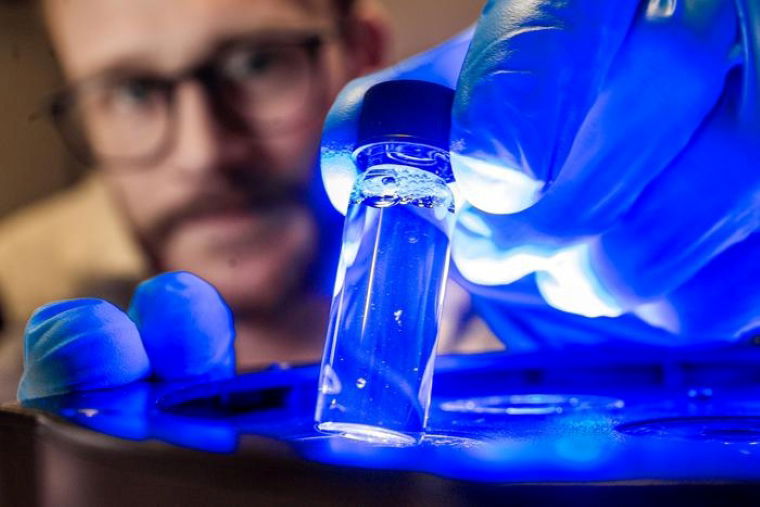
Linköping University scientists have used visible light to create electrodes from conductive plastics without the need for toxic chemicals or conductive metals.
The research team behind the novel electrode manufacturing method said their approach could help create electrodes on diverse surfaces, enabling entirely new types of electronics, including medical applications such as non-toxic biocompatible sensors.
“I think this is something of a breakthrough,” said Xenofon Strakosas, assistant professor at Linköping University’s Laboratory of Organic Electronics (LOE). “It’s another way of creating electronics that is simpler and doesn’t require any expensive equipment.”
According to a statement detailing the research, polymers used to make conductive plastics consist of large molecules linked together into long chains of monomers. The polymer manufacturing process, called polymerization, often involves the use of strong chemicals. Some of those chemicals are considered toxic, limiting the process’s scaling. This toxicity also limits the use of many polymers in medical applications.
To create polymers from biologically safe materials that can conduct electrical signals, the team started with a solution of “specifically designed” conductive monomers. Next, the team used a specially developed process where this solution is exposed to everyday visible light.
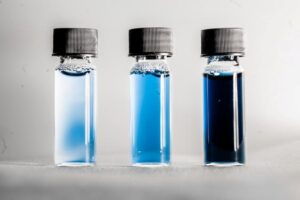 Visible light polymerisation in water: The longer the monomer is exposed to light, the bluer and darker the solution becomes as it transforms into a conductive polymer material. Polymerisation takes place directly in water, completely without toxic additives, making the process biocompatible. Image Credit: Thor Balkhed.
For example, the team said designers could place the non-toxic monomer solution on a substrate or base material. When the solution is exposed to visible light, the polymerization occurs at the molecular level. After designers rinse away the solution, the polymerized electrodes are all that remain.
When discussing the process, the research team said these electrodes can be drawn in specialized patterns, allowing the designer to customize the final electrodes into different shapes. Strakosas added that these biocompatible electrodes can be created on a wide array of materials, which “opens up a much wider range” of potential applications.
“It’s possible to create electrodes on different surfaces such as glass, textiles, and even skin,” the researcher explained.
Tobias Abrahamsson, a researcher at LOE and the lead author of an article detailing the new process, said the performance of these electrodes, made from conductive polymers that can transport electrons and ions, means they can be designed to “communicate with the body in a natural way.”
“The electrical properties of the material are at the very forefront,” Abrahamsson said.

The researcher also noted that the safe electrodes are made with “gentle chemistry,” a crucial feature for potential medical applications.
To demonstrate the performance and safety of their light-made electrodes, the research team photo-patterned electrodes directly onto the exposed skin of anesthetized lab mice. When the team tested the material’s ability to conduct electrical signals, they said the conductive plastic electrodes showed “a clear improvement” over traditional metal-based EEG electrodes.
“As the method works on many different surfaces, you can also imagine sensors built into garments. In addition, the method could be used for large-scale manufacture of organic electronics circuits, without dangerous solvents,” Abrahamsson said.
The study “Visible-Light-Driven Aqueous Polymerization Enables in Situ Formation of Biocompatible, High-Performance Organic Mixed Conductors for Bioelectronics” was published in Angewandte Chemie.
Christopher Plain is a Science Fiction and Fantasy novelist and Head Science Writer at The Debrief. Follow and connect with him on X, learn about his books at plainfiction.com, or email him directly at christopher@thedebrief.org.