
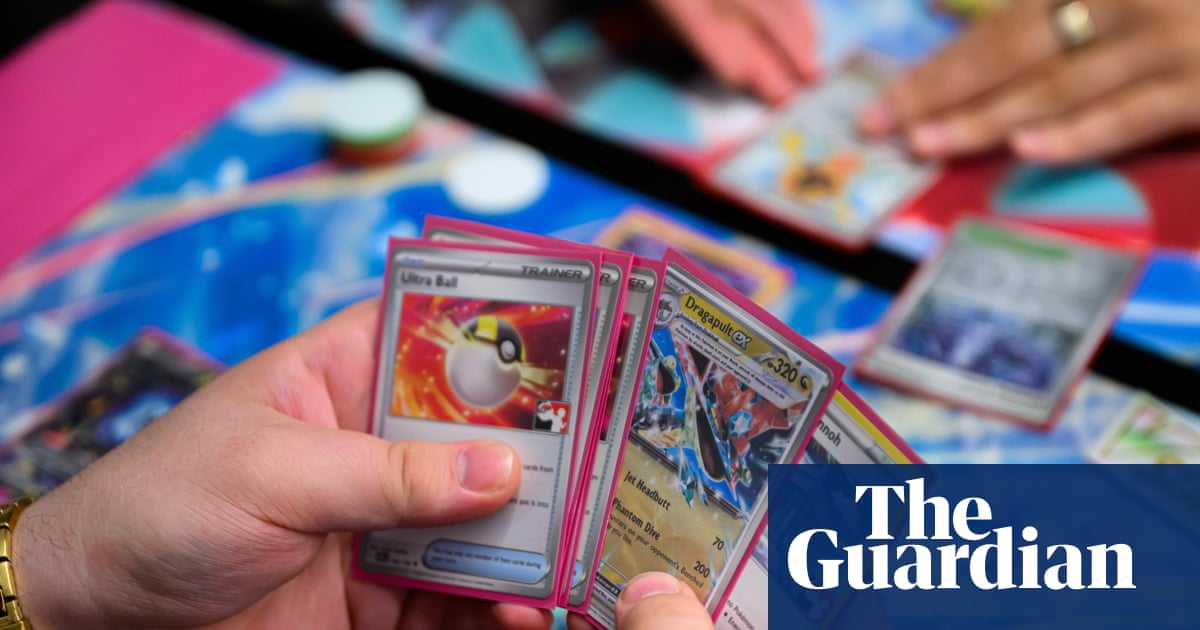
Christmas is fast approaching, the shopping days are ebbing away, and in one corner of the internet, the rush to grab highly prized Pokémon trading cards is boiling over into a competitive frenzy.
“Got any cheap Mew?” asks one buyer, deploying the frantic tone of an addict, albeit one craving a rectangle depicting a creature from the all-conquering Japanese media franchise.
Yet more buyers are gathering for a “break” – a session in which they can bid for merchandise such as cards featuring Pokémon or elite footballers, drawn at random from a real or virtual box.
This is the little-known but fast-growing empire of Whatnot, a “live auction” website and app startup that might best be described as a cross between eBay and the time-honoured cable TV shopping channel.
Its stated mission, aside from profit, is to enable anyone to “turn their passion into a business and bring people together through commerce”.
But there is a murkier side: some users have reported becoming hooked on the rapid-fire, gamified mechanics of impulse buying, not to mention its gambling-style features, posing serious risks to their mental health.
Whatnot’s specialism in collectibles also raises questions about a broader commercial ecosystem, in which the supply of must-have Christmas toys has been cornered by scalpers, or touts, creating scarcity and driving up prices for hobbyists and cash-strapped parents hoping to make their kids happy at Christmas.
What’s not to like?
Whatnot’s business model isn’t unique – eBay also offers live auctions – but its stellar growth marks it out as the face of modern-day live shopping.
In October, just six years after it was founded in the US by Grant LaFontaine and Logan Head, the company was valued at $11.5bn (£8.5bn) in a funding round that attracted investment from blue-chip backers such as DST Global and CapitalG, which is owned by Google’s parent company, Alphabet.
At the time, the company claimed its sellers had racked up “gross monetary value” of $6bn so far in 2025, with Whatnot making its cut by charging them fees.
Like eBay, the site also offers a “buy it now” option and non-live auctions but its streamed broadcasts are its distinguishing feature.
Perhaps Whatnot’s greatest asset is its army of amateur auctioneers, who broadcast on their own channels, livestreaming sessions that can feature dozens of lots, each lasting a matter of seconds.
Bidders swipe right to beat their rivals to whatever is on screen, from trading cards, to electronic goods, to box-fresh trainers. The most charismatic sellers engage in a constant stream of patter with users, who can post comments on screen.
In the regular “break” sessions, participants are sometimes invited to spend their festive funds on “spins”, bidding blind in the hope of hitting the jackpot, such as a super-rare card with a high monetary value.
A Whatnot spokesperson said that while participants do not know exactly what they will receive, they do what is in the range of items being selected from. The company said it does not allow gambling on its website or app.
One addiction expert says that, while these features cannot be defined as gambling, they bear comparison with it. “There is definitely the opportunity for harm on apps like this,” said Dr Steve Sharman, senior research fellow at the National Addiction Centre, King’s College London.
“The pressure and the speed at which auctions run are key features; aligned with the fact that there is no information about how much I’ve spent – it would therefore be very easy to lose track of spending.”
He also highlighted the “variable reward system” used in breaks with random outcomes as similar to the mechanics of gambling.
These “blind boxes” have existed for decades but live auctions have turbocharged them. In the US, bidders have reported suffering buyer’s guilt after paying out huge sums without realising the extent of their spending.
And Whatnot’s idiosyncratic features appear to be dangerously alluring for some users. In a post on the parents’ forum Mumsnet earlier this month, one described Whatnot as an “impulse buyer’s dream”, confessing she had racked up a credit card debt of £7,500 and an overdraft of £1,500 after becoming immersed in the site.
She said she feared losing her marriage over it and had even contemplated killing herself.
Whatnot said customers can adjust the settings on their account to limit the time and money they spend.
“Any concerns about someone’s time or spending on Whatnot are something we take seriously, and if people come to us with those concerns, our teams share wellbeing resources and point them to account controls so they can set limits on what feels right for them.”
Toy touts
Whatnot’s specialism in hard-to-find collectibles has also prompted concern that sellers may be profiting from artificial scarcity.
Many of the in-demand items sold on Whatnot and on eBay’s live auction site have become the preserve of ruthless scalpers using tactics more akin to ticket touts – even boasting about it online.
The most successful resellers are able to corner the market for potential Christmas presents by visiting wholesalers to scoop up items that can be flipped on for profit.
“We see tonnes of festive frustration on Mumsnet as popular toys are hoovered up in bulk and listed on resale or auction sites at hugely inflated prices,” said Justine Roberts, founder of the parenting forum Mumsnet.
“It feels exploitative – especially for families already working with very tight budgets – and it causes real anxiety for mums and dads … Most Mumsnet users would like shops to put limits in place on the number of units sold per customer to prevent such cynical profiteering.”
Perhaps the most high-profile group of scalpers operate under the name “Crep Chief Notify”, via social media accounts and an app of the same name, a reference to their love of reselling trainers, known in slang as “creps”.
In-demand items resold on Whatnot also include trainers, known in slang as ‘creps’. Photograph: WoodysPhotos/Alamy
Last year, the group was heavily involved in the resale of Oasis tickets, bragging to social media followers of using multiple identities and bots to bypass the limits on the number of ticket purchases.
As Christmas nears, the group, run from Manchester by three men in their 20s, has shifted to Pokémon cards.
In one video, a member of the team stands in a Costco car park and flags down a passerby. He complains that Costco have limited the number of Pokémon card packs he can buy and agrees to pay the stranger to go in and pick up some for him.
In a statement sent via Instagram, Crep Chief Notify appeared immune to criticism. “We can’t wait to do it all over again in 2026,” they said. “Pokémon is bigger than ever meaning there’s more profit than ever to be made.”
Among those who enjoy trading card games, the mood is less flippant. At Badger Badger, which runs two board game-focused pubs in south-east London, customers and staff are becoming increasingly frustrated.
“Scalpers have made getting products so stressful, expensive and difficult that it has strongly informed many people’s decisions to leave the hobby entirely,” said Lars Ohrvik-Stott, assistant games manager.
“Beyond the effect scalping has on the health of our community, we have also had several run-ins with people who have attempted to rob the store for cards and who have become aggressive in response to our purchase limits in particular.
“We are very fortunate to have a community who, the vast majority of the time, are a complete joy to serve, but it is always a bit bizarre when we start receiving abuse because of policies we have implemented to make the hobby we share more accessible.”
According to Lars, customers are increasingly paying vast mark-up, up to 250% of the retail price for cards, via sites such as eBay and Whatnot.
Whatnot defended the secondary market, saying: “Primary market prices often don’t fully reflect consumer demand or value.
“People have been buying limited-run products at retail and reselling them for decades, whether in local card shops, at conventions or on other marketplaces.”
A spokesperson for eBay said it had “strict policies in place to ensure essential items are offered at fair prices”, adding: “For non-essential goods, including toys and collectibles, prices are set by individual sellers, as eBay operates as an open platform.”