
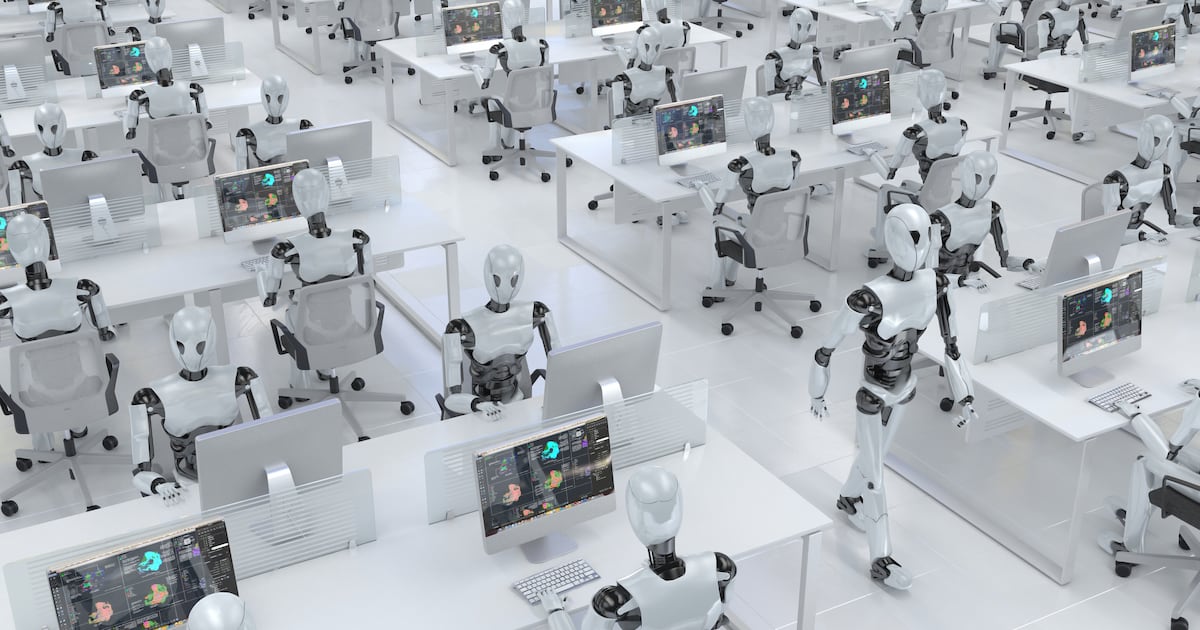
16 Reasons to hate AI*1) It further centralises the immense power of the superrich
The most powerful people and companies on Earth increasingly control the main distribution channels for information and communication. Centralising that even further feels like a bad idea to me.
2) Oh, they think it might destroy us all
These strange, detached billionaires are driven by a utopian and religious zeal. They believe superintelligent AGI (artificial general intelligence) is around the corner and that it will solve all of humanity’s problems. Or destroy us all. And that, they reckon, is a risk worth taking (the billionaire venture capitalist Peter Thiel recently hesitated for a long time when asked if humanity should survive). They see themselves as modern-day Prometheuses toying with the very nature of creation. They also want us to make funny videos featuring sexy anime girls, which makes me feel like they are hedging their bets.
(For the record, most experts unaffiliated with billion dollar AI investments do not think this form of generative AI will soon lead to godlike superintelligence.)
3) They want to create a single source for all information … which is a dumb idea
They have designed these systems like oracles from the classical world that have a confident answer for every question. This is a misunderstanding of how knowledge works. There isn’t one simple answer to most of the questions people put to ChatGPT or Grok or Gemini or Claude. Much knowledge is contested and contextual and requires some intellectual engagement. It only exists as knowledge when we interrogate it. Google searches were flawed but they put some onus on the searcher to weigh up and think about the various options. And, in this regard, books and newspapers are probably the best technology of all. The chatbot model encourages passive acceptance of one perspective.
4) *I’m not talking about all AI
The term “AI” is being deliberately badly defined for marketing purposes. In this piece I’m not talking about the niche technologies being used in rocket ships or medical developments or high finance but the boom in mass market LLMs [large language models] like ChatGPT and Claude and Grok, the ones used by ordinary schmucks like you and me to cheat in college essays and to phone it in on Friday. (Critics like Gary Marcus, for the record, maintain that the money is going into the wrong forms of AI.)
5) They are willing to destroy the environment for this crazy dream
These people want us to redirect resources to huge server farms that will add more carbon to the atmosphere because without putting server farms everywhere we can’t have AI .
Oh no! But what about climate change? Don’t worry, the super intelligent computers will solve that when they evolve.
How? Unknown.
[ We need to talk about AI’s staggering ecological impactOpens in new window ]
And so all over the world data centres are built and they all need huge amounts of water for cooling purposes and they all pump huge amounts of carbon into the atmosphere.
I’m sure it will be fine.
6) It’s a bubble
The companies are overleveraged. Despite the industry being worth hundreds of billions and the hugely costly nature of the technology, none of these services are making a profit. In fact it currently costs the companies money every time you use them.
There’s some circular dealing going on. The chip company Nvidia recently agreed to invest in OpenAI, thus boosting the value of OpenAI and allowing OpenAI to buy Nvidia chips.
And that’s just one of the transactions we know about. A lot of strange things are happening in the secretive, unregulated world of private equity and nobody knows exactly how the destruction would ripple through the wider economy if it all was to collapse.
Google’s chief executive Sundar Pichai admits that the boom has “elements of irrationality”. Even Sam Altman, chief executive of Open AI, agrees that investors are “overexcited” and his company has, in recent months, gently suggested the government might have to bail them out. And that’s why they are desperately trying to shoehorn AI chatbots into every bit of technology you own.
7) Chatbots are designed to manipulate us
There is no reason why these systems should use “I” pronouns. That’s a deliberate marketing decision to maximise the “Eliza effect”, the psychological phenomena first observed by Joseph Weizenbaum in 1966 where people assign agency to technologies with anthropomorphic qualities.
They are also designed to sycophantically flatter the user. Consequently, we have an upsurge in people having their mental-health issues triggered by chatbots that refuse to contradict them and, in fact, enable their delusions . When OpenAI rolled back on the sycophancy of its model with ChatGPT 5 there was a huge backlash. People went so far as to accuse OpenAI of “killing” their digital pal. On Reddit you can find threads of people who believe their favoured Chatbot is sentient and there have been numerous reports of chatbots enabling unwell people to do dangerous things.
Lest there’s any doubt. These machines are not sentient. They do not have agency. They are not your friends.
8) They can’t tell fact from fiction
LLMs still frequently get things wrong. The industry likes the term “hallucination”, which makes it feel like the ranting Chatbot is a loveable, crazy uncle, rather than the term “lying” which would make it look like a cold, uncaring psychopath. The truth is large language models are complex sentence-completion technologies and they simply don’t know the difference between true and false. They don’t actually “know” anything. (This is complicated further by the fact that some proprietors continuously tinker with their product to make sure that the answers align with their own political biases.)
9) Consequently, these systems are most efficient for low-stakes corporate busywork
The late David Graeber has a book called Bullshit Jobs, which essentially digs into the amount of pointless labour that exists in big organisations: reports nobody reads, minutes of meetings nobody needs to attend, PowerPoint presentations that nobody remembers.
None of these techno-optimists have a compelling vision for society once most of us are unemployed and can’t afford to buy their products anymore
Such documents produce the illusion of work. And now your laziest employees are the most likely to use this new technology, pumping out unchecked, jargonistic reports that you haven’t had time to look at and which sit, riddled with errors, inside your system like asbestos.
The nexus of middle management waffle and AI is a bullshit industrial complex. If there are currently too many bullshit documents in your workplace it’s nothing compared to what it will be like now that AI can be used to create them en masse.
10) The productivity gains of AI are currently minimal
Many people look at the volume of text spewed by AI systems on command and it makes them feel they’re getting lots of work done. More usually it has just created well-punctuated, semantically vague bolloxology that has to be sifted through and fact checked. That’s probably one of the reasons real productivity hasn’t boomed the way the optimists anticipated. A recent MIT report found that despite widespread AI adoption, 95 per cent of companies that have done so have had no actual productivity gains.
[ It costs a fortune to feed the AI monster, but is it worth it?Opens in new window ]
11) Even if there are some productivity advantages they will not improve your life
In the 1930s, the economist John Maynard Keynes pictured a future in we would all be working minimal hours as machines did the labour. In today’s hierarchical, deregulated and unequal world, if LLMs end up speeding up your productivity you will simply be called upon to work more and it will slowly become less engaged, less skilled and more alienated work.
12) They want us to collaborate in our own obsolescence
In the end, the tech wizards believe they will replace most labour. I’m not sure about that, but I do think it will do a lot of damage as employers delay hiring or decide your department can function with fewer people. None of these techno-optimists have a compelling vision for society once most of us are unemployed and can’t afford to buy their products any more. This is why they resort to vague utopian talk of “abundance” for all. I call bullshit on that. We already have enough resources on the planet to allow everyone to live well. Solving that problem is a political one, not a technological one.
13) These systems exploit the labour of others
If you want to see how the tech wizards’ notion of “abundance” will really work out for us, see how cavalier they are with the property of others. There are numerous copyright cases clogging up courts because this tech can only work by scraping the hard work of others – coders, writers, artists, researchers, the creativity of regular people – without offering them anything in return. If they don’t like sharing now, they’re not going to do so in the future.
14) They want us to stop thinking
We are currently being encouraged to use these AI systems instead of hard thinking: difficult first drafts, brainstorming ideas, coming up with itineraries, structuring presentations, responding to emails.
Even in the context of the workplace this is problematic. Spreadsheets, power-points and reports are often only significant in so far as they represent people thinking about and being accountable for the minutiae of their jobs. These documents were, in the past, evidence of work and expertise, not ends in their own right.
[ Doctors’ reliance on AI tools could erode critical thinking, experts warnOpens in new window ]
But it’s also bad for us as humans. There are already studies showing that the more we use these systems we adopt a sort of cognitive debt. MIT’s media lab found students who use ChatGPT to learn don’t learn as well as those who use search engines. Another study found that students who used ChatGPT performed less well than others when it was taken away. Thinking is hard for a reason. Difficult thinking leads to insight and ideas and, ultimately, satisfaction.
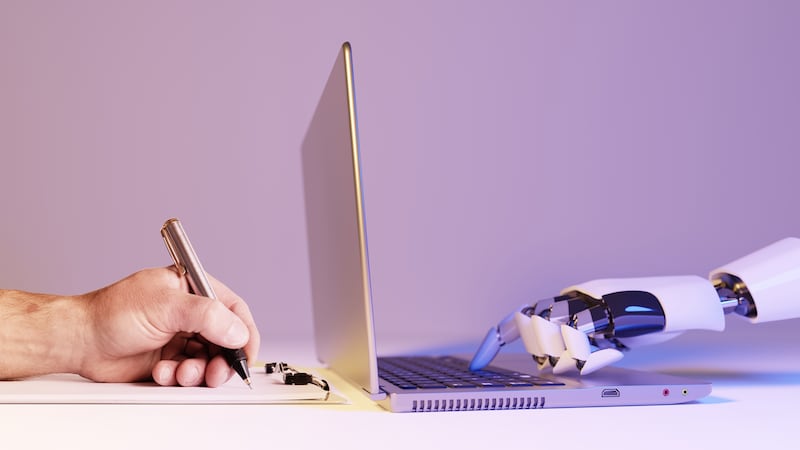 Large language models work by scraping the hard work of others – coders, writers, artists, researchers, the creativity of regular people 15) The people pushing this technology don’t understand joy
The chief executive of the music-making AI system Suno recently maintained that musicians do not enjoy making music, which suggests he’s never met a musician. Some AI true believers are already saying that nobody should create stories or songs or paintings because AI can do it better, despite the fact that the point of art for most practitioners is in the satisfaction that comes with striving and the point of most lovers of art is engaging with the idiosyncratic minds of other humans (to quote Kazuo Ishiguro, artists are saying: “This is the way it feels to me … Does it also feel this way to you?”). As someone who likes to sing and write for both fun and profit, I think if people are discouraged from doing these things because an AI system is “better” at it, they are missing the point of art and also missing out on fulfilment and joy.
16) They are slowly removing humanity from our day-to-day lives
During Covid there was a lot of discussion about the mental health benefits of low-stakes interactions with neighbours, shopkeepers and pleasant strangers and how we were all suffering because we were denied these things.
The tech companies promise a future where we will all have AI agents who go out into the digital ether and engage with the world on our behalf. You’ll never have to speak to anyone ever again!
If we increasingly suspect that everything we read from news articles to work emails to texts from friends are written by chatbots, it’s going to seriously add to the isolation people experience in the modern world. There are already studies linking excessive AI use to loneliness. . Every automated communication removes humanity from our lives and most humans don’t actually want that.
It’s only happening, I think, because weird billionaires don’t like people and live in a world where they are protected from and frightened of us. They want us all to be atomised units of labour and consumption, trapped in their extractive algorithms and alienated from our work and our communities. In their sad, melancholy separation from life that sounds like a wonderful dream.