
My Sharjah Rent is proudly sponsored by Property Finder, the UAE’s No 1 real estate portal. With verified listings, trusted SuperAgents and powerful search and comparison tools, Property Finder helps property seekers find the right home with confidence and ease.
Wael Hamadeh is a 56-year-old full-time artist and creative director from Lebanon who moved to the UAE in 1995.
For 12 of those years he and his family – which includes his wife, a daughter aged 16 and his son, 13 – have shared an apartment in the Tawoon area of Sharjah.
Mr Hamadeh, who exhibits his work locally and internationally, showed The National around the home.
What can you tell us about this apartment?
It is in Emirates Tower in Sharjah.
We have three bedrooms and a maid’s room, and one small balcony. There are four bathrooms in total, including one for the maid’s room.
We currently pay Dh65,000 a year to rent the apartment. It has good space for a family and we have a parking area.
When did you move into your home?
I have been in this home for 12 years.
I lived in Al Nahda, Dubai, from 2005 to 2013, and then moved to my current home at the end of 2013, where I’ve been ever since.
Before that, I lived in Dubai, on Sheikh Zayed Road.
Why did you choose this address?
It is cheaper than Dubai. And it is a family-orientated area, near to the kids’ school.
Our home is also near an industrial area, which is handy for my artistic and creative projects, mainly for art facilities, including access to carpenters, blacksmiths, hardware suppliers, recycled material sources, and affordable labour.
Do you feel you get good value for your rent?
Yes, it is a good deal and still cheaper for what I have, in this area.
Have you experienced strong rent fluctuations?
When I was in Dubai, my accommodation was provided by another company, so I didn’t experience fluctuations.
In Sharjah, there was a difference of about Dh5,000. But, overall, the changes were manageable.
How have you made this place your home?
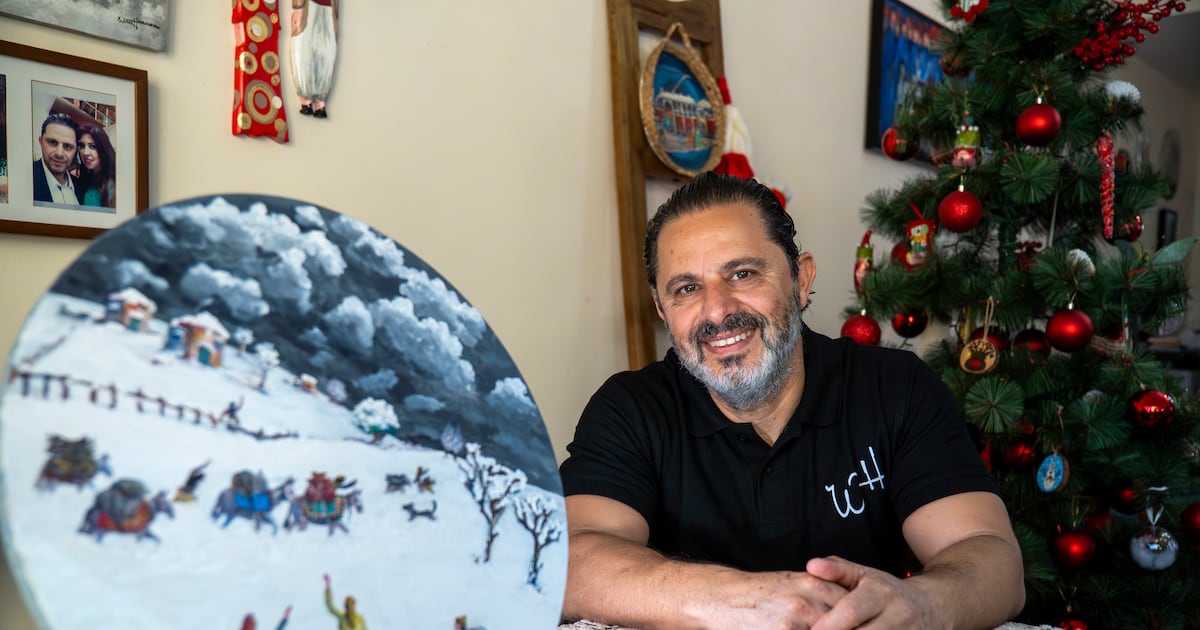
My apartment is like an open gallery to a certain extent.
I have a busy workshop area and a neatly designed salon for a display.
The walls are thoughtfully decorated with paintings, sculptures, and art pieces that reflect my style and heritage.
I have one bedroom that I use as a workshop and store area for my art.
What amenities do you have in or close to your building?
There are a lot of Arabic grocery stores near where we live, and affordable places to eat.
Sahara Centre and City Centre Al Zahia, plus big supermarkets, including Nesto, Co-op, and Viva, are nearby.
It’s easy to walk around the area. Sometimes, there’s traffic during school hours in the morning, but generally it’s convenient. Oriana Hospital is also nearby.
I’m close to Khalid Lake, where I do my morning walks. And Al Mamzar Lake is about a 10-minute drive away.
There are plenty of mosques nearby, but only a few galleries; Al Kasba has one called Al Maraya Gallery.
My artwork is mainly displayed in Dubai galleries and Beirut.
The building doesn’t have a gym, pool, or kids’ area, only parking. But, there is a gymnastics centre nearby.
Is it a friendly neighbourhood and building?
It’s somewhat friendly, but it doesn’t feel like home because of the mix of nationalities.
Occasionally, you see strangers around but, overall, safety is excellent, which is a great blessing in the UAE.
Does your home offer easy access in and out of Sharjah?
Not really. Most of my exhibitions are in Dubai, and traffic during peak hours makes it challenging, especially when transporting artworks for loading and unloading.
What would you change about living in this location?
Less traffic and more balcony space.
Also, it would be good to have a small green park around here.
Are you planning to stay at this apartment?
Yes. We have no plans for moving.
I will stay in this apartment until my kids finish university.
Have you thought about buying property?
I feel that it is too late – with the high prices I cannot afford to buy here now.
I did already buy property back home, however, in Lebanon.
Read more from Johann ChackoLearn more about Qasr Al Hosn
In 2013, The National’s History Project went beyond the walls to see what life was like living in Abu Dhabi’s fabled fort:
The Vile
Starring: Bdoor Mohammad, Jasem Alkharraz, Iman Tarik, Sarah Taibah
Director: Majid Al Ansari
Rating: 4/5
UAE squad to face Ireland
Ahmed Raza (captain), Chirag Suri (vice-captain), Rohan Mustafa, Mohammed Usman, Mohammed Boota, Zahoor Khan, Junaid Siddique, Waheed Ahmad, Zawar Farid, CP Rizwaan, Aryan Lakra, Karthik Meiyappan, Alishan Sharafu, Basil Hameed, Kashif Daud, Adithya Shetty, Vriitya Aravind
In numbers: PKK’s money network in Europe
Germany: PKK collectors typically bring in $18 million in cash a year – amount has trebled since 2010
Revolutionary tax: Investigators say about $2 million a year raised from ‘tax collection’ around Marseille
Extortion: Gunman convicted in 2023 of demanding $10,000 from Kurdish businessman in Stockholm
Drug trade: PKK income claimed by Turkish anti-drugs force in 2024 to be as high as $500 million a year
Denmark: PKK one of two terrorist groups along with Iranian separatists ASMLA to raise “two-digit million amounts”
Contributions: Hundreds of euros expected from typical Kurdish families and thousands from business owners
TV channel: Kurdish Roj TV accounts frozen and went bankrupt after Denmark fined it more than $1 million over PKK links in 2013
%20Ramez%20Gab%20Min%20El%20Akher
%3Cp%3E%3Cstrong%3ECreator%3A%3C%2Fstrong%3E%20Ramez%20Galal%3C%2Fp%3E%0A%3Cp%3E%3Cstrong%3EStarring%3A%3C%2Fstrong%3E%20Ramez%20Galal%3C%2Fp%3E%0A%3Cp%3E%3Cstrong%3EStreaming%20on%3A%20%3C%2Fstrong%3EMBC%20Shahid%3C%2Fp%3E%0A%3Cp%3E%3Cstrong%3ERating%3A%20%3C%2Fstrong%3E2.5%2F5%3C%2Fp%3E%0A
Company Profile
Name: Thndr
Started: 2019
Co-founders: Ahmad Hammouda and Seif Amr
Sector: FinTech
Headquarters: Egypt
UAE base: Hub71, Abu Dhabi
Current number of staff: More than 150
Funds raised: $22 million
Dengue%20fever%20symptoms
%3Cul%3E%0A%3Cli%3EHigh%20fever%3C%2Fli%3E%0A%3Cli%3EIntense%20pain%20behind%20your%20eyes%3C%2Fli%3E%0A%3Cli%3ESevere%20headache%3C%2Fli%3E%0A%3Cli%3EMuscle%20and%20joint%20pains%3C%2Fli%3E%0A%3Cli%3ENausea%3C%2Fli%3E%0A%3Cli%3EVomiting%3C%2Fli%3E%0A%3Cli%3ESwollen%20glands%3C%2Fli%3E%0A%3Cli%3ERash%3C%2Fli%3E%0A%3C%2Ful%3E%0A%3Cp%3EIf%20symptoms%20occur%2C%20they%20usually%20last%20for%20two-seven%20days%3C%2Fp%3E%0A
Mercer, the investment consulting arm of US services company Marsh & McLennan, expects its wealth division to at least double its assets under management (AUM) in the Middle East as wealth in the region continues to grow despite economic headwinds, a company official said.
Mercer Wealth, which globally has $160 billion in AUM, plans to boost its AUM in the region to $2-$3bn in the next 2-3 years from the present $1bn, said Yasir AbuShaban, a Dubai-based principal with Mercer Wealth.
“Within the next two to three years, we are looking at reaching $2 to $3 billion as a conservative estimate and we do see an opportunity to do so,” said Mr AbuShaban.
Mercer does not directly make investments, but allocates clients’ money they have discretion to, to professional asset managers. They also provide advice to clients.
“We have buying power. We can negotiate on their (client’s) behalf with asset managers to provide them lower fees than they otherwise would have to get on their own,” he added.
Mercer Wealth’s clients include sovereign wealth funds, family offices, and insurance companies among others.
From its office in Dubai, Mercer also looks after Africa, India and Turkey, where they also see opportunity for growth.
Wealth creation in Middle East and Africa (MEA) grew 8.5 per cent to $8.1 trillion last year from $7.5tn in 2015, higher than last year’s global average of 6 per cent and the second-highest growth in a region after Asia-Pacific which grew 9.9 per cent, according to consultancy Boston Consulting Group (BCG). In the region, where wealth grew just 1.9 per cent in 2015 compared with 2014, a pickup in oil prices has helped in wealth generation.
BCG is forecasting MEA wealth will rise to $12tn by 2021, growing at an annual average of 8 per cent.
Drivers of wealth generation in the region will be split evenly between new wealth creation and growth of performance of existing assets, according to BCG.
Another general trend in the region is clients’ looking for a comprehensive approach to investing, according to Mr AbuShaban.
“Institutional investors or some of the families are seeing a slowdown in the available capital they have to invest and in that sense they are looking at optimizing the way they manage their portfolios and making sure they are not investing haphazardly and different parts of their investment are working together,” said Mr AbuShaban.
Some clients also have a higher appetite for risk, given the low interest-rate environment that does not provide enough yield for some institutional investors. These clients are keen to invest in illiquid assets, such as private equity and infrastructure.
“What we have seen is a desire for higher returns in what has been a low-return environment specifically in various fixed income or bonds,” he said.
“In this environment, we have seen a de facto increase in the risk that clients are taking in things like illiquid investments, private equity investments, infrastructure and private debt, those kind of investments were higher illiquidity results in incrementally higher returns.”
The Abu Dhabi Investment Authority, one of the largest sovereign wealth funds, said in its 2016 report that has gradually increased its exposure in direct private equity and private credit transactions, mainly in Asian markets and especially in China and India. The authority’s private equity department focused on structured equities owing to “their defensive characteristics.”
UAE currency: the story behind the money in your pockets