
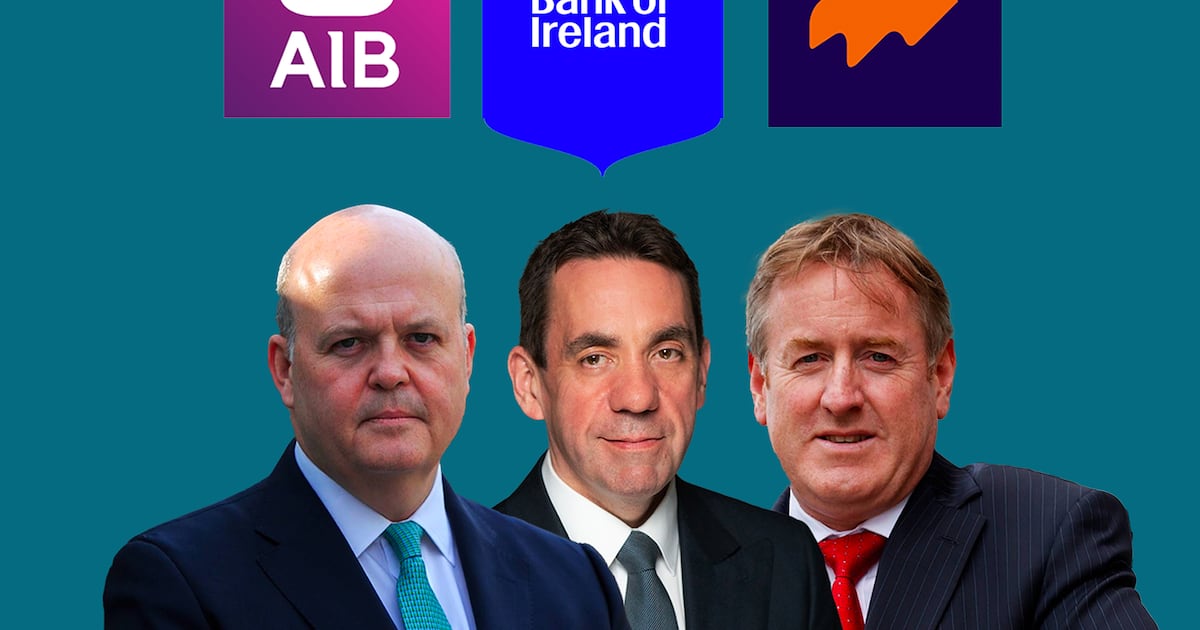
Irish financial stocks delivered their strongest annual showing in 2025 since 2013, the year the State exited its international bailout programme.
The Iseq financial index – dominated by the three surviving banks – advanced by about 75 per cent during 2025, buoyed by AIB and Bank of Ireland upgrading their net interest income forecasts as the European Central Bank (ECB) cut interest rates less aggressively than expected and there was an ongoing influx of cheap deposit funding from households.
Investor sentiment towards AIB was boosted further as the Government returned the company to full private ownership – selling its last shares in June and a bunch of stock warrants in October. Taxpayers have recovered a total of €20.2 billion from the bank since its €20.8 billion crisis-era bailout – leaving a shortfall of just over €600 million.
However, PTSB stole the spotlight. The smallest of the three firms doubled in value as it put itself up for sale.
More action lies ahead in 2026, with a potential PTSB deal, a long-awaited new mortgage entrant and a looming reckoning for Bank of Ireland over the UK car loans saga among five key themes set to unfold.
PTSB sale
Two years into the job as chief executive of NatWest, Paul Thwaite set out last summer to tidy up loose ends in the Irish banking market.
In June, the group’s Ulster Bank Ireland unit returned its banking licence, drawing a line under 165 years in the Republic. The Irish unit, renamed Ulydien DAC, was downgraded to operating as a retail credit firm as it continues a “phased and orderly” withdrawal of its operations.
Thwaite decided in July to sell the remaining shares that NatWest had received from PTSB as part payment for €6.8 billion Ulster Bank loans acquired between 2022 and 2023. It resulted in the UK bank raising a total of more than €181 million from the sale of the 16.7 per cent stake in two tranches over two years.
 Another huge corporate tax take to AI’s next phase: What’s in store for 2026?
For this week’s episode, host Ciarán Hancock Is joined by an expert panel to look forward to 2026. After another record-breaking year for corporate tax receipts, is there now a real threat of concentration risk in the Irish economy?A huge amount of money has been raised and spent on AI, but where is it at in terms of its development? When will investors start looking for a tangible return?And will Donald Trump turn his attention back to economic matters after moves to end the conflicts in Gaza and Ukraine? Could more tariffs be on the way in 2026?The panel comprises CEO of the Sherry Fitzgerald Group, Marian Finnegan, tech entrepreneur and columnist at the Irish Times, Chris Horn, and Irish Times Economics Correspondent, Eoin Burke-Kennedy.Produced by John Casey with JJ Vernon on sound.
PTSB went on to surprise the stock market in late October by hiring one of the investment banks on the last NatWest stock placing – Goldman Sachs – to find a buyer for the entire bank, including the State’s remaining 57 per cent stake. PTSB’s shares jumped 23.4 per cent on the day – and have ended 2025 up about 100 per cent, even after pulling back in recent weeks from its highs.
A deal would finally allow the Government to say in 2026 it has recovered, in the round, the €29.4 billion pumped into the three surviving banks during the financial crisis. A €2 billion surplus cash recovery from Bank of Ireland is on track to offset shortfalls from AIB and PTSB.
“We expect significant interest from private equity, given PTSB’s attractive cost structure and scope for operational improvement. In addition, trade buyers such as Bawag and Bankinter could find the transaction highly accretive, leveraging their scale, cross-border expertise and existing familiarity with the Irish market through their MoCo and Avant Money operations [respectively],” Denis McGoldrick, an analyst with Goodbody Stockbrokers, said in a recent note to clients.
PTSB, with the highest cost base among the three remaining domestic banks, offers an immediate opportunity for a buyer to go after running expenses.
While PTSB set out to cut 300 jobs in 2025 – equivalent to almost 9 per cent of the starting workforce – its cost base for the year will still end up equating to more than 75 per cent of total income, analysts say. AIB and Bank of Ireland are both below 50 per cent – a traditional target for retail banks.
The sale throws up the question of whether the State decides to use the PTSB sale to extract the best sale price for its 57 per cent stake – and maximise the cash recovery – or put a priority on backing a sale to a buyer with real vision to turn PTSB into a proper third force in banking.
There are issues that may affect a sale price. Industry observers say any potential bidders will factor in ongoing bonus restrictions across banks that were bailed out during the financial crisis as well as how access-to-cash regulations, which came into effect in 2025, will make it more difficult to close bank branches in future.
It is likely the process will come to a head in the first quarter of 2026. This will be about the same time as when the outcome of a regulatory review of PTSB’s new mortgage-risk models is expected, determining how much expensive capital the bank needs to hold against its loan book. This is expected to free up capital held in reserve on the lender’s balance sheet and influence the sale price.
Capital returns
Before PTSB chief executive Eamonn Crowley raised the for-sale sign, a key focus for investors had been on the prospects of the bank beginning to pay dividends – and potentially buy back some shares – in 2026 to play belated catch-up with AIB and Bank of Ireland.
Bank of Ireland will be expected to give investors greater clarity on shareholder distributions when it unveils its next three-year strategic plan as it publishes its 2025 results early this year.
Over the past four years the group has returned €2.8 billion to investors through dividends and share buy-backs. That’s the equivalent of about a fifth of its current market value. RBC Capital Markets analyst Benjamin Toms, for one, estimates the bank could afford to spend €4.2 billion on dividends and buy-backs over the next three years.
AIB may outline its latest strategic plan as soon as the end of 2026. Toms estimates the group will have the capacity to fork out €5.7 billion to shareholders over three years – eclipsing the €5.2 billion distributed over the past four years.
Payout expectations are underpinned by consensus estimates among analysts that both banks will deliver net interest income growth over the period as their loan books grow.
Financial markets are also beginning to price in the prospect of the ECB raising official interest rates – which boost interest income – after cutting its main deposit rate from 4 per cent to 2 per cent in the 13 months to last June. This follows ECB executive board member Isabel Schnabel saying in early December that euro zone growth risks “are clearly tilted to the upside” and that “risks to inflation are tilted to the upside”.
UK car loans scandal
Bank of Ireland should also have greater clarity by the time it reports its results on the clean-up bill it faces for its role in the UK motor finance scandal. The bank has about a 2 per cent share of the car loans market there.
The group said in October that it faced having to set aside a total of £350 million (€€400 million) to cover compensation and other costs. The UK Financial Conduct Authority (FCA) estimates the wider UK car-loan sector would need to spend £11 billion in remediation and administrative costs. However, analysts reckon it could be as high as £20 billion, having run their own assessment based on the FCA’s own methodology.
The FCA is expected to publish its final rules on the industry-wide compensation plan by the end of March and get payouts started.
Bank of Ireland’s estimated bill would eclipse the total €340 million costs the group stomached for its role in the mortgage tracker controversy – the biggest overcharging affair in Irish banking history.
The motor finance debacle centres around car buyers in the UK being overcharged because of historical use of discretionary commission arrangements (DCAs) between car dealers and lenders. The FCA review covers 14 years before such arrangements were banned in 2021 in the market. DCA deals gave brokers, typically forecourt salespeople, the discretion to set higher rates, earning them higher commission the more customers paid for their finance.
Revolut mortgages
The State’s three surviving banks accounted for 92 per cent of mortgage lending for the first nine months of last year, according to their latest trading updates. Avant’s slice of the action has remained consistent at 6 per cent throughout the year, according to investor presentations from its parent, Bankinter.
New mortgage lending is on track to grow by 14 per cent for the year as a whole, to €14.4 billion, Davy analyst Diarmaid Sheridan estimates. He sees the market expanding at a slower pace of about 8 per cent in 2026, to €15.6 billion.
Non-bank lenders ICS Mortgages and start-up Nua Money were also active in 2025, helped by declining interest rates on wholesale and bond markets, where such lenders fund their loan books. MoCo is said to have been the least active mortgage player during the year.
And while Revolut, which has more than three million customers in Ireland, had been aiming to enter the Irish home loans market in the last three months of 2025, the launch has drifted into 2026. The neobank focused during last year on Lithuania, home of its existing euro zone banking licence, where it unveiled its first mortgage product in May.
Revolut is making mortgages available directly through its app in Lithuania, with its loan rate linked to a key European benchmark – the so-called Euribor rate at which banks are willing to lend to each other in the euro zone. Still, sources have cautioned that Revolut’s mortgage distribution and product in Lithuania should not be seen as a precedent for its Irish offering.
While about 45 per cent of Irish home loans are written through brokers, they are much less of a feature in the Baltic state. Meanwhile, loans linked to Euribor are standard in Lithuania.
Béatrice Cossa-Dumurgier, chief executive of Revolut’s new western Europe hub in Paris, told the Business Post in September that mortgages were “not a product that we’re going to push very aggressively” when launched in Ireland. She declined at that stage to be drawn on timelines, saying that “there is no hurry”.
Meanwhile, UK mobile bank Monzo is set to target Irish consumers with current and savings accounts in the coming months, after its Dublin-based European unit secured a banking licence just before Christmas. Monzo plans to use the Irish licence to passport services across the EU.
Crisis-era closures
This year two State organisations set up during the financial crisis to work through mainly toxic loans and property assets – the National Asset Management Agency (Nama) and Irish Bank Resolution Corporation (IBRC) – are to be closed down finally and their legacy assets transferred to a new resolution agency in the National Treasury Management Agency (NTMA).
The special liquidators of IBRC – which housed the remains of failed lenders Anglo Irish Bank and Irish Nationwide Building Society – sold the last property asset on its books in late November at auction: a Dublin 4 apartment once owned by disgraced former solicitor Michael Lynn.
Sources say the sale has left IBRC, which had a loan and assets portfolio with a par value of €21.7 billion when it was put into liquidation in early 2013, with just one small loan on its balance sheet.
Nama, which bought €72 billion of distressed commercial property loans from the country’s lenders during the financial crisis at a discounted price of €32 billion, said days before Christmas that it has handed over a higher-than-expected €5.6 billion of cash and assets to the State, having reached “substantial completion” of its wind-down programme.
The outcome is €100 million above an objective outlined during the summer and follows a series of upgrades over the past dozen years. It comprises Nama’s almost €4.73 billion lifetime surplus, €450 million of corporation tax payments and the transfer of residential development property, valued at €425 million, to the Land Development Agency.
The NTMA resolution unit is on track to end up with €30 million of a residual Nama portfolio and around five active legal cases that involve outstanding litigation.