
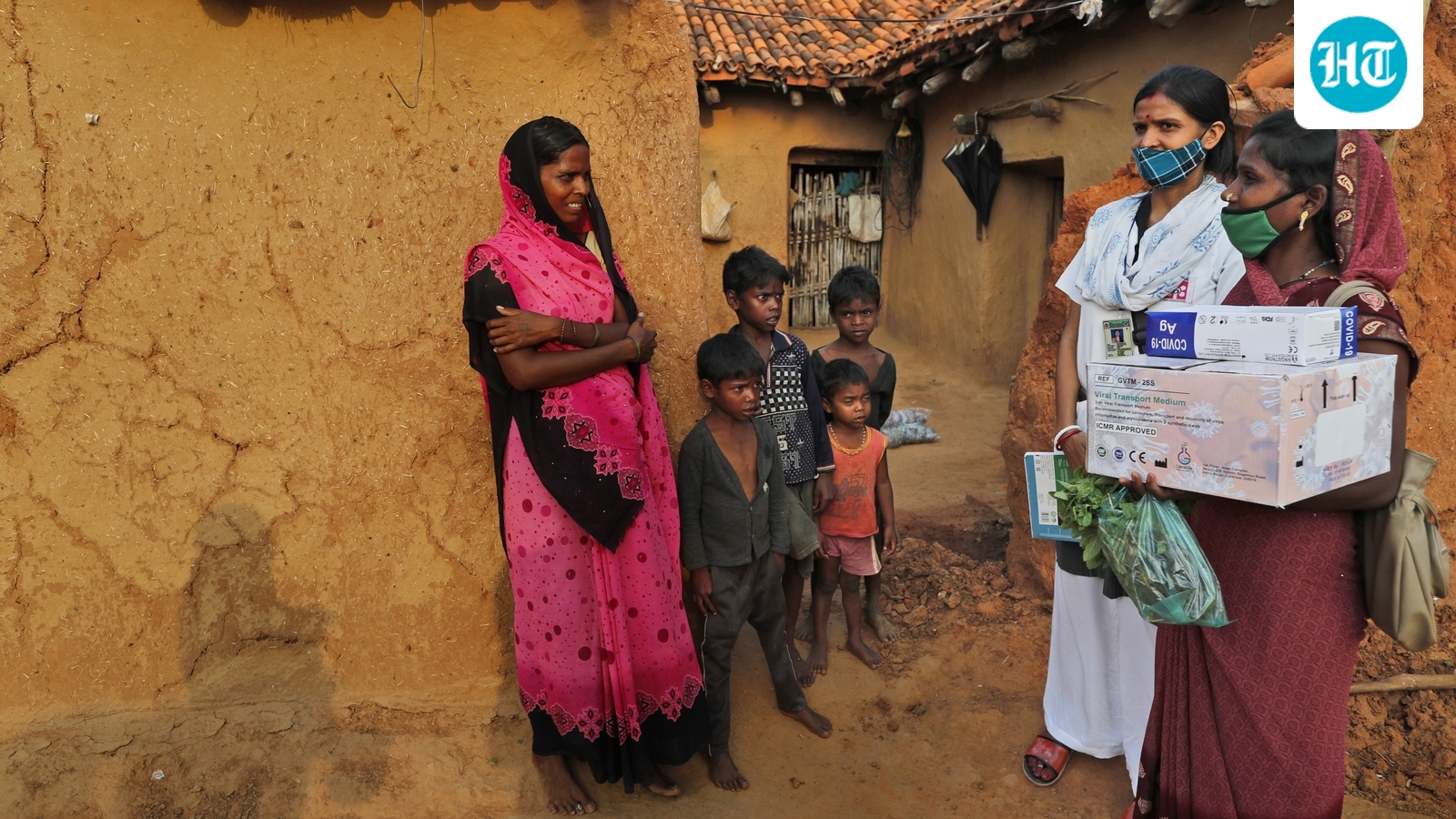
At a time when poverty, gender inequality, low literacy and climate stress continue to shape who stays healthy and who does not, India’s gains in service access face new pressure. Policymakers are aware of the importance of strengthening social infrastructure and universal public services, and its implications for health equity and its co-benefits, the idea that improving housing, education, gender rights or livelihoods strengthens health outcomes too. But these efforts cannot succeed without one essential ingredient: Deep, organised community engagement.
 Village(Rajesh Kumar Singh / AP)
As India expands public health services, from affordable medicines at Jan Aushadhi Kendras to 1.8 lakh Ayushman Aarogya Mandirs, the question is no longer whether the focus should be on social infrastructure. It is whether people trust it enough to use it. Public health systems work when communities participate, not when they remain on the sidelines.
This truth sits at the heart of global framework that argues that health investments succeed only when they simultaneously strengthen social determinants such as gender equality, local leadership, education, and accountability (WHO, Health in All Policies, 2014). Simply put: Health outcomes improve fastest when systems and people move together.
What does it take to make universal healthcare real in a crowded basti or a small village where trust in the system is thin? Policy blueprints promise coverage for all, but the truth is simple: Health care only works when people at the grassroots make it their own. Across India, communities are stepping into that role, not just as beneficiaries, but as changemakers who organise, inform, and hold systems accountable. And across India, that shift is quietly taking place. Residents are stepping forward, not as passive recipients of schemes, but as active problem-solvers who organise, inform, and keep the system responsive.
Take Bengaluru: 23 Community Health Associates (CHAs), who are women from low-income settlements, now serve as the first link between 33,000 marginalised slum dwellers and the health system. Their daily routine may look simple: Home visits, pregnancy tracking, referrals to hospitals. But over time, they are rewiring trust and reshaping norms. These outcomes are validated with records maintained by local ANMs and health centres.
When CHA Haseena Begam learned that families were avoiding child immunisation due to doubts voiced by husbands and mothers-in-law, she didn’t push. She explained risks, organised small meetings, and brought ANMs into community discussions. Attendance rose steadily.
Another CHA, Sathya, focused on improving maternal nutrition and antenatal check-ups. Her cluster saw institutional deliveries rise from 99 in 2022 to 164 in 2024, while cases of severe child malnutrition dropped from 57 to 22. Behind these numbers is a deeper shift: Women asserting greater agency over their health.
In Uttar Pradesh and Bihar, where lymphatic filariasis has persisted for decades, the greatest barrier has not been medicine but misinformation. Many people blamed swollen limbs and pain on destiny, curses, or family history.
The turning point came when, through Centre for Advocacy and Research (CFAR)’s technical help, patient support groups-local stakeholders and Community Health Officers -CHO-Patients-Stakeholder Platform- began working hand in hand at 422 Ayushman Aarogya Mandirs in UP and Bihar, with over 8,000 members representing a multi-layered coalition – frontline health staff (CHO, ANM, ASHA), trusted community leaders (pradhan, SHG, volunteers), and patients themselves, often reinforced by ration dealers and panchayat staff formed a platform. The initiative aims to unite patient-community connections through education, trust-building, personalised counseling, community engagement, and coordinating with the health system to change behaviour, secure treatment and support services.
Jai Laxmi, from Kanpur, recalls years spent believing her disease was inherited. “Now I know it comes from a mosquito bite. The pain reduced once I learned self-care practices from the programme, and now I started teaching others,” she says. Akanksha, a 20-year-old student, regained her confidence as the swelling subsided and returned to college.
Similarly, in Patna, Sita Devi lived with filariasis for 35 years. Today, she reports no acute attacks after adopting routine care taught by the group. These are not isolated cases, and they are educators, mobilisers, and living proof that health care shifts when people lead and become peer educators.
Elimination of filariasis requires 95% drug coverage during Mass Drug Administration (MDA). Yet convincing healthy individuals to take pills is not easy. Add the risk of side effects and mistrust spreads quickly. When 25-year-old farmer Himanshu Yadav from Hardoi experienced an adverse reaction after taking the anti-filaria dose in the August 2025 MDA round, he panicked for a moment. But remembering what he had heard in village meetings, that side effects often mean the drug is killing hidden parasites, he stayed calm. “I knew the medicine was working,” he said. His experience, now shared in the community, has helped counter fear. Such champions drawn from the community, sensitised by patient support group members and stakeholders, abound across the filaria endemic districts in UP and Bihar.
Once trust forms, these platforms extend naturally into other health priorities. In Barabanki, the group that began with filariasis now supports weekly immunisation drives with the anganwadi team. On the 15th of every month, they mobilise for TB and filaria outreach, with symptoms are encouraged to get screened and tested. Two women–Ramkali, a Samooh Sakhi, and Sugandhi Devi, a filaria patient-advocate, have already guided 31 villagers to TB testing; two cases were detected early.
This is the “co-benefit” effect in real terms: A single community structure addressing multiple health needs, reducing delays, and strengthening primary care without additional infrastructure.
India’s health missions, such as Ayushman Bharat, National Health Mission, Jan Aushadhi, provide a strong architectural foundation. But their reach depends on people who can translate policies into practice at the last mile: ASHAs who negotiate with families, CHAs who track pregnancies, patient leaders who debunk myths, and community volunteers who connect villagers to care.
The evidence is clear:
a) trust grows faster through doorstep conversations than clinic posters
b) behaviour change spreads when neighbours see neighbours improve
c) systems improve when communities demand accountability.
Universal health coverage is not achieved in hospitals alone. It is also built in courtyards, at water taps, in mothers’ groups, and in gatherings under the banyan tree, where people talk, question, learn, and act.
From Bengaluru’s CHAs to UP and Bihar’s patient support platforms, a new model is emerging, one where communities are not the last link in the chain but the first. These efforts show that when people move from being beneficiaries to changemakers, universal healthcare stops being aspirational and becomes achievable.
Just as a village raises a child through shared wisdom and collective care, India’s health system grows stronger when communities and institutions move in step, aligned in purpose, unified in resolve, and committed to safeguarding health against both old and new challenges.
This article is authored by Akhila Sivadas, executive director and Rajib Das, MEL consultant, CFAR, New Delhi.