
The study, carried out by St Joseph’s Centre in partnership with Dublin City University, found that the 120-strong volunteer team in St Joseph’s Centre increases meaningful social engagement and reduces loneliness for people living with dementia, while offering families reassurance and relief, knowing their loved one is actively engaged.
The volunteers also help staff deliver truly person-centred care by providing a choice of activities and creating more one-to-one interactions.
Launching the report, TV presenter Martin King, whose late mother Christina lived with dementia, said: “Through my own mam’s journey with dementia, I saw just how tough and, at times, lonely it can be for families. Dementia and Alzheimer’s are often called the long goodbye, and it is emotionally very painful to go through.
“What I have seen in St Joseph’s is that volunteers can make that journey a little easier. They bring time, company, music, walks and chats that mean people are part of a community, not just patients in beds. That support makes an enormous difference to families, to staff and to the person living with dementia.”
The study highlighted dementia as a major public health issue in Ireland, with the number of people affected expected to rise from approximately 84,000 people today to close to 150,000 by 2045.
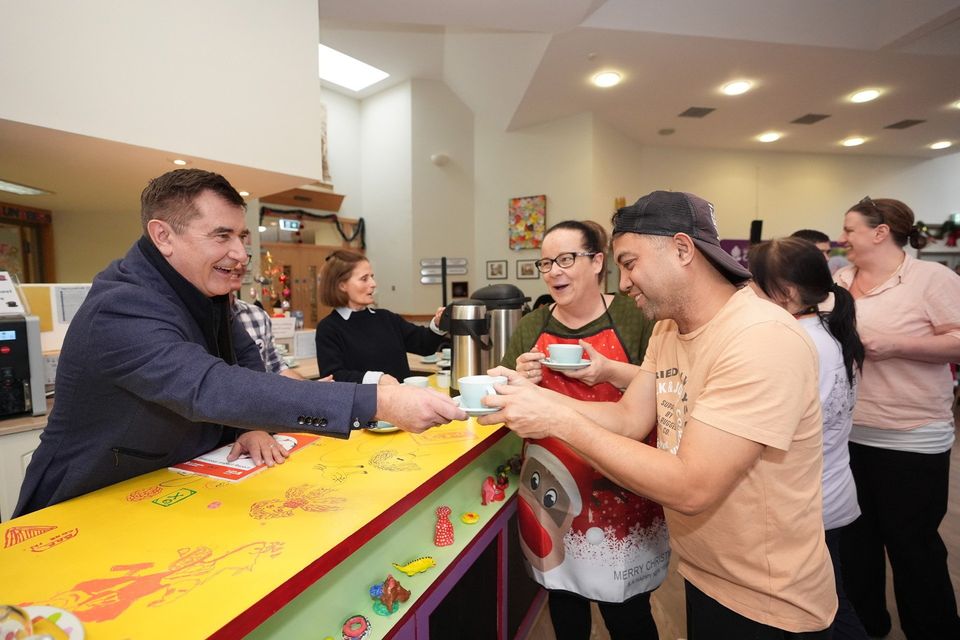
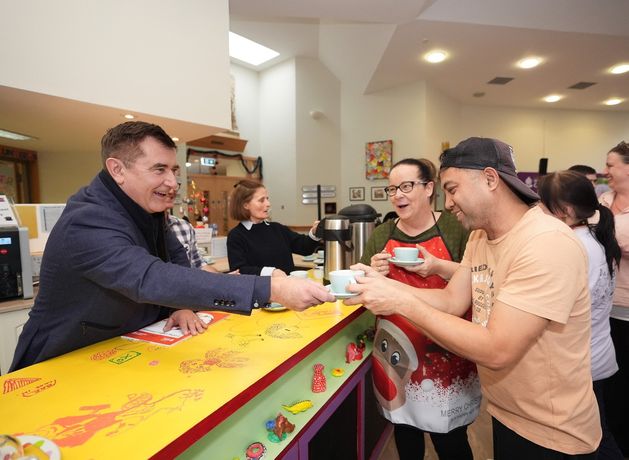
Broadcaster Martin King helps out for a day at St Joseph’s Centre, Shankill.
News in 90 seconds – 5 January
Around 4,000 new diagnoses each year will continue to place growing pressure on an already stretched health system. The report from St Joseph’s Centre provides timely evidence on how volunteer programmes can be part of the solution. The findings show that well-designed volunteer programmes are a cost-effective way to enhance person-centred dementia care and makes a clear case for dedicated funding for volunteer managers and support roles in dementia care settings, along with national pilots to establish structured volunteer programmes.
The impact of volunteering is visible every day in St Joseph’s Centre. Nicola Yau, the volunteer and community manager at St Joseph’s, said the study confirmed “what we see every day”.
“Volunteers are not an add-on, they are at the heart of how we care for people living with dementia. Their presence means more conversation, more laughter and more moments of genuine connection. It eases the pressure on families and staff, and we can now show that it is good for the volunteers’ wellbeing too.”
She said the findings send a clear message that “if we want compassionate, person-centred dementia care across Ireland, we must invest in structured, supported volunteer programmes”.
Family and friends of St Joseph’s residents also described the volunteer programme as a ‘major protective factor’ that makes it easier and less distressing to leave their loved one in care.
A family member, whose relative attends St Joseph’s Centre, said: “Before we found St Joseph’s Centre we were exhausted and constantly worried. Knowing there is always someone there to sit, chat, sing or go for a walk with Mum has changed everything. She is part of a community, not just a patient in a bed, and that gives us huge peace of mind.”
Meanwhile, the study shows that the volunteers gain clear benefits too, including a better understanding of dementia and improved mental health over time.
Volunteers at St Joseph’s support a wide range of roles including activities like music, gardening and crafting, as well as companionship and administrative support. Those who spent more time in St Joseph’s Centre reported fewer symptoms of anxiety and depression and higher dementia knowledge scores, with longer-term volunteers also reporting better overall quality of life.
Volunteer Jenny Lewis said it was “the human connection” that kept her wanting to come back.
“You feel part of something bigger than yourself, and you know that an hour spent chatting, reading or going for a walk can make someone’s day. The support we get here means we are never on our own, even if difficult moments happen.”
The centre also reaches out to young people, with the belief that they have an important role to play in creating a more inclusive and dementia-aware society. It runs a schools programme to help students in developing empathy, connection and social responsibility by learning about dementia in age-appropriate ways. The centre offers in-person interactive sessions to Transition Year students in secondary schools in North Wicklow.
The study, titled Evaluating the volunteer impact in St Joseph’s Centre: a mixed-method analysis included 75 participants (residents and day centre attendees, staff, family and friend carers, and volunteers) and surveyed 59 volunteers using validated wellbeing, quality of life and dementia knowledge measures.
St Joseph’s Centre is Ireland’s largest care home solely dedicated to dementia, providing person-centred care for 60 residents, one respite bed every fortnight and up to 120 day centre places, supported by 120 volunteers.