

The last four years are all ranked in the top five warmest years on record Beach goers in Portmarnock, Co Dublin enjoying the good weather earlier this year(Image: Mick O’Neill)
Last year was the second warmest year on record in Ireland since 1900 with the last four years now the top four warmest on record, according to new data from Met Éireann.
The national forecaster has released insights from 2025 in its annual climate report, showing that 2025 was the second warmest year in decades, and the 15th wettest year since the ’40s, with above average rainfall recorded.
Five named storms directly affected Ireland over the year, with record-breaking hurricane force winds reported during Storm Éowyn in January, the highest winds ever recorded at 184 km/h.
Mean wind speeds reached violent storm force 11 at Knock Airport in Co Mayo, Mace Head in Co Galway, Finner in Co Donegal and Malin Head, Co Donegal on Friday, January 24 during Storm Éowyn and at Malin Head, Co Donegal on Friday, October 3 during Storm Amy. Mean wind speeds reached hurricane force 12 at Malin Head, Co Donegal and Mace Head, Co Galway on Friday, January 24, during Storm Éowyn.
The number of days with up to strong gales ranged from zero days at a few stations to eight days at Mace Head, Co Galway. The number of days with storm-force winds were up to three days at Mace Head, Co Galway. Both the year’s highest gusts and 10-minute mean wind speed (142 km/h) were reported at Mace Head, Co Galway on Friday, January 24 during Storm Éowyn.
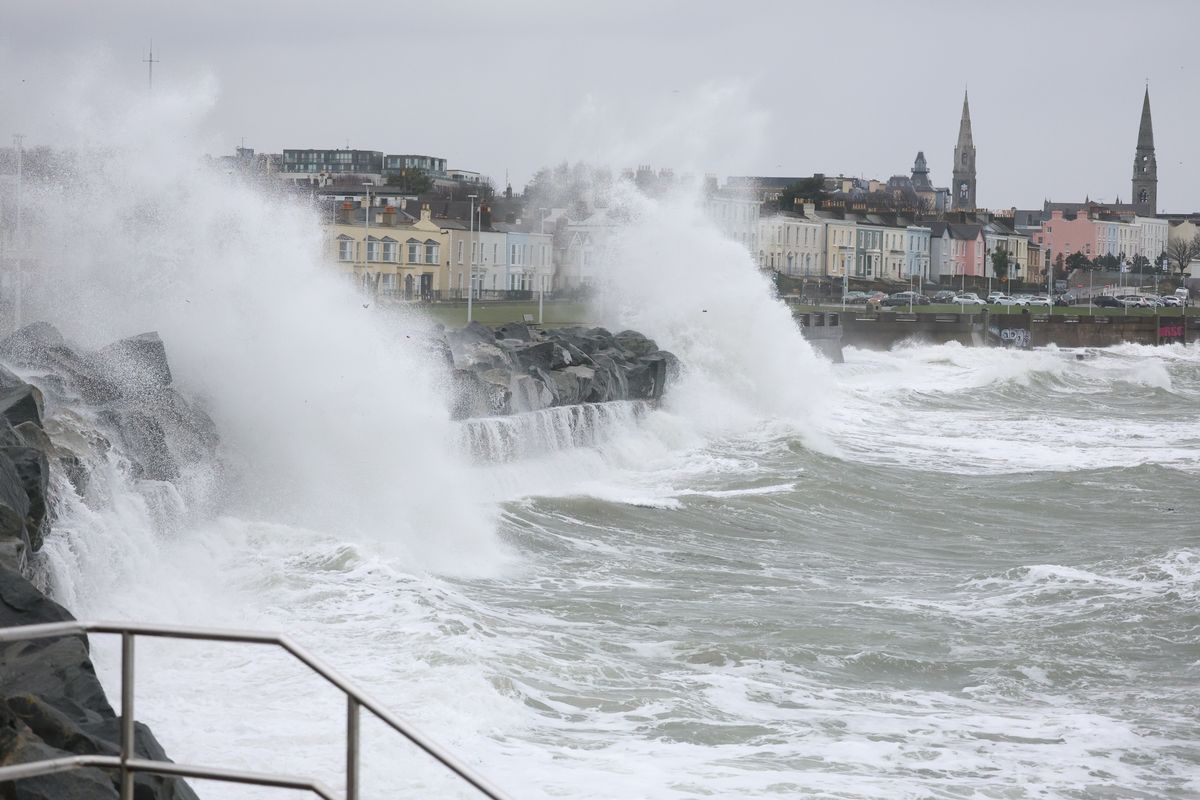 Rough weather pictured at Dun Laoghaire,Co Dublin during Storm Éowyn(Image: Collins Photo Agency)
Winter finished warm overall and was followed by the warmest and sunniest spring on record and the warmest summer on record. A mobile Atlantic regime led to the fourth wettest autumn on record.
The average annual air temperature for Ireland in 2025 was 11.14C, which is 1.59C above the 1961-1990 long-term average (LTA) or 0.97C above the most recent 1991-2020 LTA. This makes 2025 the second warmest year on record, which is only slightly behind the warmest year in 2023 (11.21C) and only the second time with a mean over 11C.
The last four years (2022-2025) are now the four warmest years on record with 2024 tying 2007 for fourth warmest, and seven of the top 10 warmest years have occurred since 2005. The coldest year on record was in 1919 with 8.73C, of the top 10 coldest years – none have occurred since 2000.
The lowest temperatures of the year were recorded on Thursday, January 9. The lowest daily air minimum was reported at Athenry, Co Galway with a temperature of -7.6C, while the lowest grass minimum was -11.8C reported at Mullingar, Co Westmeath.
All stations reported air and ground frost during the year. The number of days with ground frost ranged from 32 days at Sherkin Island, Co Cork to 135 days at Phoenix Park, Co Dublin. The number of days with air frost ranged from one day at a few stations to 45 days at Mount Dillon, Co Roscommon.
The highest daily maximum temperature of the year at a synoptic station was reported on Saturday, July 12 at Mount Dillon, Co Roscommon with a temperature of 31.1C (The highest temperature of the year including all other official Met Éireann stations was 32.2C, reported at Connemara National Park on Sunday, July 13).
 People enjoy the warm weather in St Stephen’s Green, Dublin(Image: Collins)
Provisional rainfall data suggests 2025 was the 15th wettest year since 1941, 104 per cent of the 1991-2020 LTA, with an observed average of 1,338.7mm.
The majority of annual rainfall totals were above their 1991-2020 Long-Term Average (LTA). The first eight months of the year were relatively dry but the last four months were much wetter.
Percentage of annual rainfall values ranged from 86 per cent (983.2 mm) at Malin Head, Co Donegal to 124 per cent (1322.9 mm) at Johnstown Castle, Co Wexford (its second wettest year on record). Annual rainfall totals ranged from 804.2 mm at Dublin Airport, Co Dublin to 1809.4mm at Valentia Observatory, Co Kerry.
The highest daily rainfall total was 66.9 mm at Johnstown Castle, Co Wexford on Friday, November 14 (associated with storm Claudia). The number of rain days ranged from 184 days at Dublin Airport to 258 days at Newport, Co Mayo.
The number of wet days ranged from 134 days at both Dublin Airport and Casement Aerodrome, Co Dublin to 216 days at Newport, Co Mayo. The number of very wet days ranged from 20 days at both Phoenix Park and Dublin Airport, Co Dublin to 66 days at Valentia Observatory, Co Kerry.
Subscribe to our newsletter for the latest news from the Irish Mirror direct to your inbox: Sign up here.