
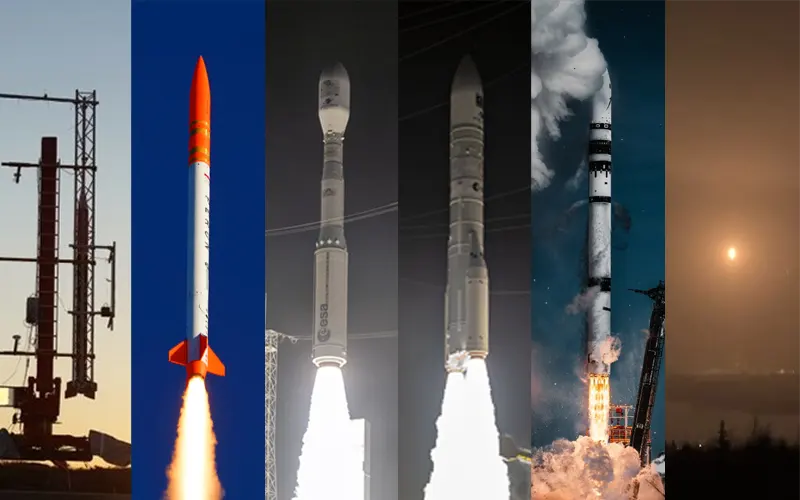
 Credit: CNW Group / Maritime Launch Services / SpaceForest / DLR / ESA CNES / Arianespace / Optique vidéo du CSG / P. Piron / Isar Aerospace / Robin Brillert / Wingmen Media / Swedish Space Corporation
While 2025 saw the first attempt to launch a privately developed European rocket capable of reaching orbit, the flight ultimately failed. Isar Aerospace’s Spectrum rocket exploded in a fireball less than a minute after it left the launch pad, its engines automatically shutting down before the vehicle plummeted into the Norwegian Sea metres from the launch facility, with much of its propellant still onboard. Despite this setback, the year also delivered several successes, including a substantial ramp-up in launch cadence for Ariane 6 and a solid year of flights for Vega C, following its successful return to flight in late 2024.
Another significant development over the last twelve months was the rapid progress of the European Launcher Challenge. The European Space Agency published a call for proposals in March, and in July, the agency shortlisted Isar Aerospace, Rocket Factory Augsburg, PLD Space, MaiaSpace, and Orbex. During the November Ministerial Council meeting, the programme attracted significant interest, with ESA Member States committing a total of €902.16 million across the five companies. This represents a substantial commitment by the European community to diversify and strengthen the European launch market.
Now in its fourth consecutive year (Here are the 2022, 2023, and 2024 lists.), the European Spaceflight ranking of European launch companies is inherently subjective and reflects our view of the industry based solely on developments in 2025. While objective factors such as total launches, success rates, and development milestones did contribute to shaping the top half of the list, greater subjectivity inevitably comes into play in the lower half. As always, if you disagree with any of our rankings, you’re welcome to share your own in the comments below.
1. ArianeGroup (+1)
In 2024, ArianeGroup conducted the inaugural flight of its Ariane 6 rocket. Although the launch was officially declared a success, an anomaly prevented the upper stage from performing its final deorbit burn, triggering an investigation that ruled out any further flights that year. As a result, ArianeGroup entered 2025 having completed just a single flight of its new flagship launcher.
Over the twelve months of 2025, ArianeGroup, through its commercial launch services provider, Arianespace, completed four successful flights of Ariane 6 carrying payloads for CNES, EUMETSAT, and the European Space Agency (ESA). Speaking on 18 December during a press conference following the 342nd ESA Council meeting in Paris, acting Director of Space Transportation Toni Tolker-Nielsen described this as “the fastest ramp-up of a new heavy launcher ever seen.” He added that the launch rate is expected to double in 2026, with a total of eight Ariane 6 flights planned, including the inaugural launch of the more powerful four-booster variant.
In addition to its work on Ariane 6, in 2025 ArianeGroup also completed the inaugural flight of its SyLEx suborbital vehicle, developed under a contract with France’s Directorate General of Armaments (DGA). The multi-use rocket was designed to reduce the country’s dependence on US-built suborbital rockets. It is expected to initially be used to test the country’s V-MAX hypersonic glider, which ArianeGroup is also developing under a DGA contract.
As part of its efforts to develop a reusable launch system, ArianeGroup completed and shipped the first variant of its Themis reusable rocket booster to the Esrange Space Centre in Sweden, where it is expected to undergo an initial series of low-altitude hop tests. While images of the demonstrator on the launch pad at Esrange were shared in September, no further updates have been provided regarding preparations for an inaugural test flight.
While the past few years have been less than stellar for ArianeGroup, with Ariane 5 being retired before Ariane 6 had entered service, 2025 marks a turning point for the company. Although uncertainty remains over when, or even if, a reusable launch system will be integrated into its commercial offering, a step that now seems inevitable for any rocket builder hoping to remain competitive, its short- and medium-term outlook appears far more secure than it did a year ago. That said, its goals of doubling the launch cadence of Ariane 6 from four to eight flights in its second year of operational service, launching the first flight of the Ariane 64 variant, and introducing the upgraded P160C booster will place significant pressure on the company over the next 12 months.
2. Avio (-1)
In July 2024, Avio returned its Vega C rocket to flight after nearly two years grounded following a December 2022 failure. In 2025, the company began working on establishing an operational cadence, completing three successful flights carrying payloads for ESA, CNES, and the Korea Aerospace Research Institute. Unlike ArianeGroup, however, 2026 will not see the company continue to accelerate the rate at which it launches Vega C.
During the 18 December post-Council meeting press conference, ESA’s acting Director of Space Transportation, Toni Tolker-Nielsen, said the agency expects three to four Vega C flights in 2026, broadly maintaining its 2025 launch cadence. According to Tolker-Nielsen, this target is “more a question of payloads than availability of rockets.”
While Avio established a stable launch cadence for Vega C following the rocket’s return to service, 2025 also saw the final flight overseen by commercial launch services provider Arianespace. As we move into 2026, the first Vega C mission of the year, VV29, will be the first launch fully managed by Avio, marking the transition to full launch responsibility for the company. ESA Member States approved Avio’s split from Arianespace in November 2023, with a July 2024 agreement setting out the full handover of Vega C launch operations.
In addition to progress across its operational programmes, the company also advanced preparations for a post-Vega E launch vehicle. In March 2023, it was awarded €181 million in funding from the Italian government to develop its Space Transportation System (STS) programme. Through STS, the company aims to mature its methalox rocket engine technology and begin developing reusable launch technologies for its Vega Next rocket, which it plans to introduce in the 2030s.
As part of the STS programme, the company is preparing two demonstrators, the first of which is a single-stage rocket expected to be launched in 2026. In its nine-month 2025 financial report, the company announced progress on several key elements of the FD1 demonstrator, including the fairing, propellant tanks, avionics, and interstage. The company also completed a final hot-fire test of the MR10 engine, which will power the demonstrator, in August 2025.
While Avio slipped one place in this year’s ranking, it was not due to a lack of notable milestones. Instead, it was the result of an exceptional performance by ArianeGroup. As we enter the new year, the company appears to be approaching a make-or-break moment. Avio will need to successfully assume full responsibility for Vega C launch operations from Arianespace while simultaneously expanding infrastructure at the Guiana Space Centre to support a higher launch cadence for the rocket. At the same time, the company must complete preparations for the flight of its FD1 demonstrator and carry out the launch, while also continuing development of Vega E, which is expected to be introduced before the end of the decade. Meeting all of these objectives in parallel in a single 12-month period will be a significant challenge.
3. Isar Aerospace (-)
After many years of anticipation, Isar Aerospace became the first European launch services provider to conduct a launch of a privately developed European rocket capable of reaching orbit. Launched in March, the 28 metre tall, two-stage Spectrum rocket cleared the pad but did not get much further, with its engines cutting out less than thirty seconds into the flight and the vehicle crashing into the water metres from the launch site. This was a not entirely unexpected outcome but nevertheless marked a significant milestone in the diversification of the European launch market.
While this first attempt was significant, Isar Aerospace is yet to reach orbit with its Spectrum rocket, a fact it appeared keenly aware of, as it raced back to its launch site in Norway less than nine months after its failed first mission to fully qualify its second Spectrum rocket for flight by December 2025. While the company had a possible launch window in December available, it ultimately did not manage a second attempt in 2025 and is currently targeting a flight toward the end of January 2026.
In addition to its progress on the hardware side, Isar Aerospace also made substantial strides on the business side. In July, the company secured an additional €150 million in funding through a convertible bond agreement with Eldridge Industries. This type of financial instrument allows a company to raise capital in the short term as debt, with the option for that debt to later be converted into equity in the form of shares, potentially reducing longer-term repayment obligations. The company also secured several new launch contracts.
The company secured its first contract of 2025 in March, with the Norwegian Space Agency committing to launch satellites for its Arctic Ocean Surveillance programme aboard a Spectrum rocket. In August, the company secured contracts with the European Space Agency, becoming the first privately funded company to be awarded a launch contract by the agency. A month later, it signed an agreement with in-orbit demonstration provider R-Space, followed by a contract with US based launch integrator SEOPS the month after that. In December, the company signed a further contract with ESA to launch the ΣYNDEO-3 mission under the European Commission’s Horizon 2020 programme.
There is certainly an argument for Isar Aerospace being higher up the list. Had it successfully completed that second flight before the end of the year, the company would have made the decision for the top spot extremely difficult. Moving into 2026, the company will be under significant pressure. While the second flight of Spectrum will be one to watch, the company will also need to rapidly progress to operational launches, having previously committed to flying at least two customers in 2026. This 2026 launch manifest includes flights for R-Space and the European Union as part of its In-Orbit Demonstration and In-Orbit Validation programme.
4. Bayern-Chemie / MORABA (-)
While Bayern-Chemie and DLR’s MORABA team, which is responsible for integrating and launching Germany’s sounding rocket missions, maintained the Red Kite suborbital rocket’s 2024 launch cadence with two flights in 2025, the year nevertheless marked a significant milestone with the first two stage Red Kite launch. The rocket’s development was commissioned by the German aerospace agency DLR with the aim of offering a more powerful option for high-altitude research missions.
The inaugural flight of the Red Kite booster in 2023 was a single-stage demonstrator designed to validate the motor’s performance. Flights two, three, and four utilised US and Canadian-built rocket boosters as upper stages, including two Improved Malemute motors and one Canadian-built Black Brant Mark 4.
On 12 November, a two-stage rocket with both stages utilising Red Kite boosters was launched from Esrange Space Centre in Sweden. The 13.4 metre suborbital rocket carried a 506 kilogram payload comprising 21 individual experiments to an altitude of 267 kilometres. The flight represented a major milestone for the programme and an important step towards reducing European dependence on US and Canadian rocket boosters.
5. T-Minus Engineering (New)
The Netherlands-based suborbital launch provider is extremely poor at self-promotion. The company rarely publishes press releases and has very little social presence. Despite lurking in the shadows of the European launch market, the company appears to have had a successful 2025.
In June, the company announced that it had partnered with Maritime Launch Services to launch a pair of the company’s Barracuda rockets from Spaceport Nova Scotia in Canada. The first of the two flights was completed on 20 November and served as a demonstration of the launch facility, enabling Maritime Launch to refine launch operational procedures and its safety and security systems.
The company also completed a flight of its smaller Dart rocket in April, launching from the Esrange Space Centre in Sweden. The flight had initially been expected to be completed in 2024 as part of a pair of flights testing the company’s ability to launch in the cold temperatures often experienced at the facility. However, after the first launch failed, the company decided to postpone the second.
It is hard to say what is in store for T-Minus Engineering in 2026. It is likely that there will be a second Barracuda flight from Spaceport Nova Scotia, as outlined in the initial partnership announcement with Maritime Launch Services. The company may also launch a Dart mission from a proposed launch facility in Ireland as part of an agreement with SUAS Aerospace.
6. SpaceForest (New)
In 2023, Polish rocket builder SpaceForest launched two flights of its PERUN rocket, both of which ended in failure. In 2024, the company went back and redesigned the nozzle for its SF-1000 hybrid propulsion system and fully requalified the vehicle for flight. In 2025, SpaceForest completed the first flight of the suborbital rocket with the redesigned nozzle. While the propulsion system appeared to have operated as expected, approximately 29 seconds into the flight, it was determined that the rocket was at risk of exceeding the designated range safety zone, and the mission was ultimately aborted.
In its post-flight analysis, the company identified the cause as a software error in the rocket’s thrust vector control system, which had not manifested itself during previous PERUN flights or testing leading up to the launch. Despite the mid-air abort, the company was able to recover all elements of the rocket and is preparing to conduct its next launch attempt in early 2026. The company also plans to complete two other missions in 2026, one from a floating platform in the North Sea and another from the Portuguese island of Santa Maria.
While its return to flight was less than ideal, SpaceForest’s progress in 2025 extended beyond its own hardware milestones. The company began and led a campaign to establish permanent launch infrastructure in Poland to support several suborbital launch systems that currently rely on mobile infrastructure. Its campaign for the creation of a permanent Polish launch facility represents an important step towards legitimising the country’s position in the launch market, and as a result, the company’s place on this list reflects more than just PERUN’s return to flight.
7. PLD Space (+2)
After 14 years in operation, PLD Space finally appears to be close to an inaugural flight of its Miura 5 rocket, which the company expects to debut this year from the Guiana Space Centre in French Guiana.
In June, the company signed an agreement with the French space agency CNES to build and operate its launch facilities at the new commercial launch site being developed at the Guiana Space Centre. A year earlier, the company revealed that its total investment in the facility would be around €10 million. In November, the company revealed that it was progressing swiftly with civil works at the site, with construction underway for the launch pad, vehicle preparation zone, and control centre.
In February, the company announced that it had signed an agreement with Oman to utilise the country’s Etlaq spaceport as its “second global launch base.” The company expects to begin launching from the facility in 2027.
In testing hardware for its Miura 5 rocket, the company announced in October that it had completed a successful test campaign of its second-stage rocket engine. This was followed by a successful hot-fire test campaign of the rocket’s first-stage engine in December. The company also announced in October that it was working toward scaling up production of its rocket engines, aiming to produce one TEPREL-C rocket engine every 14 days by the end of 2025. PLD Space has not yet confirmed that this target has been achieved.
In September, the company completed a burst test of a full-scale Miura 5 first stage to validate its performance under cryogenic temperatures and extreme pressure conditions. In 2026, this test will be followed by a wet dress rehearsal with a new qualification model, with the test campaign replicating all structural load scenarios during the fuelling and pressurisation phase.
In November, the company unveiled its first full-scale Miura 5 qualification model, which is being used to validate the rocket’s fully assembled subsystems. With the announcement of the completion of this first qualification model, the company revealed that it planned to have a second qualification model completed by the end of 2025 and the first flight model ready in the first quarter of 2026.
While in previous years it appeared that PLD Space had stalled in its efforts to develop Spain’s first sovereign launch capability, 2025 felt like a turning point for the company. Moving into 2026, it will need to reinforce the progress made last year with an initial launch attempt and a push toward operational flight.
8. MaiaSpace (+3)
As a subsidiary of ArianeGroup, and at a time when Avio has split from Arianespace, removing small-launch capability from its offering, all eyes are on MaiaSpace as it progresses toward the inaugural flight of its Maia rocket in 2026, just four years after its founding. In 2025, the company made progress toward that first flight and secured its first commercial launch contract with Exotrail, which selected MaiaSpace to launch several missions carrying its Spacevan OTV starting in 2027.
On the hardware side, MaiaSpace completed a successful full-scale separation test campaign in April, followed by a burst test of a scaled-down propellant tank in August. September saw testing of the engines that will power the Colibri kick stage, while October concluded with a full-scale fit check, marking another step toward flight readiness.
While not under the MaiaSpace banner, 2025 also saw the successful second test campaign of the Prometheus rocket engine in June. ArianeGroup is developing Prometheus under an ESA contract for use on the Themis reusable booster demonstrator and will also provide complete engines to MaiaSpace for its Maia rockets.
Moving into 2026, MaiaSpace expects to conduct the first flight of Maia toward the end of the year. The company has, however, confirmed that the mission will be suborbital. It has not yet disclosed what form this flight will take, whether it will involve only the rocket’s first stage, a first stage flying with fewer engines, or another reduced-performance demonstrator.
9. Skyrora (Returning)
In 2025, Skyrora received a licence from the UK Civil Aviation Authority to conduct flights of its Skylark L suborbital rocket from SaxaVord Spaceport in Scotland. However, according to Alan Thompson, Head of Government Affairs at Skyrora, the company was unable to attempt a flight in 2025 due to a lack of pad availability at SaxaVord, despite having a completed rocket ready to be shipped. The company has not yet provided a likely date for its next Skylark L launch attempt.
In addition to progress on its suborbital vehicle, Skyrora also reached several key milestones in the development of its Skyrora XL rocket in 2025. In May, the company announced that it had produced all nine engines required for the first stage of its inaugural Skyrora XL vehicle. These engines subsequently completed a series of test firings, including a hot fire test campaign conducted in December. In the first quarter of 2025, Skyrora also completed a burst test of one of the rocket’s first-stage propellant tanks.
Delaying the launch of its Skylark L rocket, which is intended to serve as a technology demonstrator for its larger vehicle, is a setback the company can ill afford. In 2026, Skyrora will need to complete that flight and make substantial progress towards preparations for the inaugural launch of its Skyrora XL rocket.
10. Latitude (+1)
Given that Latitude is targeting a 2026 debut for its two-stage Zephyr rocket, the company was surprisingly short on hardware milestones in 2025.
In April, the company announced that it had completed the first hot fire test campaign of a flight-ready version of the Navier rocket engine’s combustion chamber. At the time, Latitude stated that the results would inform a forthcoming long-duration hot fire test campaign, which has yet to be conducted. In November, the company revealed that it was progressing with the manufacture of the first upper stage for Zephyr and expected to begin testing the stage at its Titan Research and Test site in Vatry.
Also in April, Latitude received French government funding to construct a new rocket factory in Reims, which is expected to open in 2026 and increase production capacity from 10 to 50 Zephyr rockets per year. While part of the funding took the form of a direct grant, a portion was structured as a recoverable loan. In June, the company also announced that it had committed €8 million to developing its portion of a new commercial launch facility at the Guiana Space Centre, where Zephyr’s inaugural flight is planned to take place.
While 2025 included key steps forward for the company, Latitude appears to be behind schedule if it intends to debut Zephyr in 2026. Under ideal conditions, the company is likely targeting a late-2026 flight, with a slip into the first half of 2027 remaining a realistic possibility.
11. HyImpulse (-6)
HyImpulse had a relatively quiet year in 2025 as it continued work toward an inaugural flight of its SL1 rocket, currently targeted for 2027.
On the business side, the company secured €45 million in new funding during the year, bringing its total capital raised to approximately €74 million. Its primary hardware milestone in 2025 was the successful completion of a series of hot fire tests of its hybrid propulsion system across three combustion chambers.
Looking ahead to 2026, HyImpulse expects to conduct the first commercial flight of its suborbital SR75 rocket, following the debut of the vehicle at a launch facility in Australia in 2024.
Honourable mentions
While the ten companies discussed above represent the most concrete progress made by European rocket companies in 2025, several others also advanced toward their goals, either through new funding or preparations for future milestones.
Orbex closed out the year having secured a £20 million investment from the UK government in January, as well as a launch services agreement with D-Orbit covering two flights of its Prime rocket. The company does, however, appear to be trailing the other firms selected under ESA’s European Launcher Challenge.
Rocket Factory Augsburg spent much of 2025 in a rebuilding phase, manufacturing a new first stage for its RFA ONE rocket as it worked toward a return to the launch pad following the loss of its first flight article in a pad fire in August 2024.
HyPrSpace continued to advance the development of its hybrid propulsion-based launch systems, securing €21 million in new funding in November to support its efforts. The company is currently targeting a 2026 test flight of its Baguette One suborbital rocket demonstrator from a DGA testing facility on mainland France.
B2Space is the mad scientist of the European launch startup scene with its rockoon launch system. In 2025, the company completed a test of its balloon-based launch system with a “rocket of lower power than that planned for the commercial version of the system.” The company was, however, vague on the actual outcome of the test, stating that it had validated the ignition system.
Keep European Spaceflight Independent
Your donation will help European Spaceflight to continue digging into the stories others miss. Every euro keeps our reporting alive.