
From industrial peat plant to Sculpture in the Parklands, how artists revived damaged land
For much of the twentieth century, Lough Boora was a working bog, part of the engine room of a country trying to survive and modernise with the resources it had. From the early 1950s onwards, the bog was drained, flattened and reorganised into a precise industrial landscape. Peat was cut mechanically, and narrow-gauge railways ran across the site carrying it to collection points. It went on to fuel power stations such as Cloghan and Shannonbridge and to supply briquette factories like Derrinlough. It heated homes, generated electricity and supported employment across the midlands. For many families, this was steady work in areas where other livelihoods were scarce.
At the time, the environmental consequences of peat extraction were poorly understood or considered secondary to economic necessity. Over subsequent decades, research fundamentally changed how peatlands were valued. Once seen primarily as fuel reserves, they came to be recognised as critical ecological systems whose loss could not be reversed within human timescales.
One of the most imaginative proposals was to invite artists to work directly in the landscape, responding to its industrial past and ecological transition rather than attempting to erase it
By the late twentieth century, large areas of the bog were cut out and no longer economically viable. Power stations closed and Bord na Móna faced a practical question about the future of thousands of hectares of altered land. Some areas were converted to forestry or agriculture. In other places, drains were blocked and water was allowed to return. Lakes, wetlands and scrub began to develop slowly. Lough Boora became a site of experimentation and adaptation.
In 1994, Bord na Móna staff and members of the local community formed the Lough Boora Group to explore long-term possibilities for the site. One of the most imaginative proposals was to invite artists to work directly in the landscape, responding to its industrial past and ecological transition rather than attempting to erase it. Artists from Ireland and abroad arrived and many were immediately struck by the scale of the place, the openness of the horizon and the density of industrial remnants embedded in the land.
There were no conventional workshops. Artists worked in exposed weather, on uneven ground and in deep mud. Materials were salvaged from the bog itself, often corroded or incomplete, forcing decisions to be made on site rather than in advance. Rail lines, machinery and sleepers were not neutral resources but carried the weight of labour and routine, shaping how artists approached intervention.
Many visiting artists had little prior knowledge of peatlands or of Bord na Móna. Conversations with former workers and local residents became an essential part of the process, grounding the work in lived experience and shared memory. Over time, these conditions shaped the identity of Sculpture in the Parklands. Artists used materials already present. Old peat wagons, rail tracks, steel, stone and timber became primary construction elements. One of the most recognisable works is Sky Train by Michael Bulfin. A Ruston engine and wagons, once used to haul peat have been lifted into a dramatic arc against the sky. The machinery remains recognisable, but its function has been removed and it now stands as a marker of transition.
Eileen MacDonagh’s Boora Pyramid is made from the glacial stone of 10,000 years ago that was unearthed during the reclamation process. The large pyramid that reflects the timeframe when Mesolithic man was found on this site over 10,000 years.
Today the site is used by walkers, cyclists, families, birdwatchers and schools. Sculpture forms part of a wider experience that includes nature, recreation and learning
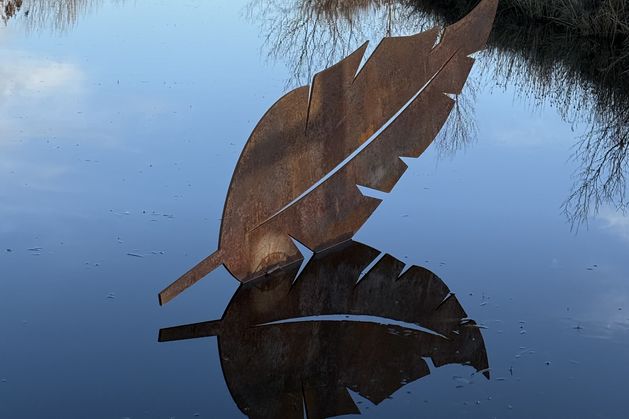
The project continues to evolve. New works are added selectively, including major pieces by Kevin O’Dwyer in 2025. O’Dwyer is a remarkable artist, sculptor and metalsmith who was the artistic director and curator of the park from 2002-2011. One of his pieces Light as a Feather, although made from corten steel, appears to float magically on the lake.
60 Degrees is a series of triangles fashioned from railway sleepers associated with the parks industrial past and stainless steel references the new use of the bog for recreation and community. The triangles play and interact with the sunlight and shadows of this beautiful landscape.
Public response to Lough Boora has evolved steadily. Early visitors were often uncertain how to read sculpture in a landscape that still felt industrial. Over time, familiarity grew. Today the site is used by walkers, cyclists, families, birdwatchers and schools. Sculpture forms part of a wider experience that includes nature, recreation and learning.
The park shows how damaged land can be rethought without erasing its history. It demonstrates that ecological recovery, public access and serious contemporary art can coexist over decades.
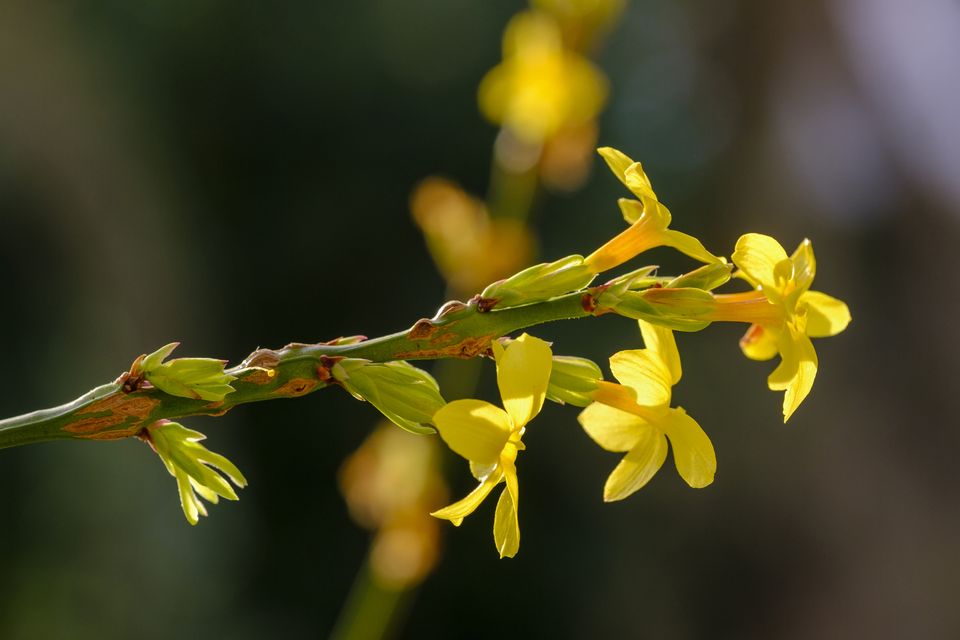
Jasminum nudiflorum (Winter jasmine)
Plant of the week
Jasminum nudiflorum (Winter jasmine)
Alas, this jasmine doesn’t smell as sweet as other members of its family but it does a great job in bringing light into a dark space in the winter months. Native to China, the yellow flowers bloom on naked stems. It’s not really a climber but you will see it against walls and growing through trellis as its long stems arch upwards. It’s pretty tolerant of moist soils and good in sun or even a bit of shade. Prune hard in spring after flowering to keep it in check.
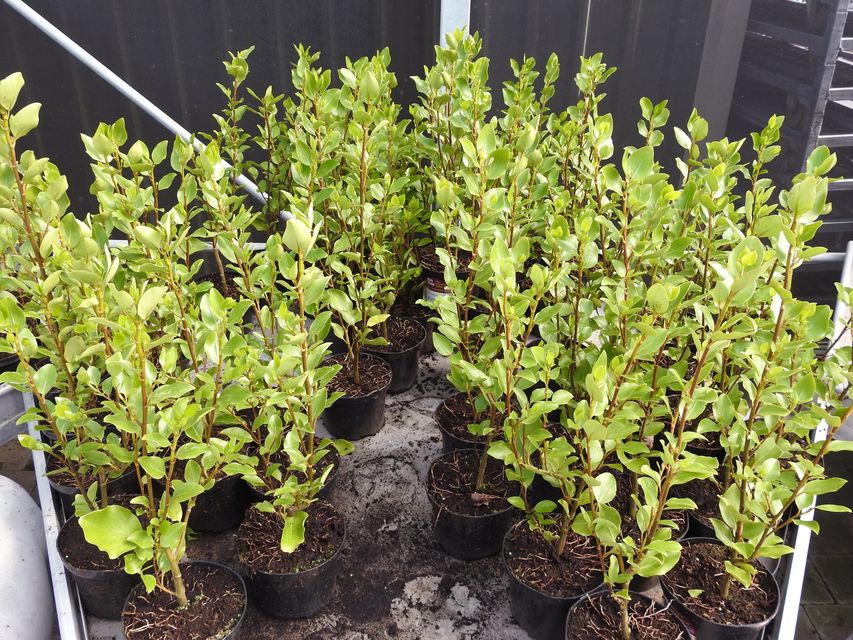
Griselinia littoralis
Reader Q&A
Q: What’s the best hedge for a new garden which is 3km from the sea?
You will need to plant salt-tolerant evergreens to provide a shelter for the rest of the garden. Griselinia littoralis, Escallonia and Olearia traversii are some examples of shrubs that can handle coastal wind and salty spray, forming dense, glossy screens with minimal fuss.
Submit your gardening questions to Diarmuid via his Instagram @diarmuidgavin using the hashtag #weekendgarden