
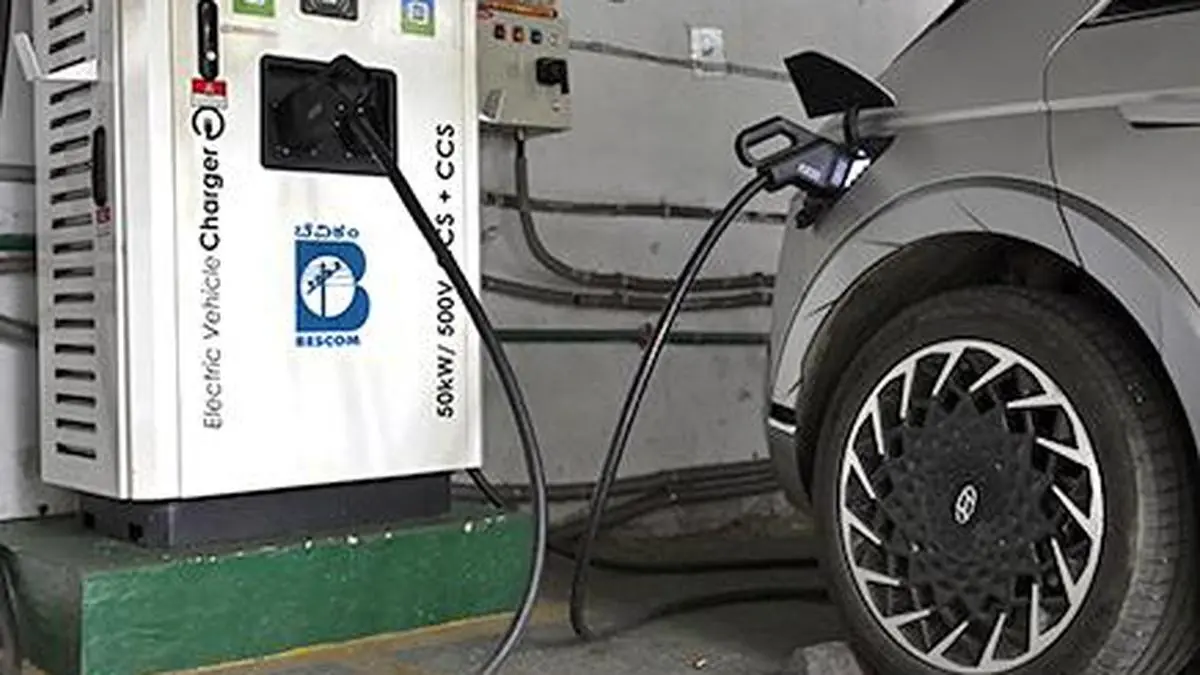

India is already seeing strong EV penetration, with monthly sales of about 1.4 lakh electric two-wheelers, 17,000–18,000 electric three-wheelers, and 15,000–16,000 electric four-wheelers, according to industry estimates
| Photo Credit:
The Hindu
As India’s early-generation electric vehicles begin approaching the end of their usable life, the country is moving towards its first large wave of retired EV batteries marking a critical inflection point for battery recycling and second-life energy storage companies.
India is already seeing strong EV penetration, with monthly sales of about 1.4 lakh electric two-wheelers, 17,000–18,000 electric three-wheelers, and 15,000–16,000 electric four-wheelers, according to industry estimates. Even before the first large replacement cycle begins, these volumes are building the base for a recycling market that could expand nearly ten-fold by 2030, led initially by commercial vehicles, said Utkarsh Singh, chief executive of BatX Energies.
“Volumes will ramp up first from two-wheelers, given India’s massive two-wheeler base and the suitability of EVs for daily-use and gig-economy applications,” Singh said, adding that commercial four-wheelers will follow, while buses and heavy commercial vehicles will ultimately contribute the largest battery volumes over time.
Recyclers are scaling capacity in anticipation. Attero, an electronic waste and lithium-ion battery recycling company, extracts more than 22 pure metals through a proprietary process combining mechanical recycling and hydrometallurgy, recovering battery-grade lithium carbonate, cobalt, nickel, manganese sulphate and graphite with extraction efficiency exceeding 98 per cent.
The company processed close to 148,000 tonnes of material annually this year, including electronic waste and lithium-ion batteries, and expects to cross 250,000 tonnes per annum in the current year, said Nitin Gupta, Attero’s Chief Executive and Co-Founder.
“On the lithium-ion battery side, our current capacity is 17,500 tonnes, which we are scaling up to 60,000 tonnes, as end-of-life volumes are increasing every quarter,” said Gupta.
Geopolitical risks
Industry experts say growth is being driven by a convergence of factors: the global push for self-reliance in critical minerals, India’s extended producer responsibility (EPR) framework, which makes manufacturers accountable for managing products across their entire lifecycle to enable a circular economy; and the energy transition, which depends heavily on batteries as storage systems. Materials such as lithium, cobalt and nickel account for a large share of battery costs and remain exposed to supply and geopolitical risks.
According to Vasudha Madhavan, Founder and Chief Executive of Ostara Advisors, the most durable margins in battery recycling come from EPR-linked processing fees and recovered materials. Processing and EPR fees are contract-backed and recurring, while recovered metals and black mass benefit from India’s long-term battery demand and import dependence.
BatX’s Singh said recycling economics can work without subsidies, but EPR plays a critical role in stabilising margins in an otherwise volatile market. “EPR enforcement can add about 6–7 per cent to EBITDA, which meaningfully supports scale-up,” he said.
Second-life applications, such as stationary storage for telecom or renewables, offer higher gross margins per usable kilowatt-hour but involve higher testing, integration and working capital risks, making them less predictable at scale, Singh added.
As India’s EV fleet matures, recyclers are racing to align capacity with the uneven arrival of end-of-life batteries. Whether the sector scales sustainably will depend on enforcement of EPR norms, clarity on traceability and the ability of players to balance capital investment with long-gestation returns.
Published on January 6, 2026