
A hill fort in Co Wicklow has been declared the largest nucleated settlement in prehistoric Ireland and Britain, following a study by researchers at Queen’s University Belfast (QUB).
Situated in the mountainous southwest area of the county, the “Baltinglass hill fort cluster” has long been of interest to archaeologists, as it is considered to be one of the most complex and exceptional prehistoric landscapes.
The site features a “necklace” of up to 13 hilltop forts, including seven big hill forts, as well as other enclosures spanning the early Neolithic to late Bronze Age (circa 3700–800 BC), near the town of Baltinglass.
The study also proposes the site, in the Wicklow Mountains just south of Dublin, as Ireland’s earliest proto-town, predating by two millenniums the Viking towns that have so far been considered the island’s earliest urban settlements.
The research project further draws attention to a possible water cistern at the site, to service a large, prehistoric community. If this is confirmed, it would be the first known feature of its kind from an Irish hill fort.
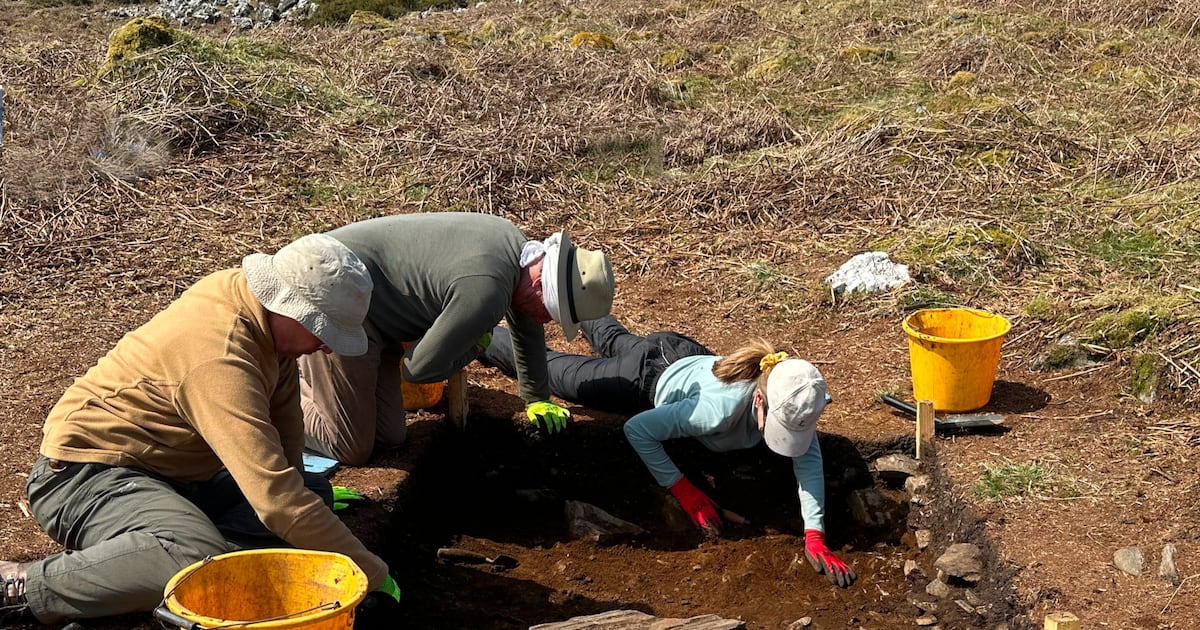
The study examined existing archaeological data as well as embarking on new excavations to challenge and extend the existing research.
Terrestrial survey work carried out within the past decade at Brusselstown Ring had detected 288 potential hut sites, but aerial surveys from 2017 and 2022 identified more than 600 topographical anomalies consistent with prehistoric house platforms.
The project combined the existing data with the results of its own excavations, to locate 98 potential roundhouse footprints within the inner enclosure, and a possible further 509 between the inner and outer enclosing elements.
Even if not every one of the anomalies represented a roundhouse, this would still make it the largest nucleated prehistoric settlement in Ireland and Britain by some distance.
Only a handful of other sites have more than a few dozen roundhouse footprints and not all of them are enclosed, according to the lead author of the research project, Dr Dirk Brandherm from the school of natural and built environment at QUB.
Dr Brandherm said the study’s discoveries “challenge previous conceptions of prehistoric settlement organisation, showing a level of social complexity, community cohesion, and regional importance not fully recognised before”.
“Such new evidence considerably enriches our knowledge of how people lived and organised themselves, contributing to broader histories of settlement, social interaction, and landscape use,” Dr Brandherm said.
Dr Brandherm hoped the new knowledge would help preserve the site as one of “big national and international heritage importance, connecting us to the island of Ireland’s deep past”.