
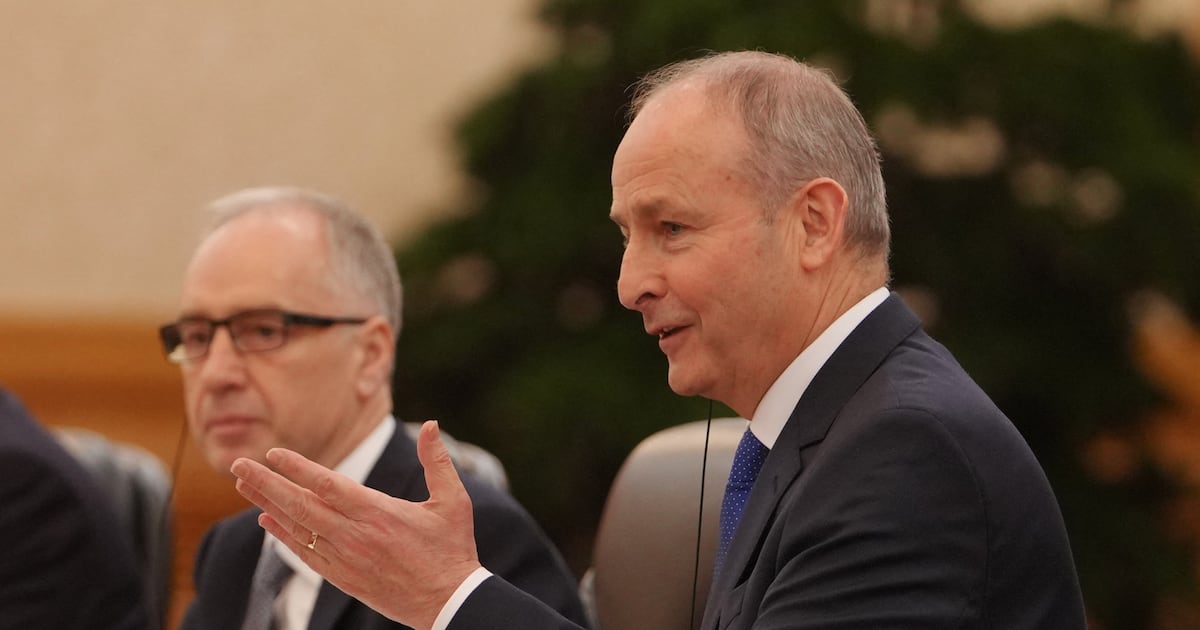
The Government will vote against the Mercosur trade deal, the Taoiseach and Tánaiste have confirmed.
The European Union is to vote on Friday on the contentious trade deal with the Mercosur countries of Brazil, Argentina, Bolivia, Paraguay and Uruguay.
Taoiseach Micheál Martin confirmed while on an official visit to China that Ireland will vote no to the deal.
Speaking in Shanghai, Mr Martin said the concessions made to allay the concerns of Irish farmers about the deal were inadequate.
“We have to be confident that the standards that we have set now and the obligations based on Irish and European farmers are not undermined by food production systems that are not as carbon efficient and that are not don’t have the same stringent standards,” he said.
“So in the round, acknowledging that progress has been made in terms of the safeguards, both the market safeguards and the pesticide issue.
“But in terms of that basic issue around the obligations and standards for Irish farmers, our sense is that we don’t have confidence that they won’t be undercut. So the Government will be voting no.”
The Taoiseach said that Irish farmers had been asked to take big steps to make agriculture more carbon efficient and that they should not have to face competition from countries with lower climate standards.
“We now have one of the most carbon efficient food production systems in the world. And we put in a lot of regulations, rightly so, that are very stringent in respect to consumer protection, food safety, carbon efficiency, climate protection measures,” he said.
Tánaiste Simon Harris also said in a statement that the Government’s position “still stands”.
“The Government’s position on Mercosur has always been clear: we did not support the deal in the form in which it was presented,” he said.
[ Ireland’s rejection of Mercosur sees Coalition concerns trump EU politicsOpens in new window ]
What is the Mercosur trade deal?
The largest trade deal negotiated by the EU, the agreement with four South American Mercosur countries (Brazil, Argentina, Paraguay and Uruguay) would see import duties phased out on 91 per cent of EU goods. In return, these countries could sell goods to the EU with fewer restrictions.
Who is for and against it?
Fans of the deal say it offers access to new markets and helps combat Donald Trump’s tariffs. In Ireland, France and Poland, farmers fear more beef coming into the EU.
The programme for government codifies Ireland’s opposition to the deal, committing the Coalition to “work with like-minded EU countries” in opposing Mercosur.
He, the Taoiseach, Minister for Agriculture Martin Heydon and Minister for Foreign Affairs Helen McEntee have been engaging closely with “like-minded countries that share our concerns” and have been “working constructively to secure additional safeguards that would address the very real concerns of our citizens”, he said.
“Unfortunately, the outcome in this negotiation is that although the EU has agreed to a number of additional measures, they are not sufficient to satisfy our citizens.
“So our position stands. We will vote against the agreement.”
Speaking later outside Government Buildings in Dublin, Mr Harris noted that while the agreement is expected to be ratified in the vote of the European Council on Friday, it would also need to be ratified by the European Parliament.
“I think the system would want to be very careful in taking for granted the views of the democratically elected representatives of citizens here in Ireland and right across the European Union, who will have to have their say on this as well.”
He added: “Tomorrow is not the end of the matter.
“The decision-making process will also necessitate, quite rightly, that the European Parliament has its say as well, and that work will continue, and there will be an opportunity for Irish MEPs, and MEPs right across the EU, to continue to engage, grapple and give their verdict.”
He said he had spoken with Fine Gael MEPs on Thursday and discussed how to “maximise” safeguards if the EU-Mercosur deal is passed.
Asked how Ireland’s position would affect its stance in the European Union, Mr Harris said Ireland did “grapple intensively” with the issue but ultimately had to “stand by our word”.
Independent politicians including junior ministers and TDs backing the Government have said Ireland is taking the “right decision” in the plan to vote against the deal.
Independent junior ministers like Seán Canney, Michael Healy-Rae and Marian Harkin have been vocal in their opposition to Mercosur.
In a statement on Thursday the group of Independents – which also includes TDs who are not Ministers like Michael Lowry and Danny Healy-Rae – said they believe “Ireland is taking the right position at EU level to protect national interests, uphold environmental commitments, and safeguard Irish agriculture.”
Minister of State for Agriculture Michael Healy-Rae denied that he threatened to withdraw support for the Government over the Mercosur deal.
Speaking on RTÉ Radio’s Today with David McCullagh show, Mr Healy-Rae said: “This has been a culmination of a lot of work and it’s in keeping with the programme for government.”
The Coalition is “doing what it said on the tin” and will be “absolutely totally opposed to the Mercosur deal as it was presented”, Mr Healy-Rae said.
“Other European countries are wavering and so be it, but we are steadfast in supporting Irish farmers.”
Mr Healy-Rae said he had not threatened to “pull the plug” on the Government.
“We don’t do threats because that’s nonsense. We’re serious politicians,” he said. “We’re about the long-term longevity of a government so that we can deliver on all of the different range of issues.”
There are growing expectations that the deal will be approved on Friday with support from the Italian government. With Rome voting in favour, a blocking minority of European states – which must consist of at least four member states and 35 per cent of the EU population – cannot be assembled.
If that were to come to pass, an Irish vote against the deal would be symbolic, and risk burning political capital in Brussels.
Hungary’s foreign minister Péter Szijjártó confirmed Viktor Orbán’s far-right government would also vote against the deal, as they had flagged earlier. “Brussels is once again ignoring the interests of our farmers,” he said.
Poland is also expected to vote against the deal. The French government, who has previously been critical proposed safeguards for farmers do not go far enough, has yet to reveal how they will vote on Friday.
Germany, Spain and a large number of other EU states are supportive of the trade deal, which they see as a way to open up a big new market for European businesses and producers.
Italy looks set to support the agreement, a swing vote that would likely deliver a big enough majority in the EU to approve the trade deal.
In a statement, Italy’s foreign minister Antonio Tajani said his government had always been in favour of the deal being signed, once “adequate safeguards” were in place to protect farmers. “The EU-Mercosur agreement has enormous benefits and potential,” he said.
European Commission spokesman Olof Gill said EU officials negotiated “like hell” to make sure any new trade deals had safeguards to protect vulnerable agricultural sectors.
Speaking in Brussels, Mr Gill said Europe’s agri-food industry enjoyed a significant trade surplus, in part thanks to previous free trade deals. “We sell €60 billion worth more of stuff than we buy from our partners around the world, that’s an astonishingly successful statistic from any economic metric,” he said.
“We’ve made the case for the Mercosur agreement … We believe it is an essential deal, economically, politically, strategically, diplomatically, for the European Union,” he said.