
Patrick Collison, co-founder of payment giant Stripe, won the competition 21 years ago and now runs the $100bn technology company with his brother John.
He visited the RDS to meet some of Ireland’s brightest young minds whose work is on show at the Young Scientist & Technology Exhibition, which is now sponsored by Collison’s firm Stripe.
The billionaire talked to students at some of the 550 project stands across the exhibition floor and took part in a Q&A session.
He told the Q&A: “I was sitting in the audience here not that long ago, now 21 years ago. I’ve been spending some time in the hall and the standard of your projects is extremely impressive and you are going to accomplish incredible things in the years to come.”
Mr Collison encouraged the students to home in on what it is that compels them – “that’s at the heart of it”.
During his visit, Mr Collison engaged with students across all five exhibition categories, including international participants from Kenya and Jordan – national winners in their own countries who travelled to Dublin to participate in the 2026 Stripe YSTE.
This year’s competitors were back under the microscope of the team of adjudicators in the main hall, including Ailbhe Harnett (13) and Sophie McKenna (14) from Presentation College in Headford, Co Galway.
The pair made what they described as ‘A Poor Woman’s Telescope’, inspired by the cheaply made 1921 version by engineer Russell W Porter and, of course, the current cost-of-living crisis.
“The Mylar [plastic film] acts as the reflective lens, which reflects the image onto our webcam, which in turn, puts it onto the computer for us so we can see clear images,” Sophie said.
They are looking forward to using their Newtonian telescope to collect images on clearer nights later in the year.
Conor O’Neill and Alexander Vysotski, from the Institute of Education in Dublin, are hoping to be second time lucky, returning to the RDS with an enhanced version of their 2025 entry.
The pair have created a robotic arm with a sense of touch, which they suggest can be used in dynamic environments including emergency zones.
“Last year we were here with an AI-simulator version of this, and the advice we got from the judges was that if it’s done using a simulator, is it even possible in real life?” said Conor, who hopes to study Computer Science in third level. “The logical next stop was to show that it is possible.”
A 3D printer was used to make the robotic arm designed by the Leaving Cert students, and a trial-and-error process was used to find a material that would enable the tactile response. They eventually settled on an inexpensive material called Velostat.
“There’ll always need to be a human to check in on what AI is doing,” he added, when asked whether they believe robots will take over.
Elsewhere in the main hall, Niall Hennessy presented his case for the use of Belizatinib as a treatment for pancreatic cancer.
The student, from St Andrew’s College in Dublin, mimicked the growth of pancreatic cancer in the membrane of an egg.
In those eggs which he treated with Belizatinib, there was a significantly lower progression in the pancreatic cancer cells.
“Every family has been touched by cancer in some sort of way,” he said when asked where the inspiration for his project came from.
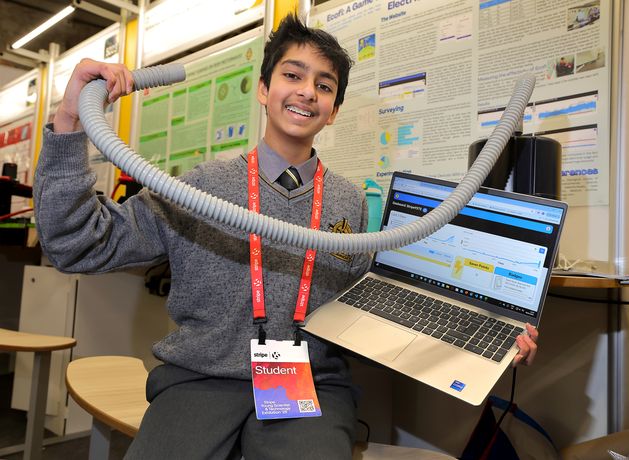
Harshit Agrawal, from Clonkeen College in Dublin, has channelled his passion for combating climate change and his interest in coding into a website and circuit that monitors our usage of electricity.
He introduced the website, which includes a leader board and badges, to local primary schools to encourage children to lower their electricity consumption.
“By working with children we can help to make them more aware of their use of energy, and help them build habits that they can carry on throughout their lives,” Harshit said.
At the primary school science fair that runs on Thursday and Friday, third-class students from St Leonard’s National School in Dunnamaggin, Co Kilkenny, were eager to discuss what they learned while investigating the health benefits of various foods and drinks.
Along with their teacher Mrs Langton, the class carried out an energy-recovery test in order to see what drink is most efficient to regain a normal heart rate after exercise.
They also investigated the decomposition rates of processed and organic foods, as well as learning to read and decipher food labels.
The overall winner of the 2026 Stripe Young Scientist & Technology Exhibition will be announced at the awards ceremony on Friday, January 9, at 5pm, with a limited number of tickets still available to buy online.