
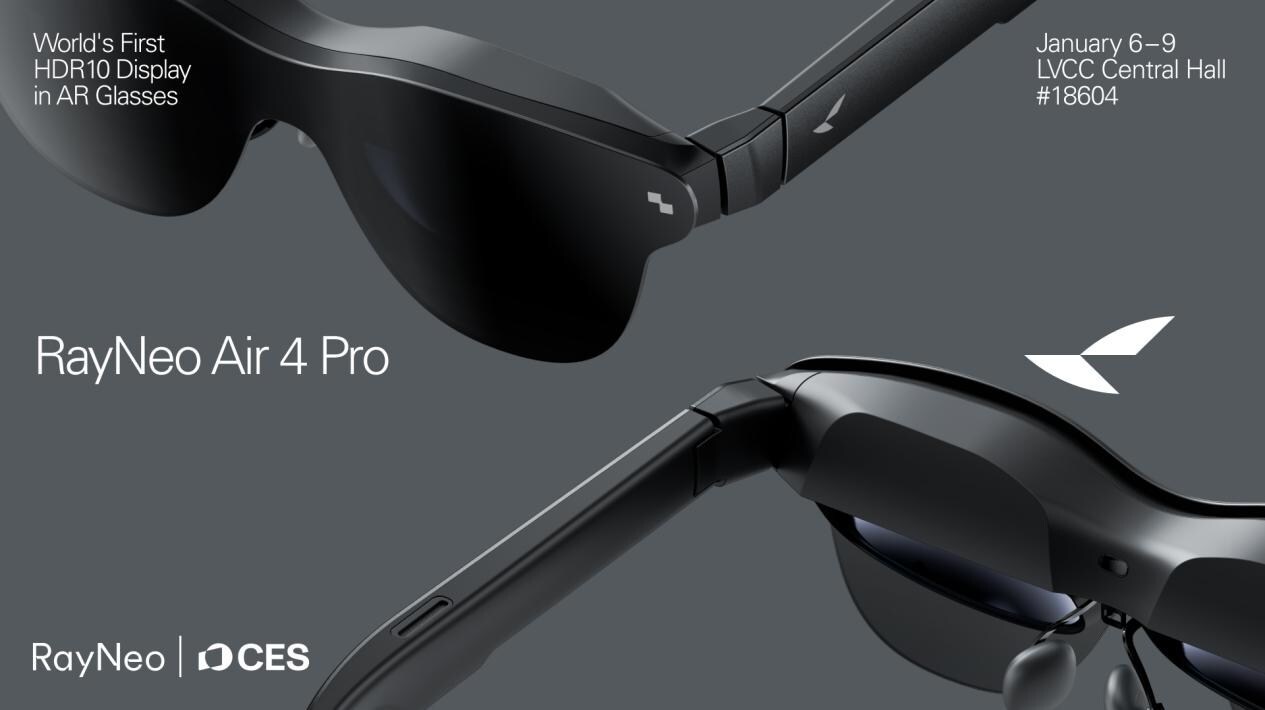
RayNeo Air 4 Pro: World’s First HDR10-enabled AR Glasses
TL;DR
RayNeo has launched the Air 4 Pro globally at CES 2026, featuring the world’s first HDR10 AR displays and Bang & Olufsen-tuned audio.
The Air 4 Pro uses FHD micro-OLED displays to create a virtual 201-inch screen experience.
These lightweight glasses are expected to go on sale on January 25 for $299.
RayNeo has been making AR glasses for a while now, and the company just launched the RayNeo Air 4 Pro at CES 2026. This marks the global debut of their latest AR glasses, which were launched in China last year.
With the Air 4 Pro, RayNeo aims to deliver a cinema-like experience in a lightweight wearable form factor. It claims that these are the world’s first HDR10 AR displays, offering brighter highlights, deeper shadows, and enhanced color and contrast within the AR experience. A Pixelworks-customized Vision 4000 chip offers real-time video enhancements, such as upscaling SDR content to HDR and converting 2D videos into 3D.
Don’t want to miss the best from Android Authority?


The entire experience is displayed on a pair of 0.6-inch dual-layer micro-OLED FHD displays featuring a 120Hz refresh rate, 1,200 nits of peak brightness, and 3,840Hz PWM dimming. Since these displays sit inches away from your eye, you get an experience that is as immersive as looking at a 201-inch screen at a 6m distance.
The RayNeo Air 4 Pro also features four precision-tuned speakers, co-designed with Bang & Olufsen, for an immersive yet private sound experience. These AR glasses retain their lightweight characteristics, weighing just 76g. They also remain compatible with USB-C devices that support display output, letting you easily connect them to phones, tablets, laptops, or game consoles.
Pricing and availability of the RayNeo Air 4 Pro are not mentioned in the press release, but Mashable reports that the glasses will officially go on sale on January 25 for $299.
At CES 2026, RayNeo also showcased a special eSIM-enabled version of its flagship RayNeo X3 Pro AR glasses. This is a prototype concept for testing independent connectivity on the glasses.
Thank you for being part of our community. Read our Comment Policy before posting.