
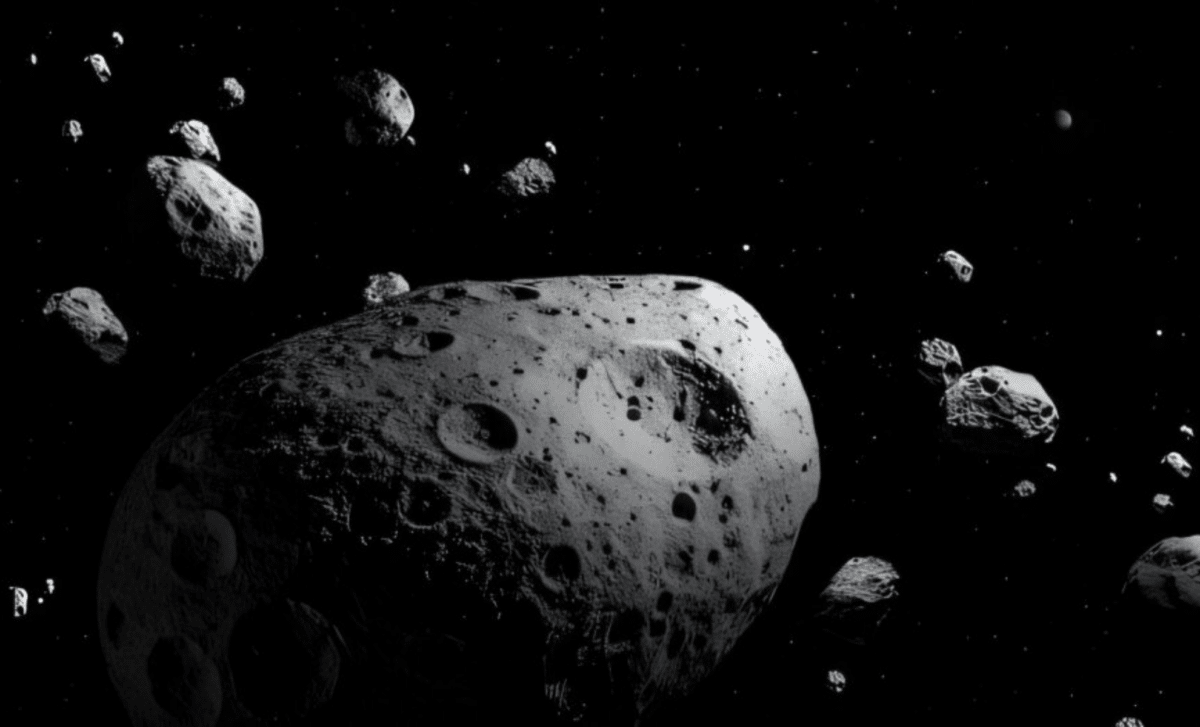
Scientists at the Vera C. Rubin Observatory have identified the fastest-ever spinning asteroid larger than half a kilometer in diameter. This extraordinary achievement, made possible by the observatory’s advanced technology and unique survey capabilities, was detailed in a paper published in The Astrophysical Journal Letters. The findings were also presented at a press conference during the 247th meeting of the American Astronomical Society (AAS) in Phoenix, Arizona. The asteroid, named 2025 MN45, spins at an incredible speed, completing a full rotation every 1.88 minutes.
The Speed of Discovery: Rubin’s Technological Edge
The discovery of 2025 MN45 underscores the powerful technological capabilities of the Vera C. Rubin Observatory, particularly its Legacy Survey of Space and Time (LSST) and the LSST Camera. This massive digital camera allows the observatory to capture high-resolution images with extreme speed, one every 40 seconds. The observatory’s ability to scan the sky with unparalleled precision is enabling the identification of previously unknown celestial bodies. As Luca Rizzi, an NSF program director for research infrastructure, highlights, “NSF–DOE Rubin Observatory will find things that no one even knew to look for.” This statement reflects the immense potential of the Rubin Observatory, which will continue to unravel the mysteries of our universe over the next decade through its comprehensive survey.
With such speed, the Rubin Observatory is set to revolutionize the field of astronomy, not just through the discovery of objects like 2025 MN45, but also by providing a detailed time-lapse record of the universe. As the observatory progresses with its survey, it will collect an avalanche of data, illuminating facets of the universe that were once out of reach. This unprecedented level of observation will give scientists insights into everything from asteroids to distant galaxies, fostering a deeper understanding of cosmic phenomena.
Strength and Composition of Fast-Rotating Asteroids
The fast rotation of 2025 MN45 raises important questions about the internal structure and strength of asteroids. To sustain such rapid spinning without breaking apart, the asteroid must be made of extremely strong material. This challenges the common assumption that asteroids are “rubble piles,” collections of smaller rocks loosely held together by gravity. Sarah Greenstreet, lead author of the study published in The Astrophysical Journal Letters, notes, “Clearly, this asteroid must be made of material that has very high strength in order to keep it in one piece as it spins so rapidly.” The strength required is akin to that of solid rock, which is surprising given that most asteroids are thought to be loosely bound collections of debris.
The discovery of this fast-spinning asteroid provides new insights into the internal composition of such objects, offering clues about the conditions of the early solar system. The fact that 2025 MN45 can spin at such an incredible rate without fragmenting suggests that it is far more cohesive than typical rubble-pile asteroids. This observation is important for understanding how these objects formed and evolved billions of years ago and could help scientists identify which asteroids might pose a threat to Earth based on their structural integrity.
Implications for Asteroid Research and Solar System Evolution
The discovery of 2025 MN45 and other fast-rotating asteroids highlights the complex and dynamic nature of asteroids within our solar system. These objects can provide invaluable information about the early days of the solar system, revealing details about the materials that formed planets, moons, and other celestial bodies. The speed at which an asteroid spins can provide insights into past collisions and the conditions under which the asteroid was formed. Fast rotation can indicate a history of impact events that either shattered a larger body or accelerated its spin.
As Greenstreet explains, “We calculate that it would need a cohesive strength similar to that of solid rock,” suggesting that asteroids like 2025 MN45 may have undergone significant transformation through collisions, which could have altered their spin rates and internal structures.
Looking Ahead: Rubin Observatory’s Legacy Survey of Space and Time
The success of this early discovery is just the beginning of what is expected to be a decade-long revolution in our understanding of the solar system. The Rubin Observatory’s Legacy Survey of Space and Time (LSST) will continue to provide data at an unprecedented rate, scanning the sky every night and documenting the movement and behavior of asteroids, stars, galaxies, and other celestial bodies. Aaron Roodman, Deputy Head of LSST, emphasizes that “We have known for years that Rubin would act as a discovery machine for the universe,” and the findings of 2025 MN45 are an early testament to this capability.
Rubin’s LSST promises to uncover thousands of new asteroids and provide critical data on their rotation rates, compositions, and possible interactions with other bodies. This vast dataset will not only help scientists understand asteroids better but will also contribute to the ongoing search for potentially hazardous objects near Earth. Rubin’s ability to capture images every 40 seconds is a game-changer in the field of time-domain astronomy, allowing for real-time monitoring and analysis of fast-rotating asteroids like never before.
Asteroids Beyond Earth’s Reach: Discoveries in the Main Asteroid Belt
Interestingly, most of the fast-rotating asteroids discovered so far, including 2025 MN45, are located in the main asteroid belt, an area between Mars and Jupiter where many of the solar system’s smaller bodies reside. This region is more distant from Earth, which historically made these objects difficult to observe due to their faint light. However, Rubin’s unprecedented light-collecting power and precise measurement capabilities have allowed scientists to detect asteroids at much greater distances than ever before.
As the Rubin Observatory continues its survey, scientists expect to find even more fast-rotating asteroids, many of which are likely to be located in the outer reaches of the main asteroid belt. These objects are harder to observe but could hold crucial information about the early solar system’s formation and the evolution of smaller bodies. The discoveries made in Rubin’s early commissioning phase, like those of 2025 MN45, show that even in its early stages, the observatory is already transforming the way we study these distant objects.