
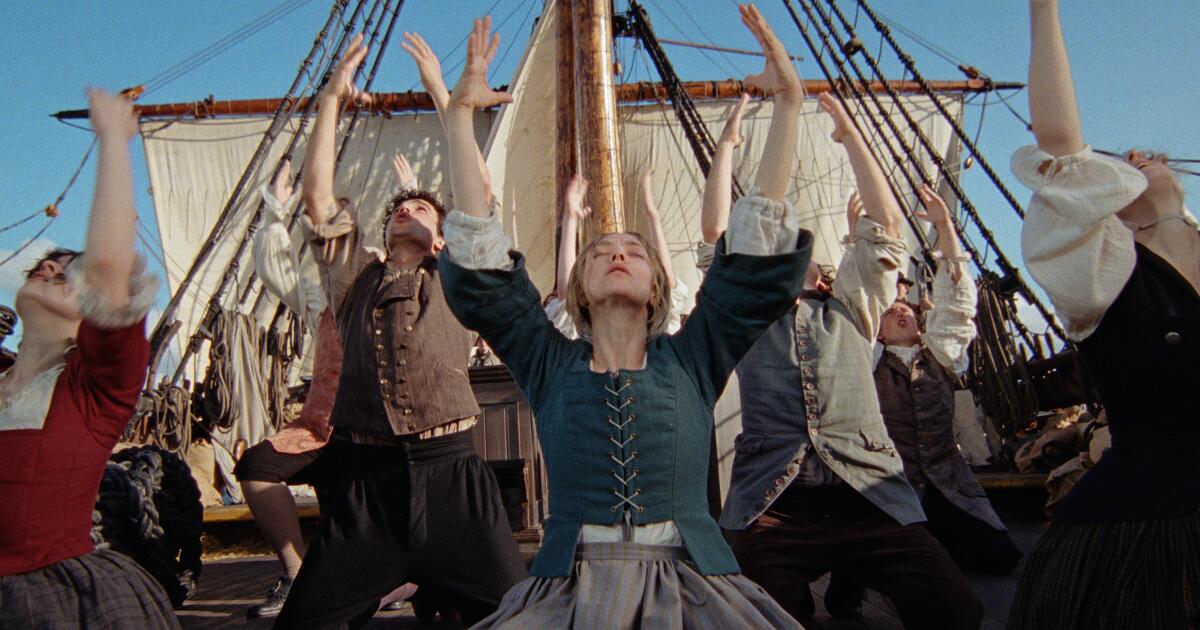
The act of faith, of believing, is by definition something that can’t be seen. Religious devotion is difficult to capture on film. “The Testament of Ann Lee,” a portrait of the woman who led the movement known as the Shakers from England to America in the 1700s, transforms the spiritual into something physical through movement and song, creating a most unusual musical and a genuinely remarkable movie.
Directed by Mona Fastvold, who co-wrote the script with her partner, Brady Corbet, the film comes quickly after their collaboration on “The Brutalist,” which was directed by Corbet. Across projects that also include Fastvold’s “The World to Come” and Corbet’s “The Childhood of a Leader” and “Vox Lux,” they continue to craft finely detailed historical fictions that have both a sweep and a specificity, made on budgets that are startlingly modest for what they manage to get on-screen. Their ongoing collaboration makes for an eclectic and engaging body of work.
But “Ann Lee” is not “The Brutalist Part II” and Fastvold definitely has her own interests as a filmmaker — in particular how the world has historically been skeptical of women, disregarding their agency and value by trying to place them in limiting, prescribed roles. “Ann Lee” as a movie and Ann Lee as a character burst open those preconceptions.
Played with a bold fervor by Amanda Seyfried, Ann Lee suffers the loss of four children in their infancy, which causes her to turn away from her uncaring husband (Christopher Abbott). As part of her growing awakening, she comes to believe that celibacy brings one closer to God. As her own beliefs begin to take idiosyncratic shape, Lee begins to engage a few followers. Her faithful brother (an affecting Lewis Pullman) begins to preach the gospel of her teachings, helping to grow their congregation. The story, divided into three chapters, follows the beginnings of the Shakers in Manchester, England, then their arduous transatlantic journey and how they settled in America.
The musical numbers, such as they are, are riveting: bodies moving within the frame and around the camera with a mix of untamed energy and angular precision. Working in concert, Fastvold, choreographer Celia Rowlson-Hall, composer Daniel Blumberg and cinematographer William Rexer have created a language of devotional movement and music that is both believable and otherworldly.
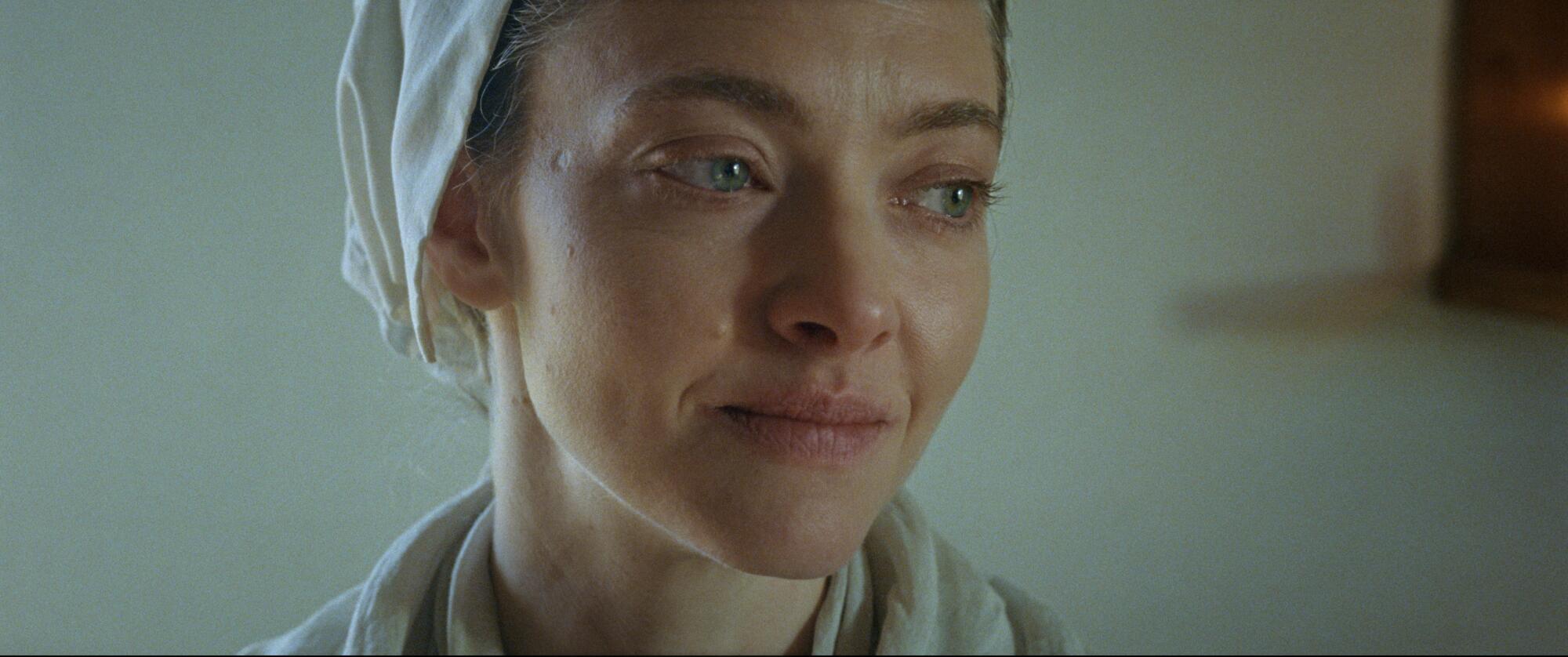
Amanda Seyfried in the movie “The Testament of Ann Lee.”
(Searchlight Pictures)
There is something uniquely tangible in the sequences of worship with song and dance, as if you feel it with your body as much as watch or listen with your eyes and ears. Each of the dance numbers feels distinctive while also serving some purpose in developing the story: from an early benefactor’s home or the deck of a ship, to a forest or meeting house.
Rather than spinning off in different directions, “The Testament of Ann Lee” is held together by the resonant and committed performance of Seyfried, who continues to prove herself an actor of astonishing depth. Also currently in the domestic thriller “The Housemaid,” she has shown a tremendous range and versatility, from musicals (“Les Misérables”) to her Oscar-nominated role in “Mank” and Emmy-winning turn in “The Dropout.” (Plus, she is a delightful presence on the talk-show circuit as just herself.) Here, Seyfried captures the inner conflict of Ann Lee’s torment and trauma along with the ecstatic release of her religious practice.
While “The Brutalist” was nominated for 10 Academy Awards, “The Testament of Ann Lee” has already been excluded from several shortlists in categories where it would seem easily competitive: score, original song and cinematography. It’s a healthy reminder that, while it is heartening when worthwhile accomplishments receive awards recognition, when a film does not find favor with voting bodies, the strength and conviction of the work remains. The revelations of “Ann Lee” will long outlast the storms of any given awards season.
A gesture that is seen throughout the film is for Seyfried to reach out, arms outstretched. (It has become a key image in the promotion of the film as well.) This sense of grasping for more, reaching out to something just out of range or possibly not even there, is central to the movie. Stretching to make a film of this scale, ambition and vision, Fastvold has grabbed hold of something genuinely singular.
‘The Testament of Ann Lee’
Rated: R, for sexual content, graphic nudity, violence and bloody images
Running time: 2 hours, 17 minutes
Playing: Now in limited release