
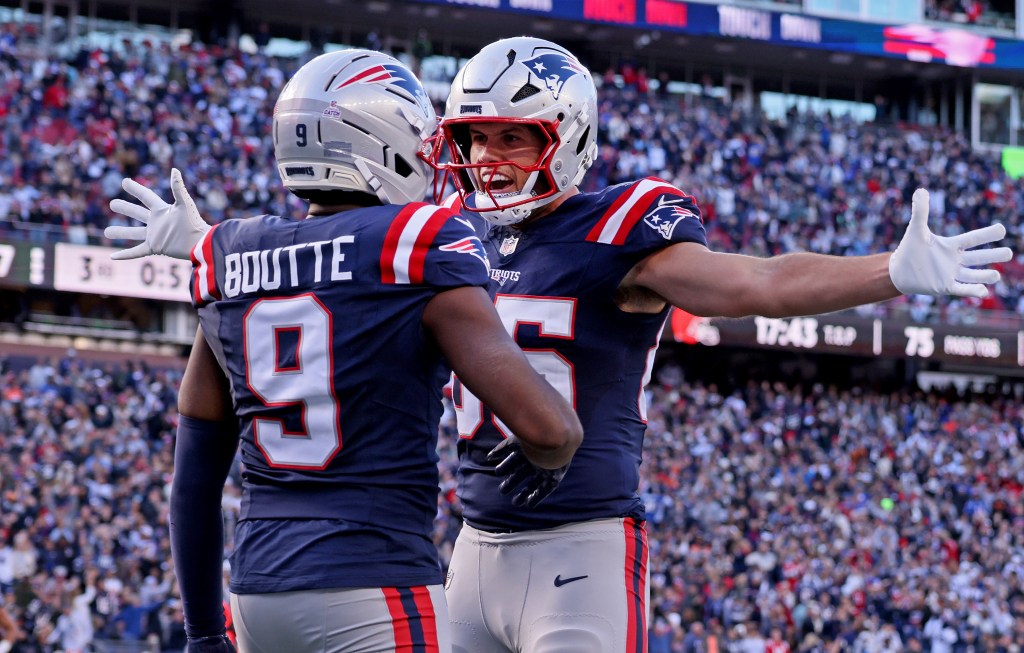
Set to make his NFL playoff debut on Sunday, Kayshon Boutte has come a long way since he “lost it all” to sports gambling, as public health leaders credit the Patriots wide receiver for changing lives.
Boutte is opening up about the challenges he confronted when betting took over his life after he broke his ankle during his promising sophomore season at LSU following a standout freshman campaign.
The third-year Patriot has admitted to losing $90,000 on bets because of an unrelenting gambling addiction, causing the then-20-year-old to go “completely broke” and live “paycheck to paycheck” while in college.
In his first training camp with New England in 2023, Boutte says he strongly considered giving up on his NFL dream, feeling mentally, emotionally and physically drained.
But that’s not how the story ends.
In a personal essay for The Players’ Tribune, titled “How The Hell Did I Get Here???,” Boutte writes about how he considers himself a changed man after overcoming his addiction. He says recovering from his ankle injury to play football again and becoming a father, as a junior in college, are the “only two things” that saved him.
Public health leaders and gambling treatment specialists across Massachusetts are applauding Boutte for coming forward with the essay published this week and spotlighting his recovery journey.
Gambling addiction, referred to by specialists as “problem gambling,” is a public health issue that affects “millions of people” in the Bay State and across the country, according to Victor Ortiz, who heads the Office of Problem Gambling Services, under the state Department of Public Health.
The addiction is “strongly connected to mental health, substance use, and suicide,” Ortiz said.
“Every person struggling with gambling who speaks out is changing the lives of so many others by reminding them they are not alone and that there is hope,” Ortiz told the Herald on Thursday. “Kayshon using his platform to share his story is courageous and will make a dramatic difference for those struggling with problem gambling.”
Boutte, now a 23-year-old who has become a top downfield target for MVP-contending QB Drake Maye, said Thursday that he was “instantly” into the idea of telling his story when The Players’ Tribune asked him if he’d be interested.
“It’s always good to talk about what you went through,” Boutte told reporters at Gillette Stadium. “I think that’s what makes you who you are today. … It wasn’t no second opinion, no second doubt about doing it.”
Opening up about addiction isn’t easy, according to experts who spoke with the Herald on Thursday.
“Kayshon Boutte’s story is raw, and it is real,” Massachusetts Gaming Commission Chairman Jordan Maynard said. “It’s hard to admit suffering from addiction. It’s even harder to seek out help and then turn success into a cause that benefits others. It shows that even a playoff-bound star wide receiver can face gaming harms.”
Maynard highlighted how the state’s betting regulator continues to require operators to provide Massachusetts residents with budgeting tools, cool-off periods, and the ability to “self-exclude.”
A leading national clinical provider of specialized treatment for gambling addiction is also catching onto Boutte’s essay. Elliott Rapaport, the CEO and founder of Birches Health, said that many of the clients his organization serves have delayed seeking help because they believe the issue should be “handled privately or not at all.”
“Stories like Kayshon’s help shift that mindset,” Rapaport said. “They give young men permission to ask for help and reinforce that gambling addiction is a treatable behavioral health disorder, not a personal failing. Recovery is possible with the right support.”
Boutte’s writing highlights the contrast between the reality of those confronting gambling addiction and how sports betting is advertised as an “exhilarating and highly social activity,” said Mark Gottlieb, the executive director of Northeastern University’s Public Health Advocacy Institute.
“In 2026, it is time to set some limits on the kinds of products offered,” Gottlieb said, “and to make online sports gambling safer for all of the young men like Kayshon Boutte who are suffering alone and in pain.”
In his essay, Boutte writes that gambling is “just gonna keep getting bigger and bigger” and that “people who are in a dark place, they’re gonna use it to escape,” pointing specifically to athletes.
Marlene Warner, CEO of the Massachusetts Council on Gaming and Health, described Boutte’s story as “heartbreaking, but not surprising,” given how mobile gambling has made it “far too easy for young people to slip into repetitive and risky behavior.”
That’s exactly how Boutte fell victim – his phone was always with him. “All day. All night,” he wrote.
“I had insomnia,” the wide receiver explained, “so if I woke up in the middle of the night, phone next to the bed, I’d bet. Any little money I had, it was going straight to FanDuel.”
College students are easily susceptible to betting, Warner said, as their prefrontal cortex – the part of the brain responsible for impulse control and decision‑making – is still developing.
“Kayshon’s story should be a call to action: to take gambling education at the high school and college levels seriously,” Warner said, “and to regulate out advertising that targets vulnerable populations.”
The Gándara Center in Springfield runs a “Youth Prevention of Problem Gambling PhotoVoice program,” which helps young people understand the risks of gambling before harmful habits can form. Lessons focus on financial awareness, critical thinking and healthy decision-making skills.
“At Gándara Center, stories like Kayshon Boutte’s matter,” Amanda Lesnick, vice president of support services, said, “because they tell the truth about how addiction often begins long before people recognize it as a problem.”
In January 2024, after his first season, Boutte was arrested on underage gambling and fraud charges for betting while at LSU. Louisiana officials dropped the charges in July 2024 after the receiver completed a gambling awareness program and executed self-ban agreements in Massachusetts and with several sportsbook companies.
Boutte says he owes “everything” to the Patriots organization for trusting him to grow. Helping New England to an impressive 14-3 turnaround, the LSU product recorded 33 catches, 551 yards and six touchdowns in the regular season. He posted the NFL’s fourth-best 16.7 yards per reception among qualified players.
“I’m in my third year, just helping this team get back to its winning ways,” Boutte wrote in his essay. “Man, we about to have a playoff game in Foxborough for the first time in 6 years. Last time that happened, I was still in high school!!!”