
By simply standing, you’re revving up the demand on your abs.
Standing exercises are extremely popular—especially among older adults. In fact, they’re highly recommended for building strength and balance, activating many muscle groups at once, and channeling daily movements, like climbing steps and walking. Standing exercise can boost your coordination—plus, this form of training is easy on the joints. And that’s not all! With consistency, they can help you shrink pesky belly fat.
We spoke with Steve Chambers, Senior Certified Personal Trainer and Gym Manager at Ultimate Performance, who shares five standing exercises that will shrink belly pooch faster than gym machines after 55.
“Your core exists to stabilize your body while you are upright. Walking, lifting, bending, carrying shopping, getting up from a chair etc.—all of these require your abdominal muscles to work while you’re standing,” Chambers tells us. “The simple act of standing already demands core activation. Once you start adding load, movement, and instability, the demand on your abs increases dramatically. This is why standing core exercises are so powerful. They force your abdominal muscles to brace, stabilise, rotate, resist movement, and support your spine in real-world positions.”
Unlike exercises you perform when lying down, you can also work progressive overload into standing workouts easier by revving up the time under tension or weight.
“That progressive overload is essential if you want your muscles, especially your abs, to actually change,” Chambers explains. “After 55, this approach becomes even more important. You’re not just training for appearance as you might have done in your 20s and early 30s. Instead, you’re training for strength, balance, posture, metabolic health, and longevity. Standing core exercises deliver all of that in one package.”
5 Standing Exercises That Shrink Belly Fat
 Shutterstock
According to Chambers, it’s important to note that spot reduction is a myth and fat loss occurs throughout the body.6254a4d1642c605c54bf1cab17d50f1e
“Doing hundreds of crunches will not reduce the fat across your midsection unless your diet supports fat loss, which means eating in a calorific deficit,” Chambers says. “However, standing core exercises are exceptionally effective because they help you build muscle, raise energy expenditure, and strengthen the muscles that give your waistline shape and firmness as fat comes off.”
Farmer’s Walk
The farmer’s walk is one of the most underrated core moves. By carrying a set of heavy weights while walking, you’re forcing your core to stay braced and your torso to remain stable and tall.
“Farmer’s walks heavily recruit the abdominals, obliques, lower back, shoulders, and grip, all the while driving up your heart rate. That combination of muscular tension and cardiovascular demand makes them incredibly effective for fat loss,” Chambers explains.
Hold a heavy dumbbell or kettlebell—50% of your body weight—in each hand at your sides.
Start walking forward, keeping your torso still.
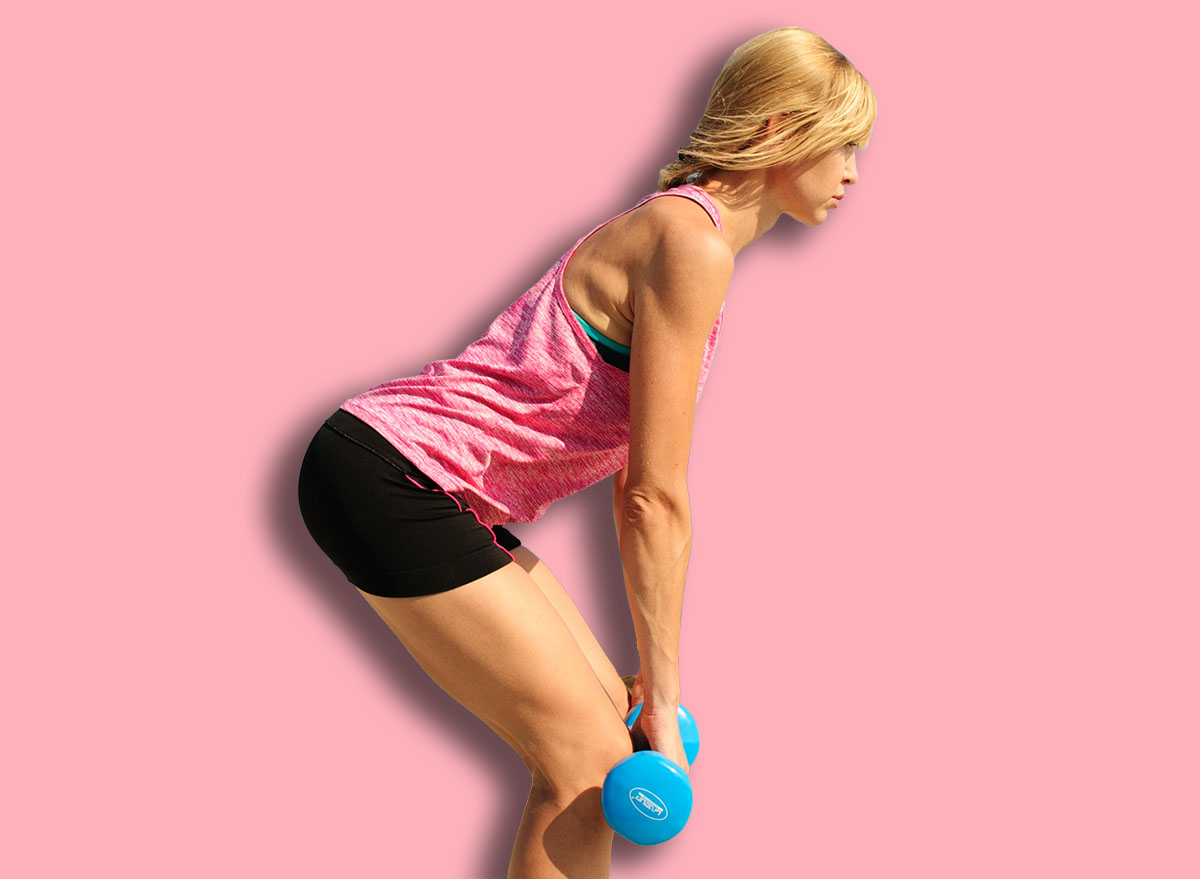
Deadlifts
Deadlifts may not seem like a classic ab workout, but Chambers says they’re one of the best core builders out there.
“Every repetition requires your abdominals and obliques to brace hard to protect your spine while your lower body generates force, and will improve your posture (which is a big concern as you get older,” Chambers tells us. “For people over 55, deadlifts are especially valuable because they help preserve muscle mass, strengthen the posterior chain, and raise metabolic demand, all of which are incredibly important since people over 55 face health problems such as sarcopenia (loss of muscle mass) and osteoporosis (bone weakening), both of which can negatively affect your posture. A stronger, more muscular body burns more calories at rest, which directly supports belly fat reduction.”
Stand tall, feet hip-width apart, holding a heavy dumbbell in each hand in front of your thighs.
Make sure your legs are mostly straight with just a slight bend in the knees.
Hinge at the hips to lower the dumbbells down your legs and toward the floor.
Keep your back flat and the dumbbells close to your body when lowering, feeling a solid stretch in the hamstrings.
Activate your glutes and hamstrings as you rise.
Squats
Squats are another essential exercise that should be prioritized. They fire up almost the entire muscular system, including your abs, which are constantly working to keep you balanced and upright.
“One of the most effective ways to maximize the core benefit of squats is to focus on bracing. In other words, taking a deep breath, tightening your midsection, and maintaining tension throughout the movement,” Chambers says. “This turns the squat into a powerful core-strengthening tool as well as a calorie-burning exercise.”
Stand tall with your feet shoulder-width apart.
Extend your arms in front of you or place your hands on your hips. Use a chair for support, if necessary.
Bend at the knees and hips as you lower into a squat.
Use control to descend until your thighs assume a “sitting” position or lower.
Press through your heels to return to standing.
Dumbbell Side Bends
“Side bends are an excellent way to directly target the obliques and the deep muscles that support the spine. Unlike many floor-based oblique exercises, side bends allow you to use meaningful load, making progressive overload possible,” Chambers points out. “This is particularly important after 55, when maintaining muscle mass around the waist helps improve posture, spinal support, and the appearance of the midsection as body fat decreases.”
Stand tall, feet hip-width apart, holding a light dumbbell in each hand.
Activate your core and slowly bend your torso to the right, lowering the right dumbbell toward your thigh while keeping your left arm by your side.
Return to the start position.
Slowly bend your torso to the left, lowering your left dumbbell toward your thigh.
Standing Woodchops
“Wood chops are another highly effective rotational movement. Performed with a cable, dumbbell, resistance band, or even bodyweight, they train the abs, obliques, shoulders, and upper back simultaneously,” Chambers says. “Because the movement pattern involves twisting under tension, wood chops challenge your core in ways that sit-ups and planks simply cannot.”
Hold a dumbbell with both hands and stand with your feet shoulder-width apart.
Lift the dumbbell toward your right side, keeping your arms straight.
Twist your torso, and carefully rotate your legs to bring the dumbbell down to your left.
Bend at the knees while dropping your hips to bring the dumbbell toward the ground.
Repeat by lifting the dumbbell back to the right and overhead.