
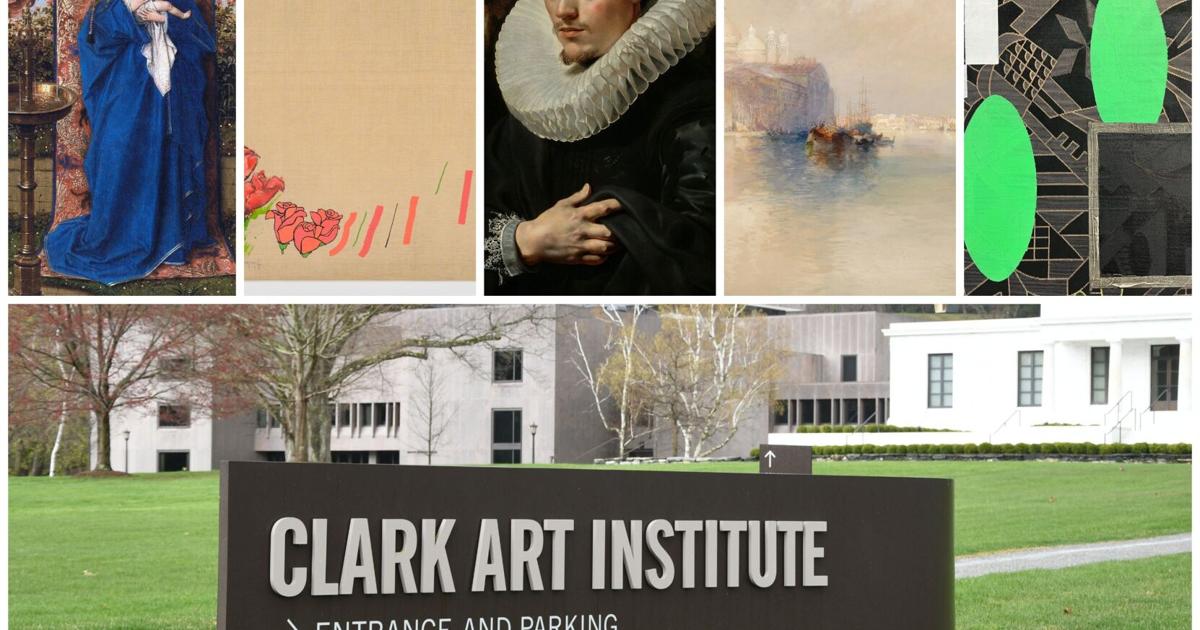
WILLIAMSTOWN — The Clark Art Institute will open a diverse slate of exhibitions in 2026, highlighted by the first public presentation of the Aso O. Tavitian Collection and installations by contemporary and international artists.
“We are eagerly anticipating the arrival of our 2026 exhibition series,” Olivier Meslay, Hardymon Director of The Clark, said in a statement. “From contemporary art both inside and outdoors to the European masterworks of the Tavitian Collection, this year promises to offer visitors extraordinary encounters with art across time and media.”
CONTEMPORARY KICK OFF
Sónia Almeida, detail from “Stages (Tracks, Cables, Vectors, Anchors),” 2025, oil on jacquard fabric, steel brackets, theater gel filters, and wood moldings.
COURTESY SONIA ALMEIDA
The year kicks off with “Sónia Almeida: Stages,” opening Feb. 14 at the Clark Center and Manton Research Center. Almeida, a Lisbon-born artist who lives and works in Boston, will present three site-responsive installations in public spaces across the museum. Combining printmaking, painting and fabric arts, Almeida’s richly textured works explore process, pattern and the choreography of viewing, with the subtitle “Stages” reflecting both the layers of her work and the ways audiences engage with it. The exhibition, curated by Robert Wiesenberger, curator of contemporary projects, will remain on view through Jan. 24, 2027, and is free to the public.
ASO O. TAVITIAN COLLECTION
Peter Paul Rubens, “Portrait of Young Man,” c. 1613-1615, Oil on panel. Clark Art Institute, gift of Aso O. Tavitian Foundation.
THE CLARK ART
In June, The Clark will debut “An Exquisite Eye: Introducing the Aso O. Tavitian Collection,” which draws from the 331 works gifted to the museum by the foundation of the late collector and philanthropist Aso O. Tavitian in 2024. The exhibition highlights European art from the Renaissance through the 19th century, including paintings, sculpture and decorative arts by artists such as Jan van Eyck, Andrea della Robbia, Gian Lorenzo Bernini, Peter Paul Rubens, Jean-Antoine Watteau and Jacques Louis David.
Born in Bulgaria of Armenian descent, Tavitian immigrated to the United States in 1961. Beginning in 2004 and continuing until his death in 2020, he assembled one of the most significant private collections of European art in North America. “An Exquisite Eye” is the first public presentation of selected works; the full collection will be installed in 2028 with the opening of the new Aso O. Tavitian Wing. The exhibition is curated by Esther Bell, deputy director and chief curator, and Lara Yeager-Crasselt, the Aso O. Tavitian curator of early modern European painting & sculpture.
‘PATHS IN THE FOREST’
Giorgio Griffa, “Rosa,” 1968, acrylic on canvas.
Courtesy of the Fondazione Giorgio Griffa and Casey Kaplan, New York
Also in June, the Lunder Center at Stone Hill will host “Giorgio Griffa: Paths in the Forest,” the first solo U.S. exhibition of the Italian contemporary artist. Griffa, who turns 90 this year, is known for his unprimed, unstretched canvases covered with lines, letters and numbers painted in acrylic. The survey examines 13 painting cycles, exploring the material and conceptual limits of his work. The exhibition is curated by Wiesenberger and supported by the Edward and Maureen Fennessy Bousa Fund for Contemporary Projects and the Italian Ministry of Culture.
‘COASTLINES’
Thomas Moran, “View of Venice, 1887,” watercolor and gouache on paper. The Clark, gift of Mary Carswell.
THE CLARK ART
The Clark’s summer exhibitions also include “CoastLines: American Prints and Drawings,” opening July 4 in the Eugene V. Thaw Gallery for Works on Paper. The show features 19th- and 20th-century watercolors, etchings, drawings, lithographs and wood engravings that depict the eastern U.S. coastline, highlighting both the artistic line and the region’s cultural and economic history. Curated by Hannah Chew, a graduate student in the Williams College/Clark Graduate Program in the History of Art, the exhibition runs through Sept. 27.