
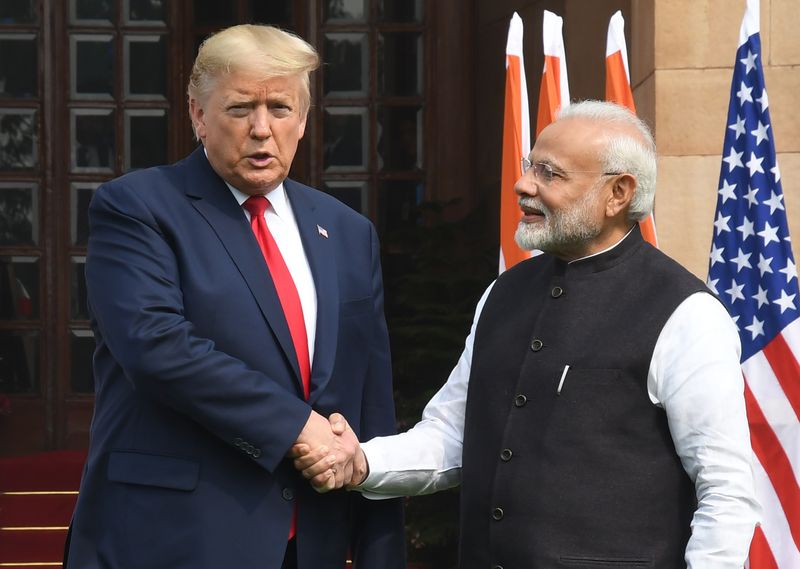
FOR the first time since India’s 1998 nuclear tests, when the US imposed sanctions and the two governments virtually stopped talking to each other, India’s relations with its most powerful partner have hit a dangerous new low. In the last few days, the taunting has come from the highest echelons of the White House, portraying PM Modi as a supplicant. “Sir, may I call you,” the PM is supposed to have asked President Trump. Yes, America’s Great White Hope is believed to have answered.
Last time a Prime Minister — Dr Manmohan Singh — was seen as genuflecting to an American President (when in 2008 he told George W Bush, ‘India loves you’), the country had exploded in righteous anger. Only 24 hours ago, the Ministry of External Affairs denied Modi’s supposed comment. But it has been awful to watch the descent into the abyss.
To see the Indian elite, the unique and great inheritors of a civilisation that connects back to a hoary past, ridiculed and mocked by America because Delhi dared to protect its own national interests — in this case, refuse to lower tariffs on certain agricultural commodities and refuse to stop buying cheap Russian oil — has been deeply disquieting.
As US Commerce Secretary Howard Lutnick told a journalist, the US gave India “three Fridays,” or three weeks, to agree to the trade deal with the US. Modi was supposed to personally call Trump to sign off. But the PM didn’t make that call. When the Indian side finally got back, Lutnick told them it was “too late”.
Certainly, none of this is new. India is — especially — used to Western leaders dressed up as emperors throwing their weight around. Inside the Ministry of External Affairs as well as outside, everyone understood the hypocrisy that was waged by the Big Powers, especially during the Cold War; the media revelled in exposing them.
The problem is that at least for the last 20 years or so, India thought it was on the same side as the Americans. We got their jokes, our kids went to their colleges — Indian parents scrimped and saved to buy the golden dollars to send them — and our IT whiz generation won the H1-B lottery to make America great again and again.
We were equals. Or at least we thought we were.
External Affairs Minister S Jaishankar, who is easily one of the smartest men in Modi’s Cabinet, was part of the transformation from the old India to the new, because as one of India’s top diplomats he was trained to be friends with people on both sides of the fence. Jaishankar’s father, K Subrahmanyam, back in 1971, had ticked Henry Kissinger off for America’s “great tilt” towards Pakistan in the run-up to the Bangladesh war. (Why, Subrahmanyam told Kissinger, would you support Pakistan when millions of East Pakistanis are streaming into India escaping the massacres carried out by the Pakistan army, about ten million at last count, and don’t you remember what the Jews, your own community, had gone through with Hitler?)
In the new world order, Jaishankar was perfectly positioned to explain India’s unique position as an ancient nation with a long memory of colonisation to a global audience shaken up by Trump.
So what went wrong? Why is Trump’s America laughing at Modi’s India when we were both supposed to be on the same side, not least as we sought to save the world against China? Why are our new best friends turning against us?
There are many answers, some pleasant, some not so convivial. First, Trump’s ego — he believes the world must permanently kowtow in his direction. But when Modi refused to call Trump back to sign off on the trade deal, the Americans turned the screws differently — they put out that there would no longer be such a deal, and India would be slapped with 500 per cent tariff for buying Russian oil.
India became so nervous as a result that, among other things, it even refused to condemn the US capture of Venezuelan President Nicolas Maduro. The words, “territorial integrity and sovereignty,” that have for decades been a sort of moral anthem for India, which were also used to chastise Russia for its invasion of Ukraine, were simply dropped for the US.
Second, it is increasingly clear that India is not relevant to Trump’s world view. He is not interested — as previous US administrations for several decades, including the Democrats who brought India into the de facto nuclear fold by signing the Indo-US nuclear deal in 2008 — in shoring India up so that it can be the local hegemon that contains China. Trump is certainly concerned about China’s rise, but he has publicly said he will directly deal with Beijing.
Third, Trump doesn’t care that India, an old friend, ally and rising regional power, is upset. He does not remember that Modi in 2019 bailed him out in his own election by exhorting the Indian diaspora with the slogan, “Abki baar, Trump sarkar.” It is said that he won’t forget that Modi refused to also see him when he came to the US in 2024 to meet the Bidens. He hates the fact that India has publicly denied, several times, that he did not broker the end to the Op Sindoor standoff.
India is in a worrisome foreign policy spot today. The Americans are toying with Delhi. The Chinese are brooding and watching on the northern border. Bangladesh, the country that India helped liberate, is angry that its favourite cricketer is persona non grata — they have decided not to play matches in India during the coming T20 World Cup. India’s enemy, Pakistan, is cosying up to the Americans. UAE President Mohamed bin Zayed Al Nahyan paid his maiden official visit to Pakistan in the last week of December. South America is unlikely to forget India’s prevarication on Venezuela. Nepal is in a crisis.
That leaves Russia and Western Europe and Israel and Iran. Iran’s Foreign Minister Abbas Araghchi is likely to visit Delhi in the coming week. Maybe Delhi can begin the clawback from the abyss with him. But here’s the other problem : If it does, Trump is likely to be even more furious.
The new year is already turning old in Delhi.