
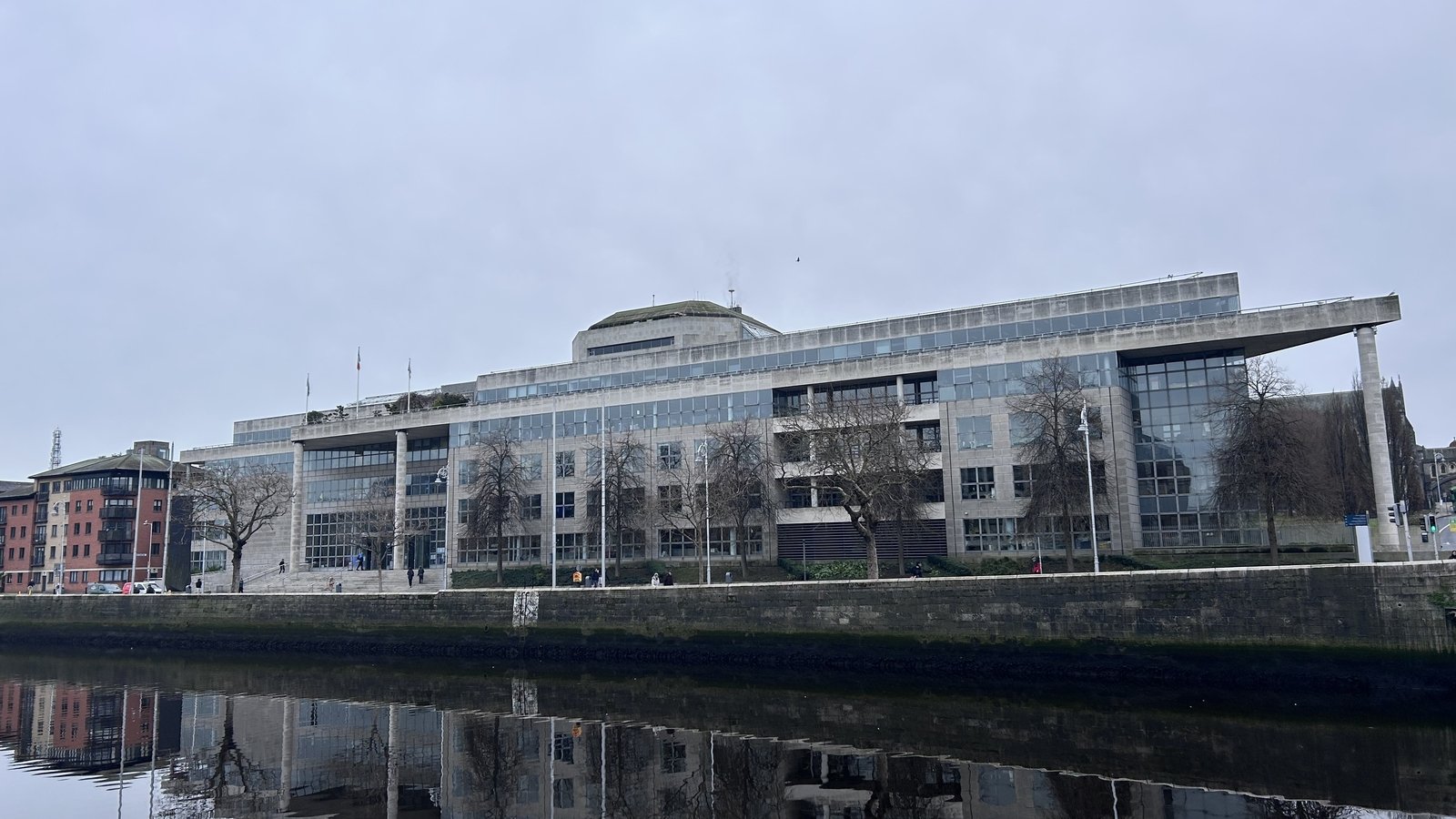
Councillors have called for more details about plans by Dublin City Council to leave its headquarters on Wood Quay and replace the controversial office block with social housing.
The council said the cost of retrofitting its current civic offices to meet its climate commitments could cost up to €400m and that it is in talks to relocate to the site of the former DIT Kevin Street.
It is almost 50 years since major protests took place in the capital against plans by Dublin City Council to build new civic offices on a Viking settlement discovered on Wood Quay.
The campaign of opposition was ultimately unsuccessful and the project was completed in 1994.
Now, after just four decades using the site as its headquarters, Dublin City Council said it wants to leave Wood Quay because it says upgrading the offices to meet climate targets could cost up to €400m.
Dr Pat Wallace, the former Director of the Wood Quay Excavation and the National Museum of Ireland, said he was astonished by the plans and said moving the council head office from Wood Quay would be unconscionable.
“They compromise 1,000 years of Dublin’s heritage to get those buildings built and now after 40 years, they’re not good enough! That’s just not conscionable.
“They should be stopped from doing that, and these should be rectified in whatever way they are to become the civic offices of the city of Dublin. It’s unthinking that they would leave them aside. They spend so much time, so much pressure, so many court cases, it cost millions.”
He said the Wood Quay excavation was one of the world’s most significant archaeological discoveries from the Viking era and that part of the site has still not been excavated.
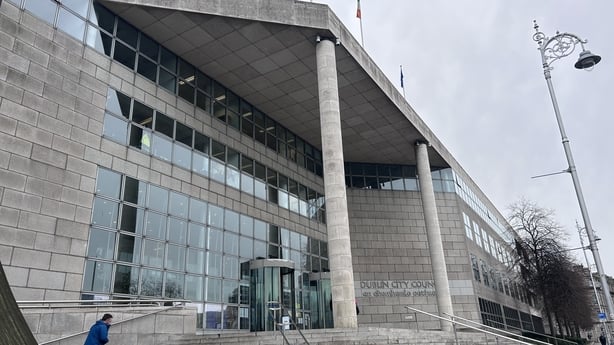
The Dublin City Council’s offices are built on a Viking settlement on Wood Quay
“What we learned in Wood Quay is the buildings, the shapes, the makes, the composition, the layouts, the position of buildings and plots, streets, ways, pathways, all from the late Viking Age, from the 10th and the 11th century. Nowhere in Europe matches that.
“We found the dockside of the Normans, again the most extensive waterfront excavations, probably in Britain or Ireland. We have the best collection of ships’ timbers in northwest Europe of the late 11th century, all from this exploration. So this is the richest archaeological urban Viking and Anglo-Norman site anywhere.”
Dr Wallace said he believes the offices should be retrofitted and remain at the site.
“These should be rectified in whatever way they are to become the civic offices of the City of Dublin. That’s what they were built as, that’s what they were sold as. So they should think again.”
Dublin City Council said it is in “exclusive” talks to buy the former DIT on Kevin Street, now known as Camden Yard, for its new headquarters.
The site, which has planning permission for 38,000 square metres of offices and almost 300 apartments, went into receivership over a year ago and the reported price tag is around €100m.
In a statement, the council said: “Retrofitting the existing civic offices at Wood Quay to meet climate commitments is currently estimated to require €350-€400m.
“Relocating from Wood Quay would unlock the potential for in excess of 500 public homes on the current Civic Offices site, while enabling modern, sustainable workplaces for staff and improved public services for citizens.
“Developing modern, energy‑efficient accommodation at Camden Yard would significantly reduce our operational emissions while freeing the Wood Quay site for much‑needed public housing. Heads of Agreement have been signed to facilitate a 10‑week due diligence period.
“The acquisition would enable the delivery of a new civic offices and up to 300 public homes on the Camden Yard site.”
However, a number of councillors have called for more detail on the plans which they said were not discussed with them in advance.
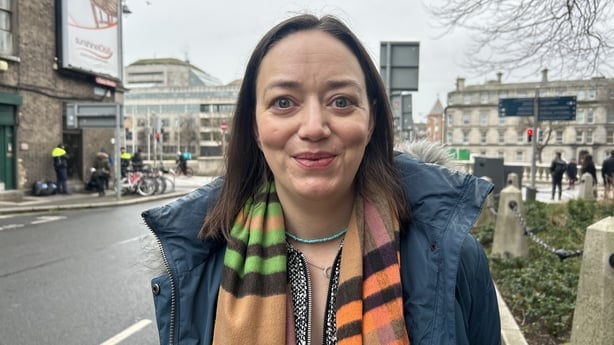
Janet Horner said it is not good leadership from public bodies to be abandoning old buildings
Green Party group leader Cllr Janet Horner, who is part of the ruling coalition on Dublin City Council, said public representatives have many questions about the proposals.
“I was very surprised when I read the news firstly, as it hadn’t come to us initially as councillors. I think it’s obviously a huge move for the city, it’s a huge financial undertaking for the city council. Looking at the figures, it’s one of the biggest projects I think I’ve ever seen come across a desk in the city council.
“So there’s a lot of questions around whether it makes financial sense for us to be looking at that, what the logic is for it, and what the what the future implications are.
“There’s a Buildings Directive, which we know a lot of public buildings are going to have to be retrofitted in the next number of years. But what we don’t know is how that is going to be financed at the moment.
“If the city council is left to foot the bill entirely on their own for this, it does make financial sense for them to buy new offices instead of retrofitting old ones. But it is not good leadership from public bodies to be abandoning old buildings without a plan and to be investing in new ones.
“If we want to see proper leadership from public bodies and really from the Government, we need to see a sizeable amount of budget allocated for the retrofitting of public buildings so that this isn’t the start of a trend where every public body now is saying, ‘okay, well, let’s just leave our own building behind and buy a brand new office block somewhere else’.
“In the last government, the climate fund allocated €1.2bn for the retrofitting of public buildings to ensure that they could be brought up to the standards needed for energy efficiency. That fund no longer exists under this Government, and that’s really worrying,” Ms Horner said.
The council said vacating Wood Quay would unlock the site for 500 public homes but experts say it would be extremely challenging to convert the current office blocks to housing and that demolition of the civic offices is the more feasible option.
However, David O’Connor who is a member of the Royal Institute of Irish Architects and who was involved in the original competition to build part of the civic offices and who later went on to be CEO of Fingal County Council, said he was surprised by news of the plans and said he would be upset if the civic offices need to be demolished to make way for social housing.
“I was part of the Inner City Renewal group who looked after rebuilding the city in the 90s, because the city was fairly devastated, particularly along the quays with a lot of dereliction and this site here was empty.
“This was a big gap in the quays so the city felt it was important to make its own contribution back into the city by filling up the gap.
“I think it’s very commendable that the city will be putting housing as their first priority. The strategy about how they go about that is complicated. The original two buildings, block one and two, were very much of their time and artificially ventilated, whereas this [front building] is a naturally ventilated building, and also is very innovative. It would be a pity to lose that for this building, which would stand up to commercial use as an office building very well,” explained Mr O’Connor.
He said it would be a significant challenge to convert the current offices to housing and that they would likely have to be demolished to make way for the planned social homes.
“You could look at turning them into housing. It would be a pretty considerable challenge. But Dublin city intended always that this will be used as their headquarters from the 1940s. It was the 1980s before they got the first phase finished, and the second phase, which was an architectural competition, was finished in the early 90s.
“I can’t see advantages gained by not continuing to use them as they are, because they work for what they are. The thought of having to demolish them, really I think would upset me. The loss of the carbon that’s embedded in these buildings is very significant, and the City Council itself is very reluctant to allow demolition in any event. So the thought that they would demolish them, is difficult to understand.”
The Trade Union Fórsa said there has been no engagement with hundreds of its members who work in Wood Quay and they want immediate clarity about the plans.
“As the largest trade union in Dublin City Council there has been no engagement with us at all on this really important matter, leading to grave concern and uncertainty amongst the workforce, despite management having had the opportunity, in clear contravention to industrial relations norms. We are calling on management to provide immediate clarity and engage in meaningful discussions,” said Fórsa.
Dublin City Council management is due to brief councillors ahead of tomorrow’s monthly meeting.