
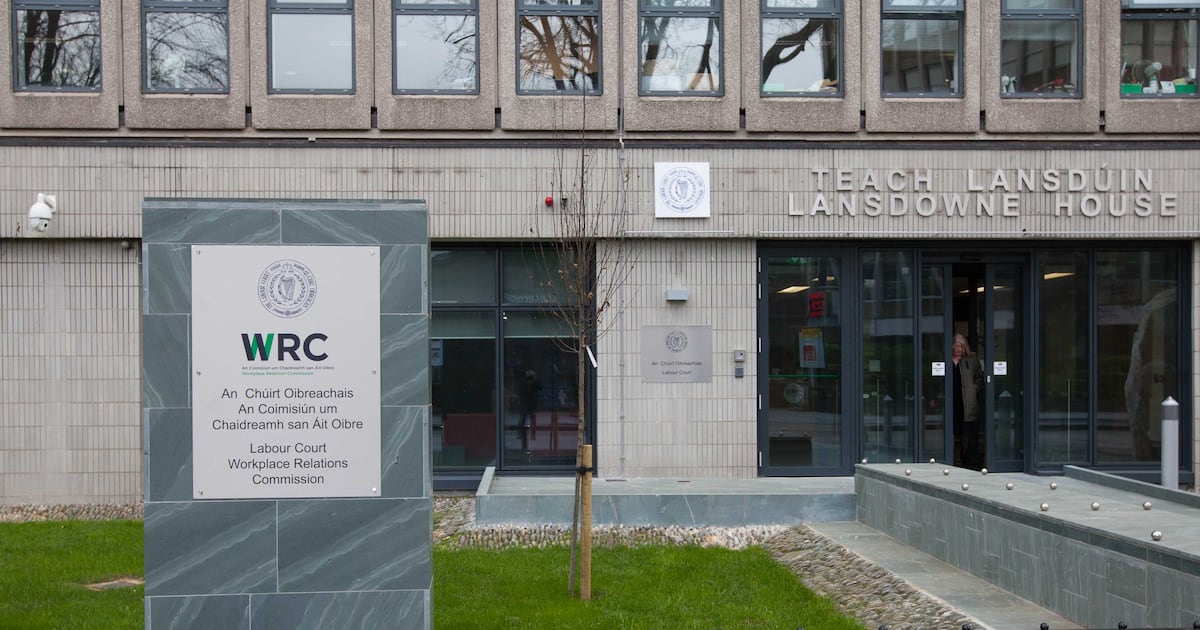
The Workplace Relations Commission (WRC) and the Labour Court – two key State agencies involved in dealing with industrial relations – expressed strong concern about a lack of engagement before the Government launched its new plan on collective bargaining rights.
Minister for Enterprise Peter Burke announced a new strategy in early November to promote and protect collective bargaining between employers and unions.
The plan was drawn up by the Department of Enterprise, Tourism and Employment in collaboration with the Irish Congress of Trade Unions (Ictu) and employers’ group Ibec.
The publication of the plan on November 5th featured comments from Taoiseach Micheál Martin, Mr Burke and Minister of State for Employment and Small Business Alan Dillon.
However, in complaints to the department, the Labour Court and the WRC said they had not been told in advance about the launch and had only learned about it in the media.
The Labour Court said unions and employer representatives had been given a draft of the plan some time earlier and given notice about the announcement.
The department said it had to consider a number of issues including Cabinet confidentiality and “responsibilities to the social partners who prepared the plan with us”.
The WRC told the department it had not had “any foresight into the fact that this significantly important action plan was being published”.
In an email to the department’s secretary general, Declan Hughes, on the day the plan was published the WRC’s chief executive, Audrey Cahill, said the “lack of engagement, insight, consultation and communication” with her organisation about the plan presented a “challenge”.
“The first time any of us have seen the plan and the commitments set out on behalf of the WRC is when we printed it on arrival to the office this morning,” she said.
“The first we knew of the launch was through the media this morning the same as every other member of the public.
“The functions of the director general are clearly set out in section 14 of the Workplace Relations Act 2015 and are not ambiguous in terms of my role to manage and control the business of the Commission.
“It is disconcerting that I would be excluded in the way that I have been in this instance but be expected to deliver the plan to a high standard.
“It would be my view that this entire matter raises serious questions for us in relation to risk and governance. Notwithstanding the risk to my own professional integrity where I am not well read into matters as important as this when facing my stakeholders on a day-to-day basis.”
She said the WRC intended to play its full part in supporting the action plan.
Labour Court chairperson Louise O’Donnell told Mr Hughes in a separate letter how it was disappointing the court only became aware of the plan’s launch through the media, “particularly in circumstances where we attended a management board meeting two days ago [and] a number of the court’s slides were in respect of collective bargaining”.
She said the Labour Court was included in the plan under several headings in the report, but its input was only sought in respect of one area, technical assessors.
“It’s difficult to see how this ties in with the department’s strategic plan and the commitment to support the work of the court,” Ms O’Donnell said.
The approach suggested the department did not see the Labour Court as a stakeholder in the industrial relations environment, she said.
Ms O’Donnell said she understood that other stakeholders had received drafts of the plan “some time ago” and were given a “heads up” about the announcement.
“It’s unfortunate that the same courtesy could not have been extended to the court,” she said.
In reply to Ms O’Donnell and to Ms Cahill, Mr Hughes said: “The timing of Government decisions is not exact, and we are required to balance a number of important objectives including Cabinet confidentiality, the needs of our Ministers and our responsibilities to the social partners who prepared the plan with us.”