
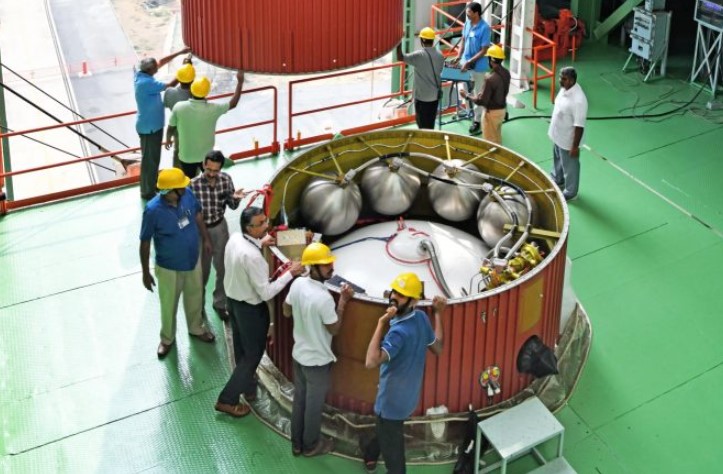
India’s space agency is preparing for one of the longest missions undertaken by its workhorse Polar Satellite Launch Vehicle (PSLV), which is scheduled to lift off at 10.18 a.m. on Monday, 12th January, from the first launch pad at Sriharikota in southern India.
The countdown for the PSLV mission, which will place 16 satellites into orbit, began on Sunday afternoon and is progressing smoothly, an Indian Space Research Organisation (ISRO) official said, requesting anonymity.
The rocket, designated PSLV-C62, will carry a strategic earth observation satellite developed by the Defence Research and Development Organisation (DRDO), along with 15 smaller satellites belonging to Indian and international customers.
This mission marks India’s first space launch of 2026 and is expected to last about 108 minutes—one of the longest flights for a PSLV. If successful, India’s tally of foreign satellites launched using its rockets will rise to 442, all on a commercial basis.
The mission is fully commercial and is being executed by NewSpace India Ltd (NSIL), ISRO’s commercial arm. The primary payload is DRDO’s Anvesha, also known as EOS-N1, a hyperspectral earth observation satellite.
Anvesha is equipped with advanced hyperspectral sensors capable of capturing hundreds of narrow spectral bands per pixel, enabling the detection and identification of materials invisible to the naked eye. In strategic applications, the technology allows for improved surveillance of camouflaged military assets, troop movements, vehicles, concealed weapons, and other defence-related targets.
The launch assumes added importance following a series of setbacks in recent years. On May 18, 2025, PSLV-C61 failed mid-flight while carrying EOS-09, resulting in losses estimated at Rs 850 crore. Earlier, on January 29, 2025, GSLV-F15 failed to place the NVS-02 navigation satellite into its intended orbit due to a pyro valve malfunction, causing losses of about Rs 300 crore. Additional failures in previous years included GISAT-1 in 2021 and IRNSS-1H in 2017, together contributing to significant financial and opportunity costs.
For Monday’s launch, ISRO will use the PSLV’s DL variant, which features two strap-on booster motors. This configuration was first flown in January 2019 to launch the Microsat-R satellite. In its standard form, the PSLV is a four-stage rocket using alternating solid and liquid propulsion, typically aided by six strap-on boosters during lift-off.
During the countdown, liquid propellants will be loaded and all onboard systems will be thoroughly checked and monitored.
About 16 minutes into the flight, the rocket’s fourth-stage engine will shut down and coast briefly. Around 17 minutes after lift-off, Anvesha/EOS-N1 and 14 co-passenger satellites will be deployed into orbit at an altitude of about 511 km.
Among the payloads is AyulSat, a technology demonstration satellite developed by Indian startup OrbitAid. Designed as a prototype in-orbit refuelling system, AyulSat aims to extend satellite lifespans, reduce mission costs, and help curb space debris.
The PSLV’s fourth stage will later be restarted to alter its orbit for atmospheric reentry. About 88 minutes after engine cut-off, the stage will perform a de-boost manoeuvre, carrying with it the Spanish Kestrel Initial Technology Demonstrator (KID) capsule developed by startup Orbital Paradigm.
KID, which does not have a parachute and will not be recovered, will transmit payload data before reentering Earth’s atmosphere. The system is intended as a precursor to a reusable cargo capsule capable of carrying up to 120 kg and remaining in orbit for up to three months.
According to ISRO, the KID capsule will be ejected at an altitude of about 504 km roughly 108 minutes after lift-off. Both the capsule and the PSLV fourth stage are expected to reenter Earth’s atmosphere and impact the South Pacific Ocean.
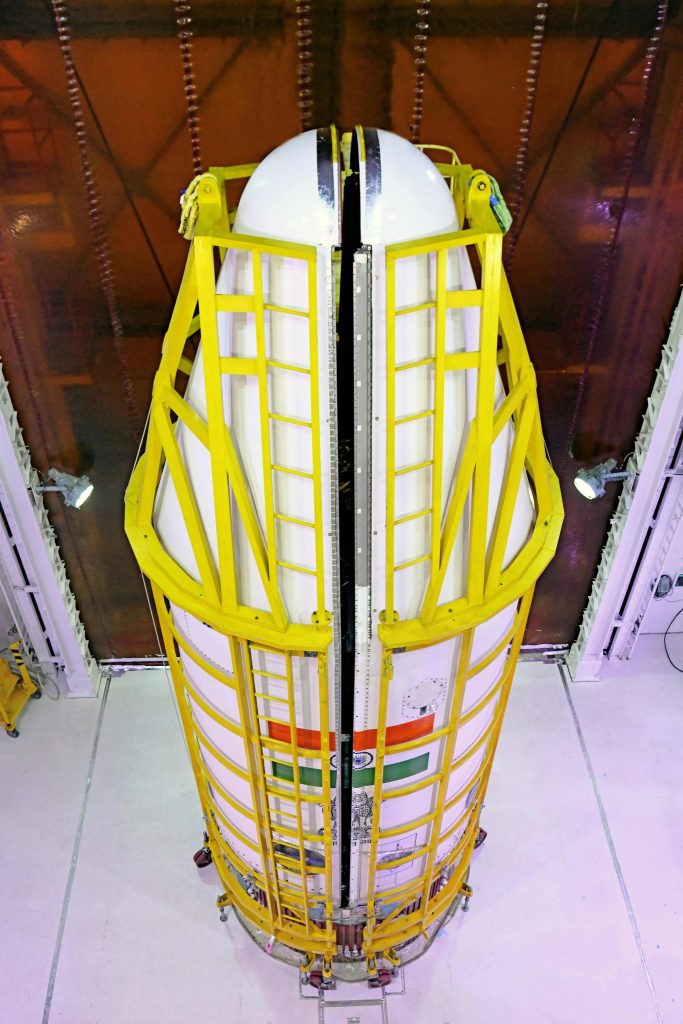
Image Credit: ISRO
 Published by Venkatachari Jagannathan
V.Jagannathan (Byline Venkatachari Jagannathan), is a freelance journalist based in Chennai, India covering the country’s space, nuclear, insurance, automobile and several other industries. Jagannathan was with IANS newswire, one of India’s premier news agencies and his articles – news, news analysis, interviews, profiles and others- on various sectors were published in several leading print, online publications within and outside India. He was also with India’s first online business magazine www.domain-b.com. A school and college chess player Jagannathan also writes about Indian chess and has covered World Chess Championships, Chess Olympiads and others.