
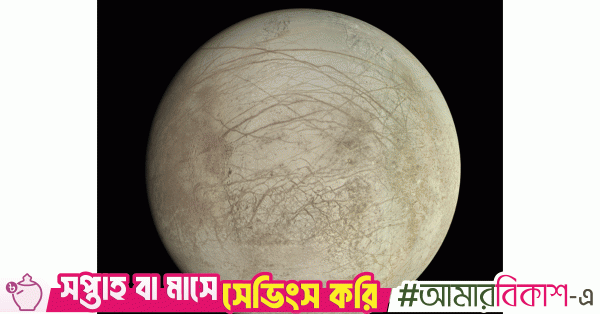
Europa, one of Jupiter’s moons long considered a promising site for extraterrestrial life, may not have the conditions necessary to support life, according to a new study. Despite its vast subsurface ocean, scientists say the moon’s rocky seafloor is too rigid to allow tectonic or volcanic activity that could generate essential nutrients and chemical energy.
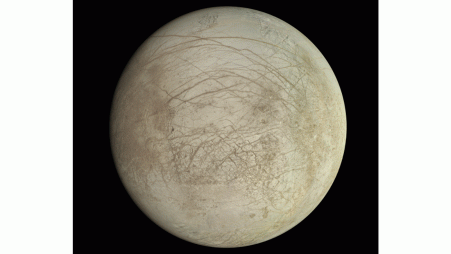
Europa is unique in the solar system because it possesses liquid water, organic compounds on its icy surface, and energy from Jupiter’s strong gravitational pull. Its salty ocean is believed to contain nearly twice the volume of all Earth’s oceans combined.
However, researchers found that cracks or fractures on the seafloor are likely minimal, limiting the chemical interactions needed for sustaining life.

Keep updated, follow The Business Standard’s Google news channel
Planetary scientist Paul Byrne of Washington University in St Louis noted that tectonic activity on Earth exposes new rocks to water, triggering chemical reactions that produce elements like methane, which microorganisms use.
Without similar processes on Europa, life would find the environment extremely harsh.
Europa, measuring about 3,100 kilometres in diameter — roughly a quarter of Earth’s size — is covered by an icy crust estimated to be 15 to 25 kilometres thick, under which lies a 60 to 150 kilometre deep ocean.
The moon ranks fourth among Jupiter’s 95 officially recognised satellites.
Geologist Christian Klimczak of the University of Georgia said hydrothermal activity, such as underwater volcanoes, deep trenches, or black smokers, is unlikely on Europa, though he remained hopeful that future missions might challenge these findings.
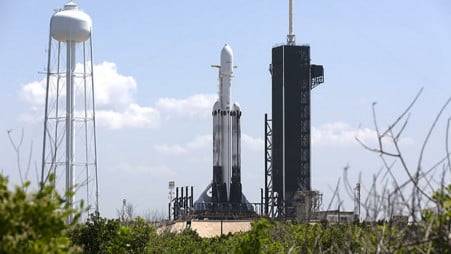
NASA’s Europa Clipper spacecraft, launched in 2024, aims to explore the moon and investigate whether it can support life. The mission will conduct multiple close flybys beginning in 2031 to study the mysteries hidden beneath Europa’s icy surface.