
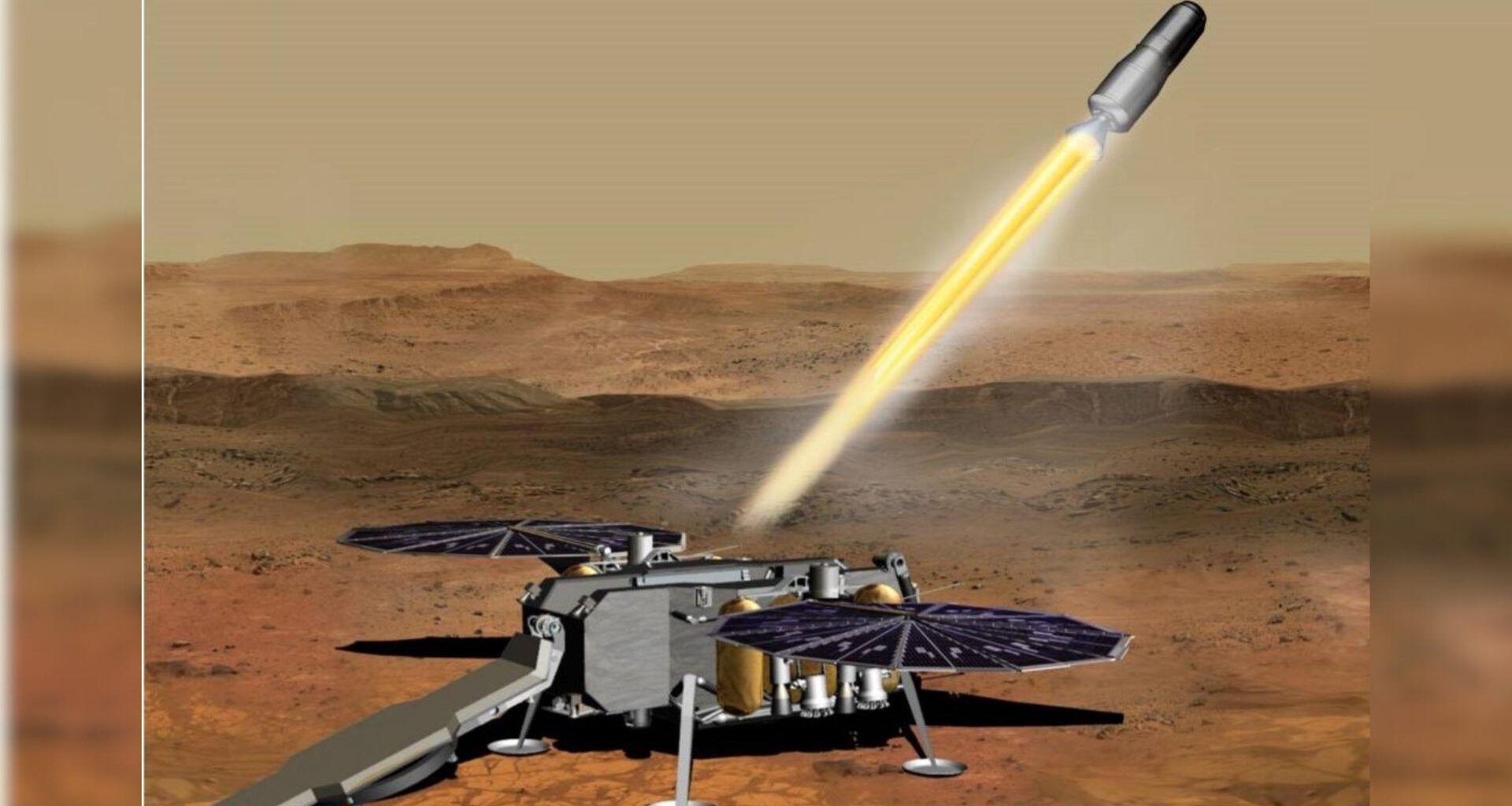
BOULDER, Colorado — The existing NASA-European Space Agency effort to establish a Mars Sample Return program is slated to be discontinued.
That’s the word according to the Commerce, Justice, Science, and Related Agencies Appropriations Act, a “minibus” legislative package passed by the U.S. House of Representatives on Jan. 8. Next up is the Senate vote.
You may like
Deeply concerned
A group reacting to the MSR termination news is the Mars Exploration Program Analysis Group (MEPAG). It serves as a community-based, interdisciplinary forum for inquiry and analysis to support NASA Mars exploration objectives.
The MEPAG Steering Committee is encouraged by the latest budget language for NASA and planetary science; the minibus allocates $24.4 billion for the agency in fiscal year 2026, compared to the $18.8 billion that the White House proposed in its budget request.
However, “we are deeply concerned by the cancellation of the MSR program,” said Victoria Hamilton, chair of MEPAG and a leading space scientist at the Southwest Research Institute in Boulder.
Tantalizing samples
MSR has been the top planetary science mission priority of the last two astronomy and astrophysics Decadal Surveys, the MEPAG chair said. These are major reports prepared by the U.S. National Academies of Sciences, Engineering and Medicine at the request of NASA every 10 years.
“We are on the cusp of finally determining whether there was life on ancient Mars, and the logic for where to go and which samples to collect has been rigorously and widely debated,” Hamilton told Space.com. And as a result, she said, “there are incredibly tantalizing samples in the Perseverance rover’s cache that could revolutionize our understanding of life in the solar system.
Perseverance has been dutifully scouting out Mars’ Jezero Crater since early 2021, on the prowl for signs of ancient life on the Red Planet, gathering samples of rock, regolith, and atmosphere for eventual return to Earth.

Artwork depicting NASA’s moon and Mars ambitions. (Image credit: NASA)Invaluable information
“These samples also will provide invaluable information about the surface environment of Mars for the Moon to Mars program that could greatly reduce risk to human explorers and save billions of taxpayer dollars by reducing the need to engineer around a multitude of unknowns about the Martian environment,” said Hamilton.
You may like
A program like MSR is also a symbol of America’s leadership in deep space exploration, a stated priority of the Trump administration.
“But that leadership is threatened by other nations who have announced their intention to conduct their own Mars sample return missions in the near future,” Hamilton, alluding to China’s robotic Mars sample endeavor in the coming years.
Sit on the sidelines
“It would be devastating to America’s and NASA’s reputation if the United States is forced to sit on the sidelines as remarkable scientific discoveries are made by the scientists of a nation with whom we are not even allowed to collaborate scientifically,” said Hamilton. “It is difficult to understand how the cancellation of MSR is anything but an admission that returning samples from Mars is too hard for the United States.”
In that case, Hamilton added, “how do we expect to be successful at something orders of magnitude more ambitious and costly as the Moon to Mars program, where human lives are at stake?”
Hamilton said that MEPAG is also concerned about what cancelling MSR means for the future of the Mars Perseverance rover.
“Maintaining the integrity and accessibility of the samples collected so far is of great importance,” Hamilton said. “We urge NASA to quickly begin working with the scientific community to develop a plan that both preserves the samples and our ability to retrieve them, while also allowing Perseverance to continue conducting phenomenal science on Mars.”
On one hand, while it is fair to want to revisit the MSR architecture and cost of the remaining portions of the program, Hamilton noted that Congress has long used the Decadal Surveys as a guide to scientific priorities.
“Abandoning this guidance is a deeply concerning move with implications not just for U.S. space leadership but other NASA priorities such as Moon to Mars,” Hamilton concluded.
Flat funding
Eyeing the NASA budget wrangling situation is Jack Kiraly, director of government relations for The Planetary Society, an independent space advocacy group.
The recently released fiscal year 2026 funding bill for NASA is pegged at $24.4 billion, with $7.25 billion allocated for the space agency’s Science Mission Directorate. That’s a 1% decrease from previous years and a near-total rejection of proposed cuts advocated earlier by the Trump White House, Kiraly said. (Trump’s 2026 budget request slashed NASA funding by 24%, and also cancelled the MSR campaign as it is currently envisioned.)
“This flat funding will allow NASA to continue progress on many of its most ambitious space science projects,” Kiraly told Space.com. “Unfortunately, Mars Sample Return, as currently formulated, will be canceled as a result of the bill’s passage.”

Artist’s illustration showing a Mars astronaut inspecting ancient Red Planet rock. (Image credit: Composite image by Ella Maru Studio for the National Academy of Sciences)A path forward?
But that’s not to say that the idea of sample return is canceled, said Kiraly. “In fact, the bill instructs NASA to fund a Mars Future Missions program line to formulate and develop a common technological heritage that enables more robotic scientific investigations and eventually crewed exploration missions of the Red Planet.”
Despite this cancellation of the MSR program, Kiraly said, flat funding for NASA Science overall and this direction will help develop a sustainable path forward for Mars exploration that includes a future sample return campaign.
“Hopefully, that involves returning the scientifically compelling samples already collected by the Perseverance rover,” Kiraly said.