
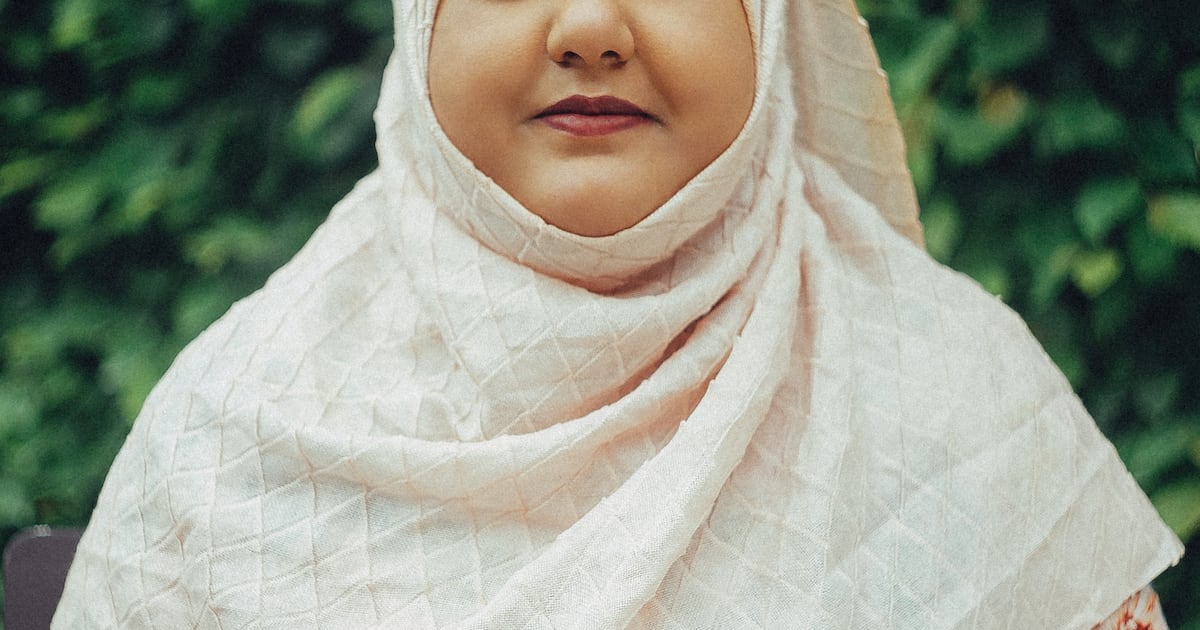
I grew up in a couple of different places. I was born in Bangladesh and lived there for a few years, but I also lived in Saudi Arabia for a little while, and between the two places. Then I moved to Ireland when I was 10 years old, and grew up here for the rest of my childhood.
I first moved to Tullamore in Co Offaly, which was quite different from what I experienced in Bangladesh. I had lived in the capital city Dhaka, which is very busy, very noisy all the time. To come from that to Tullamore, which is a very small town – you can walk it, essentially – and there’s not a lot of people or noise, I was surprised by how quiet it was. But I quickly learned to appreciate that.
After about six months I moved to Dublin. I lived on the outskirts, which was still very quiet compared to Bangladesh. But even at the time, it was a bit more multicultural [than Tullamore]. When I started school in Dublin, it was nice to see people from different cultures and different backgrounds. I think I was lucky to make a lot of diverse friends.
There are a lot of similarities between Irish and Bangladeshi cultures. Irish people, are very friendly, very polite, very welcoming. Bangladeshi culture is also very similar. On top of that we have a very similar history of colonialism and partition and famine. The biggest difference would be that Irish people have a culture of drinking in pubs, whereas Bangladeshi people generally don’t drink, if they’re Muslim. But Bangladeshi people love to hang out and talk and have a very communal culture, which is very similar to Irish culture.
When I was about 12 or 13 years old, I discovered this website, called NaNoWriMo [National Novel Writing Month]. It’s not around any more, but it basically encouraged you to write a novel in 30 days. I wrote 50,000 words. It wasn’t great, unfortunately, but I got into the habit of doing that every year during November. The more I wrote, the more I discovered what I was good at and what I needed to improve on. Slowly, I got better and better.
When I was a bit older, I wrote a book I was really proud of. I went back and edited it and thought, okay, maybe I could try and get this published. I started looking for a literary agent. With that book, I actually didn’t accomplish it. It got rejected. But I felt like I had finally hit a point in my writing where I could become published. I then wrote my debut novel, The Henna Wars, and I found a literary agent through that.
When I was younger, I struggled to find books where my own experiences were reflected back at me. When I started writing, I thought about the things I wish I could have read. I wrote for my younger self, but also for the people out there today who are hopefully looking for books like mine.
For my latest book, Nadia Islam, on the Record, I wanted to write a book that had significant settings in Bangladesh. That led me to thinking of my time in Bangladesh and what Bangladesh is like. I thought about the fact that even when I was younger, there was a lot of flooding there. It has got worse and worse now. The major reason for that is climate change. All of these things came together to create Nadia Islam, On the Record, because it is about a young journalist who learns about climate change in Bangladesh.
Ireland is a great place to be a writer. It’s been a great place to grow up as well. I’ve had so many great experiences here. I think it’s definitely given me a perspective and made me into a person that I wouldn’t be if I didn’t grow up here.
At the same time, I’ve also had bad experiences. There’s been such a rise in racism and Islamophobia in Ireland, which is really frustrating to see and experience. A lot of it is small things that chip away at you. When I was at school, I would have kids say racist things to me, assume things about me, and if I brought it up with white Irish friends, their response was never to have a conversation about it or even acknowledge it. They would say, oh, you have to ignore it. I’ve had experiences where I was walking down the street and someone would shout at me. I’ve had people try to attack me and grab me. It’s a blend of different kinds of things. It feels almost like it shouldn’t happen in Ireland, because Ireland has faced colonialism, has faced discrimination in a worldwide way. I’ve always hoped that Irish people and Ireland in general know better and don’t fall for being anti-immigrant and racist. I have a complicated relationship with all these things. I’m very appreciative of Ireland. I’m appreciative of the person I have been able to become because I grew up here.
Being Bangladeshi and being Irish is a very unique perspective and identity to have. When you grow up across two cultures, or even multiple cultures, it can be frustrating to figure out exactly who you are or where you belong. But I ultimately think it lends you something special, because you have a unique perspective on the world.
In conversation with Niamh Donnelly. This interview, part of a series about well-known people’s lives and relationship with Ireland, was edited for clarity and length. Nadia Islam, On The Record by Adiba Jaigirdar is published by Hodder Children’s Books.