
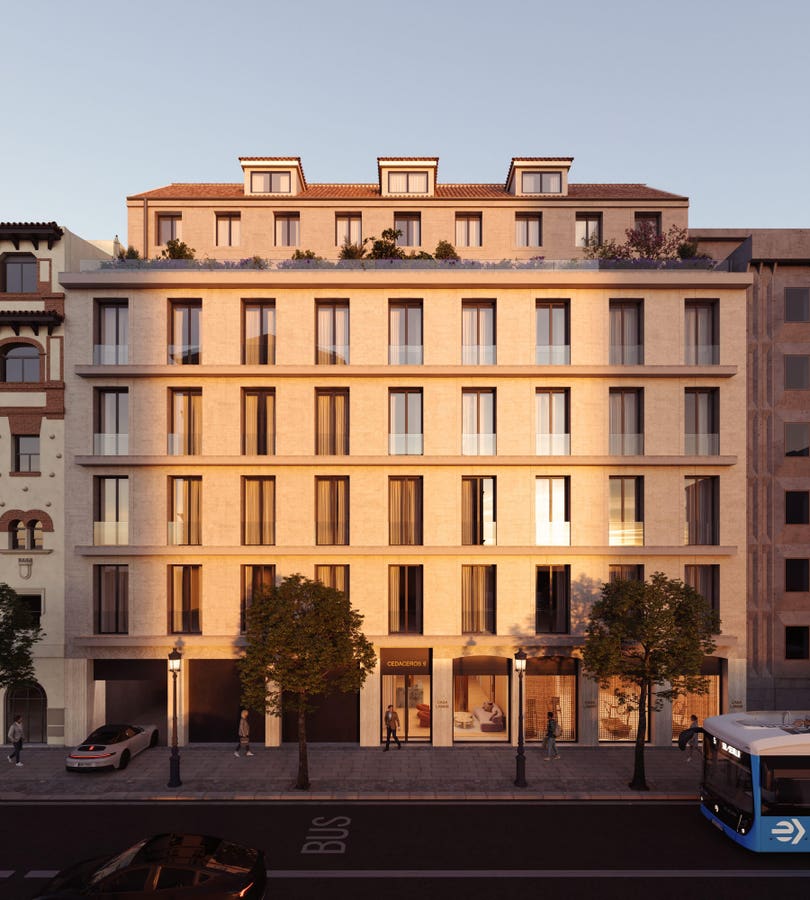
Casa Lamar Cedaceros 9 is located in the heart of Madrid, close to the Prado Museum, El Retiro Park, Círculo de Bellas Artes, and Gran Vía
Courtesy of Casa Lamar
It’s hard to decode how a TikTok video goes viral but there’s more of a science when it comes to predicting where people prefer to live. From Lisbon to Bali, the combination of relaxed immigration rules, favorable cost of living, a bounty of employment opportunities, and an interesting lifestyle make certain places a magnet for global expatriates.
For the high-net worth individuals, the pull is strong in Madrid, which has eclipsed Barcelona in terms of popularity. “Madrid’s connectivity has been significantly enhanced with expanded high-speed rail links and one of Europe’s most connected airports. This, combined with a vibrant cultural scene, a thriving global tech ecosystem, and the growing presence of multinational companies, reinforces its strategic role,” says a spokesperson from Knight Frank Spain.
Home to headquarters of multinational firms that leverage the city’s position as a key triangulation hub between Europe, Latin America, and the rest of the world, it’s very appealing to affluent global citizens. “It’s clear why the Spanish capital is undergoing a renaissance—it’s no longer just Spain’s political and financial center but is rapidly emerging as Southern Europe’s hub for capital, talent, and innovation.”
Photo by: Roberto Machado Noa/UCG/Universal Images Group via Getty Images
UCG/Universal Images Group via Getty Images
Like bees to honey, many of the global elite are choosing to relocate to Madrid and settle in here. “Having worked with international families, I’ve observed that Madrid manages to strike an authentic balance: cosmopolitan but welcoming, urban yet manageable. The city also has first-rate international schools,” says Valeria Cimonetti of Driven Properties.
For investors, it also has a level of institutional and fiscal stability that’s important to them. “Buyers are becoming more strategic and demanding. They value transparency, speed in administrative processes, and a clear path to return on investment. Madrid delivers on these fronts better than Barcelona today,” adds Cimonetti. “The permitting process tends to be faster, premium new-build projects are more thoughtfully executed, and there’s greater availability of institutional-grade products. This makes Madrid not only more attractive, but also more investable.”
Casa Lamar Cedaceros 9 is the first residence in mainland Spain by renowned designer Patricia Urquiola
Courtesy of Casa Lamar
With the stars aligning, it’s not surprising it has led to a surge in demand for places to live. One that’s shaking up the scene is Casa Lamar Cedaceros 9, a brand-new luxury residence by Lamar Development. A firm known for working with the world’s top architects and designers, they enlisted acclaimed Spanish designer Patricia Urquiola to craft the interiors marking her first landmark residential project in her home country. They also tapped Madrid-based architecture firm Touza Arquitectos to highlight the building’s heritage; they restored the travertine marble street facade as well as preserved the neo-Mudéjar red brick courtyard façade.
Located in one of Madrid’s most prestigious neighborhoods and just steps from the Four Seasons Hotel, the property has only 22 residences comprised of one to five-bedroom apartments with interiors designed by Urquiola herself. Future residents will also enjoy luxury hotel-grade amenities: 24-hour concierge service, a sommelier-curated wine cellar, a modern fitness centre, a spa with a 35sqm swimming pool and contrast therapy pools, and a landscaped roof garden with bar.
Urquiola used travertine, green Antigua marble, Calacatta Viola, rovere Civita wood, terracotta and more to create the art-filled, textured interiors
Courtesy of Casa Lamar
What went inside creating these exclusive homes? We speak to Urquiola on how she approached this luxury residential project in mainland Spain.
Madrid is experiencing a resurgence with non-stop development. What do you think about the area where Casa Lamar Cedaceros 9 is?
Having lived in Madrid, I know this part of the city very well. It’s right in the very center, but it’s not obvious or predictable. It’s an area that is being revitalized in an interesting way—you feel the energy of the city, its pulse, but also what it was before.
For me that’s important: it’s not about erasing, but about adding new layers, creating a dialogue between memory and transformation. Today, Madrid is a city in constant motion that keeps evolving while finding ways to respect its own rhythm. The challenge is to embrace growth while preserving the connection with its environment.
From Six Senses Rome to Casa Brera, you have a lot of adaptive reuse and conservation projects. Which particular elements did you want to highlight in this heritage building and why?
I wanted to highlight the layers, the traces of what was already there and the possibility of adding new ones. It’s not about conserving in a rigid way, but about creating a dialogue. For me it was also about perception, about how you walk through the apartment and how light guides you, how the inside extends naturally towards the terrace.
The homes feature pieces from Cassina, cc-tapis, Flos, Glas Italia, and Spanish brands like Kettal and Andreu World
Courtesy of Casa Lamar
With only 22 residences, this ultra-luxury property is incredibly intimate. How did you approach it?
For us it was more about a personalized kind of luxury, something more contemporary. With only 22 residences, the scale already suggested intimacy rather than excess. We wanted to create homes that are easy to live in, where the value comes from atmosphere, from light, from materials that feel good under your hands and feet.
You are known for blending feminine and unexpected elements in your design. How did you express that here?
I don’t think design should be read as feminine or masculine. For me it’s about cultivating a certain attitude, an understanding, a curiosity, and sometimes even a small surprise into the space.
At Cedaceros 9, this comes through in the staircase that becomes almost a sculpture, in kitchens conceived as adaptable systems that can shift and open depending on the moment, or in the wellness area softened by sheer curtains. There are also quieter gestures like the contrast of glossy and matte surfaces, the dialogue between stone and wood.
A sculptural staircase anchors the space at Casa Lamar Cedaceros 9
Courtesy of Casa Lamar
You regularly collaborate with the world’s top furniture brands. Which pieces did you bring into this space?
The interiors bring together different pieces I have designed with companies I have collaborated with for many years like Cassina, cc-tapis, Flos, Glas Italia, and Spanish brands like Kettal and Andreu World, alongside works by the great masters and more contemporary objects.
Many of these products focus on sustainability, the exploration of new materials, and circularity. I feel proud that the companies I work with share this vision, and support it through research, investment, and experimentation.
For instance, the Cassina Mon-cloud system in the living area features a metal frame wrapped in quilted recycled PET fibre padding, gently embracing the backrest and armrests. The seat cushions also use recycled PET combined with polyurethane inserts that contain a percentage of bio-based Polyols.
Another example is Babar for Glas Italia, a series of low and high tables produced entirely from leftover materials from the company’s production. Made from a special 100% recycled glass grit blended with polymers partly derived from renewable plant-based sources, each table is handcrafted with an irregular surface and organic shape, making every piece unique and imperfect.
The extensive wellness area features a spa, pool, Jacuzzi, sauna and contrast therapy pools
Courtesy of Casa Lamar
Can you share any statement features and the type of materials used throughout the space?
We worked with materials like travertine, green Antigua marble, Calacatta Viola, rovere Civita wood, terracotta, glossy tiles, and terrazzo. What interests me is the conversation between surfaces—glossy against matte, the warmth of wood beside the coolness of stone. These juxtapositions make the spaces breathe.
Lastly, how different was it for you working on this project at home versus elsewhere in the world?
Every project is a journey and a conversation with the client, at the same time very different and somehow very similar. You can discover unexpected correspondences between places that are geographically far apart, and contrasts even between spaces that are close.
What matters to me is how each context brings its own energy. Cedaceros 9 is deeply rooted in Madrid—in its light and in its rhythm—yet it also connects to other projects I’ve done around the world through shared questions about living and atmosphere.
Sales for Casa Lamar begin in September 2025; www.casalamar.com
MORE FROM FORBESForbesArtist JR Uses Trains As His Canvas—See Inside His Latest MasterpieceBy Kissa CastanedaForbesIs Quiet Luxury Over? Top Designer André Fu Believes It’s Here To StayBy Kissa CastanedaForbesWhat To Expect When Olympia, London’s Cultural Landmark, Opens In 2025By Kissa CastanedaForbesA Creative’s Guide To Notting Hill: Where To Go Beyond Portobello RoadBy Kissa CastanedaForbesInside The New Waldorf Astoria Residences Yas, Which Sold Out In A DayBy Kissa Castaneda