
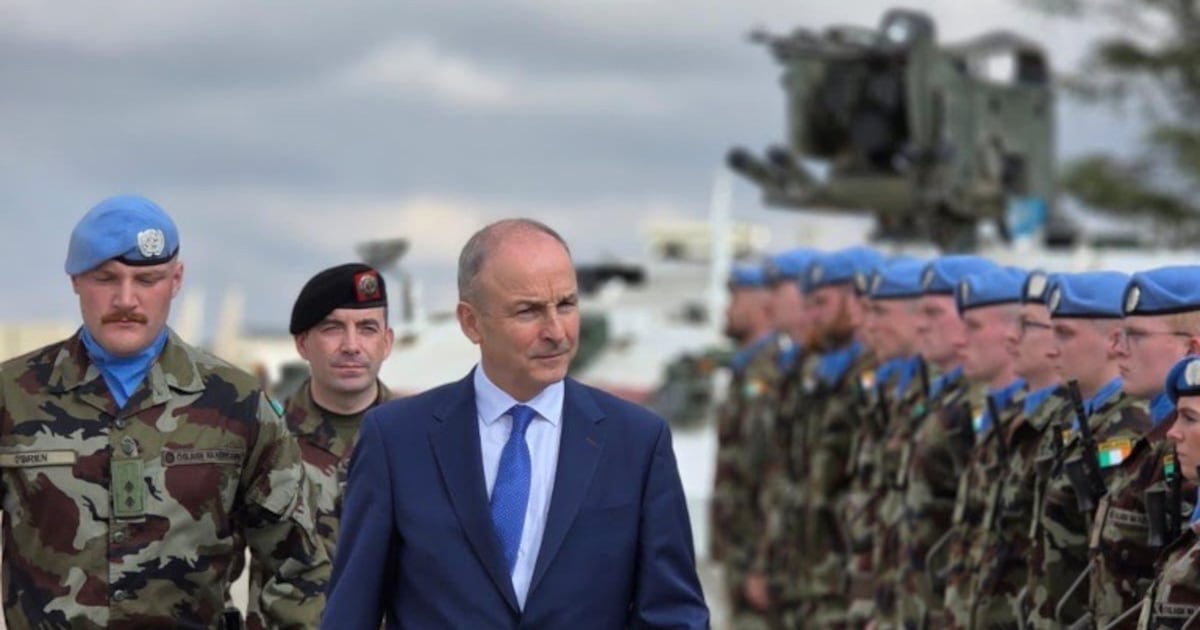
Last month, Irish soldiers assigned to the EU Battlegroup, which is designed to act as the bloc’s rapid response force, got an unwelcome surprise.
Christmas pay packets would be smaller than expected, they were told. The problem was that, while on Battlegroup exercises in Hungary and Germany, they had mistakenly been paid a higher rate of daily allowances usually only available to soldiers while on standby in Ireland.
The mistake had to be fixed and that could only be achieved by clawing back the money from their December salary payments.
The amounts were small, no more than €140 per person, and fewer than 200 people were impacted. But the move left a sour taste in the mouths of soldiers who viewed it as another example of penny-pinching by financial bosses.
“If we were sitting at home in barracks, we would have got more money. By deploying, we actually get less,” one Defence Forces member says.
“It’s the principle of the thing,” says another.
“At a time when we are trying to convince people to join the Defence Forces and remain in service, it undermines efforts.”
In response to queries, a Department of Defence spokesman said “some Defence Forces members of the EU Battlegroup were paid an incorrect allowance” and that “this error was rectified before year end”.
The episode has a wider, more symbolic resonance for where the State’s military stands. In the view of some Defence Forces members, it is an example of the type of bureaucratic inertia and small-mindedness that will cause the military to miss drastically the goals of increasing its numbers to 11,500 by 2028.
The goal was recommended by the Commission of the Defence Forces in February 2022 in response to what it said was growing international threats, both of a conventional military nature and in the hybrid sphere.
Two weeks later, Russia invaded Ukraine.
The international threats described in the report have only grown since then, both in number and complexity.
This week, France and Germany sent troops to Greenland in support of Denmark, following threats by US president Donald Trump to take the Danish territory by force. The rules-based order that Ireland has relied on for security for many decades is fracturing fast.
Years of underinvestment in defence have left the State poorly positioned to respond to these changes.
In a briefing document prepared for incoming Minister for Defence Helen McEntee late last year, and subsequently released to The Irish Times, officials said there was zero chance of bringing Defence Forces numbers up to 9,739 “in any reasonable time frame”, never mind finding an additional 2,000 troops.
The assessment stood in stark contrast to repeated promises by politicians, including a month previously by Tánaiste and then minister for defence Simon Harris, that the 2028 target would be met.
It will take until 2031 to reach 9,739, and that depends on net recruitment – the numbers joining less those leaving – rising from 140 to 400 a year, McEntee was told.
Reaching the goal of 11,500 will take until 2035, officials said, 12 years after the Government first accepted the commission’s recommendation.
“This is what failure looks like,” said Lieut Col Conor King, general secretary of the Representative Association for Commissioned Officers.
“And it is because the pace of implementation of the commission’s recommendations has simply been too slow and leisurely for the past four years, even in the face of serious global instability and an acknowledgment by the commission that urgent action was needed.
“Multiple achievable targets have been missed, with little apparent accountability.”
Politicians and officials have declined to acknowledge publicly that the goal of 11,500 troops by 2028 is a pipe dream.
A Department of Defence spokesman said in response to queries: “There continues to be very strong interest in a career in the Defence Forces with further growth again this year in the number of applications received.”
The spokesman says the 11,500 figure is “intended to support the delivery of enhanced operational capability rather than to function as a fixed or stand-alone target”.
Behind the scenes, officials and military management have been scrambling for ways to accelerate recruitment. The Defence Forces is to hire consultants to help draft a new strategy, and the Chief of Staff, Lieut Gen Rossa Mulcahy, is to provide a “workforce plan” to McEntee by April.
The Defence Forces was also offered the assistance of the Public Appointments Service to help with recruitment. However, military management rejected the offer and said the Defence Forces should have sole responsibility for this.
The problem in growing numbers is not due to a lack of interest. More than 1,100 people a month applied to enlist in the Defence Forces last year, up 34 per cent on 2024 – and 83 per cent on 2023 numbers.
The increase has been driven by widespread advertising campaigns, improvements in the application processes and fast-track entry routes for candidates with specific skill sets.
Perhaps most important is the many improvements in pay and allowances, including the introduction of free healthcare. Private soldiers now start on a salary of almost €42,000 a year after completing their 24 weeks’ training – this is only €3,000 less than a new officer’s starting salary.
Officials also point to the success of the new Joint Induction Training Centre in Gormanston Camp, Co Meath.
The centre centralises initial military training for all Defence Forces recruits. This is far more efficient than the previous system, which saw each brigade, along with the Naval Service and Air Corps, conduct all of their own training.
The centre is designed to train 900 recruits a year, but it is still not at its full intended operating capacity. Last year it graduated 788 intakes. It is hoped that figure will rise to 850 this year.
Improvements in training procedures have also helped reduce the number of people leaving boot camp before graduating. Last year 25 per cent of recruits who started training dropped out before it finished, according to figures provided to The Irish Times, down from 39 per cent five years ago.
However, this still means that the Defence Forces must recruit 400 people to be able to produce 300 trained soldiers.
Another bottleneck for increasing military strength is the number of serving members leaving for better pay and conditions in the private sector.
[ Defence Forces pay levels rise in bid to retain staff amid ‘poaching’Opens in new window ]
This number has stabilised in recent years but, in the view of military representative associations, the churn is still too high.
Retaining military personnel, particularly those with specialist skill sets, is vital to allow the Defence Forces to carry out its tasks, including the training of new recruits, they say.
The Department of Defence previously acknowledged the retention of specialists is a “serious challenge”. However, according to Lieut Gen King, a review mechanism to examine specialist pay and allowances has still not been introduced, despite being promised for February last year.
Ger Guinan, general secretary of PDForra, which represents enlisted personnel, said his organisation was always sceptical the Defence Forces could reach its targets on time due to the amount of personnel churn.
“The pace of implementation of positive measures for members has been all too slow, and where positive measures are eventually implemented, it appears to be grudgingly,” he said.
In particular he called for pay increases for the instructors responsible for training new recruits.
“These members are vital to the sharing of knowledge and experience to those whom we expect to enter service,” he said.
Military management is also worried that a lack of opportunities for overseas service will impact retention. Soldiers often volunteer for peacekeeping tours, which come with additional pay, when trying to save money or when going for promotion.
Ireland has withdrawn from various UN and EU missions in recent years.
Next year the Defence Forces will withdraw from the Unifil peacekeeping operation in Lebanon after almost 50 years, leaving it with no significant overseas posting for the first time in decades.
The Government is searching for a new mission, including potentially a replacement for Unifil that will involve training the Lebanese Armed Forces. This is one reason why the Government is so keen to abolish the so-called triple lock, which requires UN approval before more than 12 soldiers can be sent overseas on peacekeeping duty.
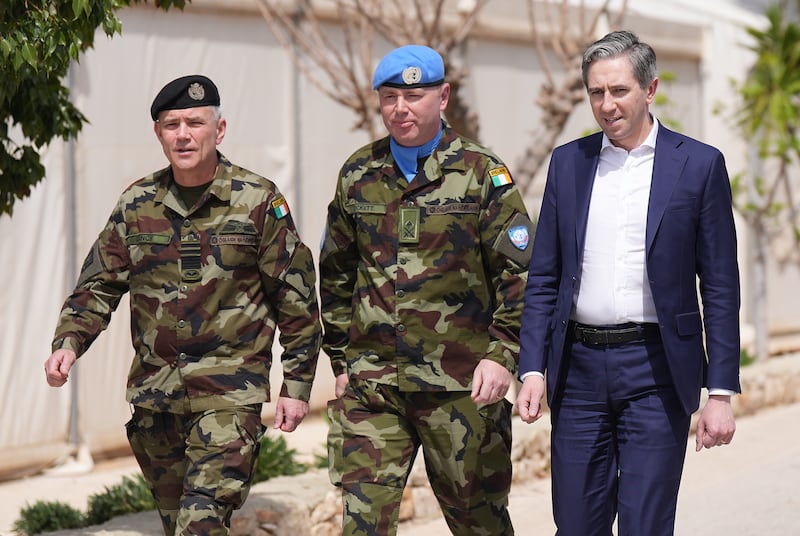 Chief of Defence Forces Lieut Gen Sean Clancy, Tánaiste Simon Harris and Lieut Col Shane Rockett at Camp Shamrock near the border with Lebanon and Israel. Photograph: Niall Carson/PA Wire
Senior military officers view the decline in international postings, as well as the cessation of on-island Defence Forces duties such as guarding Portlaoise Prison, as offering a chance for the organisation to catch its breath and reorganise.
However, they also recognise that without opportunities for overseas service, it will be hard to increase Defence Forces numbers.
Officials must also think outside the box when planning recruitment, says Dan Harvey, a retired lieutenant colonel and one of the members of the Commission on the Defence Forces.
This includes recognising and accepting that many young people joining the organisation are not looking for a lifelong military career.
“Education is what is attractive. Offer recruits a qualification that is recognised in the civilian world. If that means tweaking our course syllabuses a little bit here and there to make them Fetac-level friendly, then so be it,” he says, referring to Further Education and Training Awards Council, the qualification-awarding body for further education.
Harvey also advocates increasing the geographical footprint of the Defence Forces by reopening closed bases, which would allow personnel to work closer to home. This includes reopening Reserve Defence Forces outposts, which would serve as a pipeline into the permanent forces.
“Bring the FCA back to Skibbereen and equivalent towns,” he says, using the old term for the Reserves.
Given current events, Ireland is running out of time to address the deficits in the Defence Forces, Harvey says.
“We think neutrality is a protective cloak,” he says. “I’ll say it straight: that is naive because it has translated into a state of defencelessness. From the top to the bottom, the whole thing needs to be shaken and reviewed.”
Ireland is far from the only country struggling to fill its ranks.
Many European states have reported difficulties recruiting soldiers. In response, France, Belgium and Germany are introducing voluntary national service, allowing young people to sign up for a year.
Croatia is reintroducing compulsory military service, similar to Denmark, Estonia, Finland, Greece, Latvia, Lithuania, Norway and Sweden.
Ireland has never had conscription, even under British rule. Could it be a solution to the problems?
“It’s an emotive thing in Ireland,” Harvey says.
“I won’t bang that drum for now. If we can achieve the goals we have set ourselves, that will be enough.”