
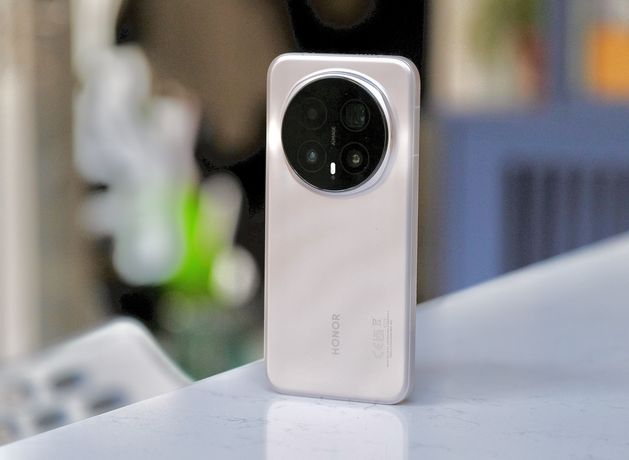
Honor’s latest flagship phone puts distance between itself and rivals on one particular feature: telephoto zoom photography. Samsung should be worried.
While it competes well in most other ways — a superb display, very fast engine and really long lasting battery life — these aren’t particularly unique features in €1,000-plus phones.
But almost none of its rivals can match the Magic 8 Pro’s 200-megapixel telephoto zoom camera.
.…
Tested: Honor Magic 8 Pro
Price: €1,299 (512GB)
Pros: best telephoto camera we’ve ever tested, top-end battery life and engine
Cons: user interface not as slick as some other flagship phones
….
In the weeks I’ve been testing it, I’ve been taken aback by just how much clearer and better it is than the established hyper-powers of smartphones, particularly Apple’s iPhone 17 Pro Max and Samsung’s Galaxy 25 Ultra.
It is simply better, in all lighting conditions.
Honor Magic 8 Pro photographed by Adrian Weckler
Its optical telephoto lens, which kicks in at 3.7x, is clearer and sharper than anything else on the market, with the exception of Xiaomi’s 15 Ultra, a phone that costs €200 more (€1,499).
The reason for this is mainly down to the huge telephoto camera sensor (1/1.4”) that Honor put inside the device.
For context, this sensor size is much, much bigger than the (1/2.55”) telephoto zoom camera sensor on the iPhone 17 Pro Max.
What that means in plain English is that it lets way more light into the camera, resulting in much better photos. This is a far more important metric than megapixels.
And a sensor this large is very rare. Premium smartphones typically have three rear cameras. Usually, it is the ‘main’ (1x) camera that delivers the highest quality and technology, partially because that’s the one that people use most and partially because it’s much harder to deliver similar high quality in a telephoto zoom lens within the constraints of a flat smartphone. (Top telephoto lenses on regular cameras are always huge barrels, reflecting the optical challenges that exist to deliver top quality on a zoom photo.)
For example, on both the iPhone 17 Pro (and Pro Max) and Samsung’s Galaxy S25 Ultra, it is the 1x camera that has by far the biggest, most powerful sensor.
While they also invest in their ultrawide and telephoto lenses and sensors, they’re far smaller and narrower than the 1x sensors and don’t deliver results anywhere close to being as optically refined. Normally, we forgive them this because those telephoto shots, even with the smaller sensors, are still much better than pinching in for a ‘digitally’ zoomed photo (which is often blurry and fuzzy).
Honor Magic 8 Pro photographed by Adrian Weckler
But the Magic 8 Pro has decided that we’ve all been making do with too little for too long. So it has packed in a (relatively) giant optical sensor behind the telephoto zoom lens.
And the results are just stunning. From inside a window within our office in Dublin’s Talbot Street at dusk, when I zoom into 25x, I can make out the details of engravings below the clock at the top of the Customs House, at a distance of around a half-kilometre away. When I take the same photo at 25x on the iPhone 17 Pro Max, those details are mostly a blur.
Equally as impressive — if much less likely to be applied — is what happens when you zoom into the maximum 100x. This is the first camera I’ve ever tested where 100x shots are almost usable. This is largely down to the stabilisation happening under the hood. When you zoom in to some ridiculous length — 30x, 50x or 100x — the digital stabilisation kicks in impressively. But details may still be strained and blurry, as you’d expect at that infeasible focal length. Within a second of taking the shot, the phone’s (optional) AI definition refines the details to a pretty impressive degree. Tiny writing on a fire extinguisher 10 metres away becomes legible within the photo. The same shot on almost any rival premium smartphone shows simply some white squiggly marks on red, or gets over-processed to appear as something weird.
This means that if you’re the type who likes taking telephoto landscapes (such as tree lined avenues in the Autumn, moonrises or sunsets), this is now the Irish market’s compelling option.
Night-time shots are also excellent, matching anything else on the market.
So does this make the Magic 8 an automatic must-buy as a cameraphone?
Not necessarily. Its main 1x (50-megapixel) camera — while admittedly excellent — isn’t quite as good as the best of the rest. Comparing it against the iPhone 17 Pro, in particular, my tests suggest that Apple’s phone is slightly clearer and better.
And while the Magic 8 Pro’s video capture is generally very, very good — at up to 120 frames per second in 4K — it doesn’t quite match the iPhone Pro models for overall balance, stability and processing. (In fairness, it’s a lot closer than previous models and certainly good enough for a ‘flagship’ label.)
As for the Magic 8 Pro’s 50-megapixel ultrawide (0.5x) camera, that is comparable to the other premium flagships, which makes it good enough.
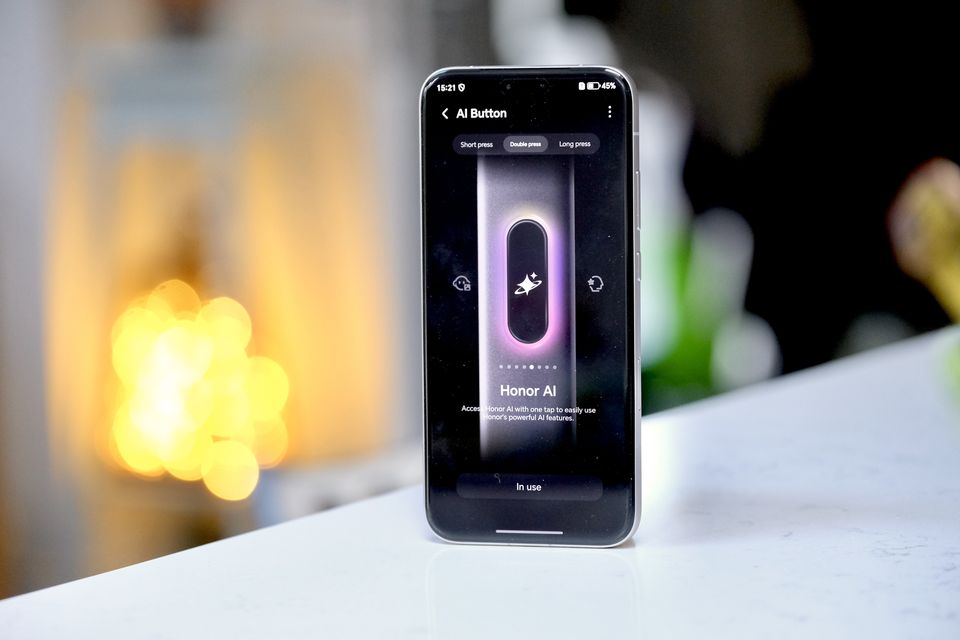
Physically, Honor has copied the Apple iPhone’s camera button, which lets you quick-load the camera feature, focus and vary the zoom.
Like the iPhone camera button, this is a little awkward to use and I found myself mostly avoiding it.
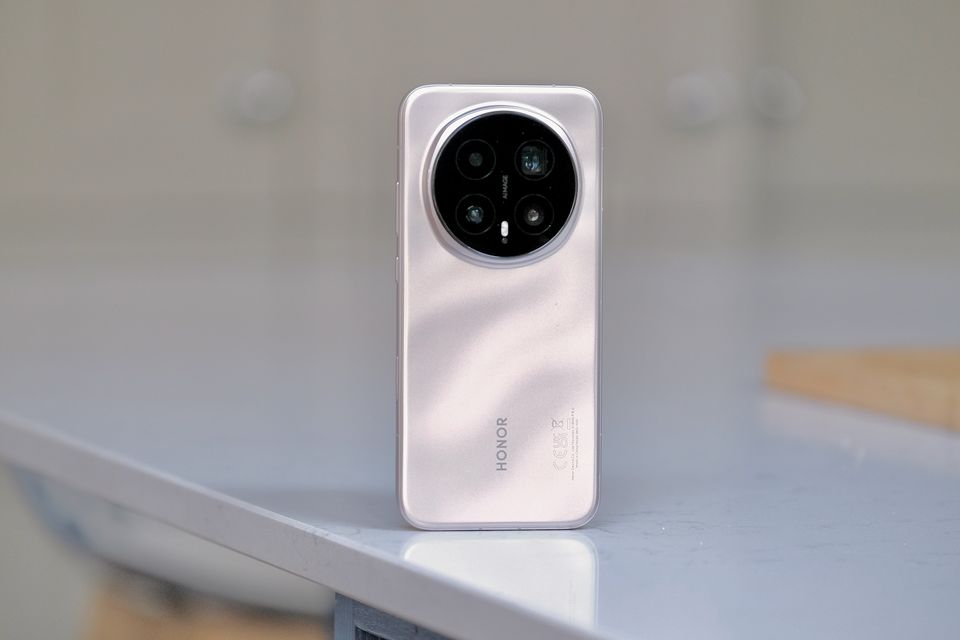
One other consequence of having such a good camera system is that there’s a huge circular camera housing unit on the rear of the phone.
Otherwise, the look and feel of the phone is pretty nice, if nothing special.
My test model came in the ‘sunrise gold’ colour, which is a muted, slightly unadventurous tone. But it’s also available in black.
The casing is admirably fingerprint-resistant.
It’s a pretty robust unit, with almost all of the highest-end water and dust resistant ratings and fairly tough for typical drops, too.
It’s chunky and heavy enough, though, at around 230g and 8.4mm at its thinnest point.
But it’s actually slightly smaller, overall, than most top flagships.
At 6.7 inches, it’s a smidge more compact than flagships such as the iPhone 17 Pro Max and Samsung Galaxy S25 Ultra (both 6.9 inches).
I like this size, though — the Pro Max and S25 Ultra hover on being too large, especially for pockets. But 6.2-inch and 6.3-inch junior flagships are a little too small for real top-end usage. So this strikes a good balance.
The display is slightly disrupted by Honor’s version of Apple’s ‘dynamic island’ front camera cutout, but this can be very handy as it expands for shortcuts to certain controls, features and functions.
Otherwise, it’s a fairly top-end Oled display that matches most of what you’ll see on any other flagship smartphone.
There’s an underscreen fingerprint reader on the front that works pretty well.
Honor’s MagicOS 10 interface skin — which is layered on top of Android 16 — is fine, but still finds itself third or fourth choice compared to rival interfaces. This isn’t really a criticism, just an acknowledgement that it’s really, really difficult to match the smooth, flowing experience on Google Pixel and Samsung Galaxy, in particular, with their many years of experience in creating super-clean and efficient operating systems.
However, you do get seven years of security patches and OS updates, which should give some peace of mind on that front.
As you’d expect with a 2026 flagship, there’s a host of AI features built into the Magic 8 Pro, including stuff like translation and subtitles, as well as photo editing tools. It also adds a novel one in the form of an ‘AI deepfake’ detection tool, which is supposed to help you sniff out potential deepfakes on activities such as video calls.
There’s a shortcut to some of these configurable AI features through the camera button loaded on the side. Long-pressing it, by default, gives you access to a ‘circle to search’ feature, letting you look up whatever you circle on the screen with your finger.
This has the latest top-end engine power under the hood, with a Snapdragon 8 Elite Gen 5 chip and 12GB of Ram, meaning it will cut through anything you throw at it and, thanks to the efficiency within that latest chip, will also give the battery extra longevity too.
It comes with 512GB of storage, which is enough for most people, though the absence of a 1TB option (available on the Magic 8 Pro’s main flagship rivals) will be seen as a drawback for power users considering this phone.
As for battery, you won’t have anything to worry about here. The days when battery life on top smartphones was a challenge are basically gone. The Magic 8 Pro’s longevity is ridiculously good, thanks to its 6,270mAh silicon carbon battery. In my experience, this usually got to two full days of use on a single charge. It will last a day for anyone, even with a lot of gaming or intensive use of the cameras.
As if the mega-battery wasn’t enough, its charging speed is unfeasibly quick, supporting 100-watt wired charging and 80-watt wireless charging, far faster than many rivals.
CONCLUSION
Previous Honor flagship phones have been hard to recommend over similarly-pitched options from, in particular, Samsung. The Magic 8 Pro now has clear blue water between it and Samsung on at least one — and maybe two — features. It simply beats the Galaxy S25 Ultras on the telephoto zoom lens. It’s also slightly better on battery life. And it’s over €200 cheaper for the storage version (512GB) on offer.
….