
It was 1992, and the now retired Bord na Mona (BnM) workers, Murphy an electrician and Hopkins a fitter, were selected to became Ireland’s first “experts” in the construction and maintenance of commercial wind turbines.
“There wasn’t much emphasis on health and safety back then,” explains PC Hopkins.
“That’s for sure,” agrees Tony.
The men returned from Denmark and got to work in the wild, boggy, bleak and beautiful Bellacorick, Co Mayo.
It was there Ireland’s first commercial wind farm came to life.
Over three decades later, the two men are back in Bellacorick to see the turbines they nurtured into generating enough clean energy to power 4,500 homes every year, be decommissioned.
Recalling the physical side of maintaining a wind turbine Tony and PC say it was much different back then.
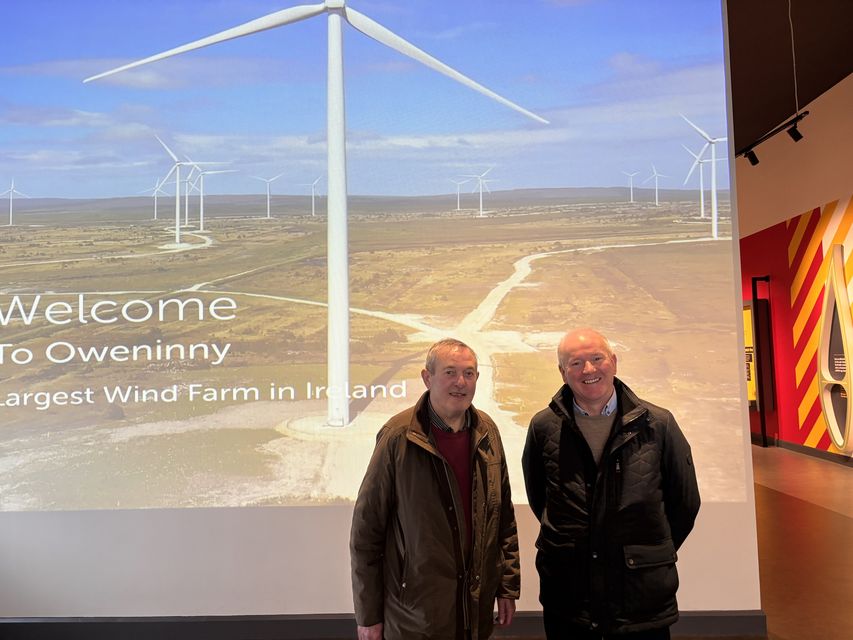
Tony Murphy and Patrick Christopher (PC) Hopkins
On any given day they would have to climb up the 30 metre high internal ladder of each turbine in almost pitch darkness dragging whatever tools they needed up after them.
The turbines were so narrow they would have to open the sides and carry out the repairs exposed to the elements.
“There wasn’t as much emphasis on health and safety back then,” explains PC.
“If you were stuck for help you would just call in any one passing by come and give you a hand. And there was always a few lads around to help.
“Then if someone wanted to go up and have a look – There was no problem. Off you go.
“They could just climb right up the ladder and have a look around. There was no harness or anything.
“Nowadays, there is a construction zone around a turbine you can’t even walk in to,” says PC.
“It’s completely different,” agrees Tony.
Remembering the arduous dimly lit narrow ladders they climbed daily, PC continues: “With the new turbines there are lifts inside them and you are inside all the time.”
Tony recalls their two weeks in Denmark as hugely educational.
“We were supposed to know everything when we came back. That’s what you call a crash course,” said Tony.
But they took it in their stride and say the only thing they struggled with in the early days was the extensive paperwork they were required to fill out.
Shaking his head at the memory, “That was that was all new to us,” said PC.
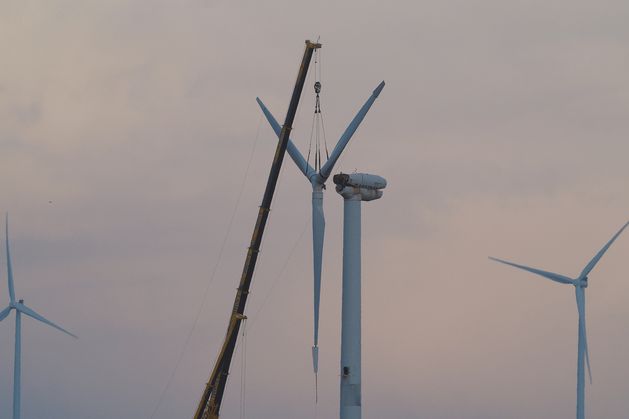
Thirty-three years on Tony and PC are back in Bellacorick to watch the turbines they brought to life and kept in good order for decades be decommissioned.
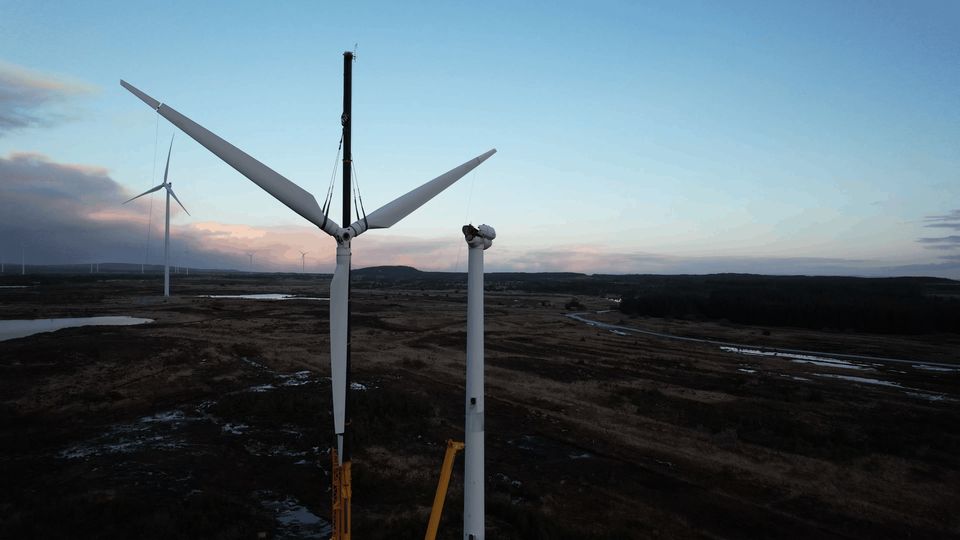
The windfarm, the oldest in Ireland, has completed its full life cycle and all 21 turbines have been dismantled and are heading for recycling.
The turbines were only supposed to be operational for 25 years but have delivered for over 30 years a combined total of 6.45 megawatts of renewable electricity, enough to power the equivalent of approximately 4,500 homes per annum.
But what is coming in their place will dwarf that capacity.
The decommissioning of Bellacorick Wind Farm will make way for the development of Phase 3 of the BnM (formerly Bord na Mona) owned Oweninny Wind Farm, Ireland’s largest onshore wind farm.
Just one of the 18 turbines to be installed as part of the new phase has the potential to provide as much energy generation as all the 21 turbines at Bellacorick Wind Farm combined.
The older turbines have been dismantled and recycled by Plaswire, a specialist materials company that participated in BnM’s 2025 Accelerate Green programme.
Plaswire has developed a solution to ensure wind turbine components are processed, repurposed and reintroduced into manufacturing, rather than being sent to landfill.
Andrew Billingsley, CEO of Plaswire, said: “End-of-life turbine materials present a real challenge for the renewable energy sector. Our work at Bellacorick shows how these materials are being recovered and repurposed into new sustainable and circular construction products, no longer a waste.”
Speaking to the Irish Independent Minister of State Alan Dillon TD, said: “Bellacorick Wind Farm has been a significant part of Ireland’s renewable journey. It was pioneering, and it has proven the importance of wind energy and what could be done with it before it became mainstream.
“We see these original turbines come to the end of their natural lifespan and it allows this site to transition to a more efficient renewable technology.”
Asked about the future plans for offshore wind projects in Ireland, which has been floated as having the potential to transform Ireland as a renewable energy hub in Europe, Minister Dillon said “it (offshore wind generation) is a significant commitment we are focused on.”
“We have to maximise as a country onshore and offshore. We have done incredibly well with onshore, we have created over 7.8 gigawatts of energy at the moment.”
Moving to offshore is a significant commitment we are very much focused on. We have created all of Ireland National DMAP (Designated Maritime Area Plan) with the East and South coast first.
“And in time we will see significant development hopefully for the west coast.”