

US President Donald Trump answered “no comment” when asked if he would use force to seize Greenland, as transatlantic tensions over the Arctic island escalated further and threatened to rekindle a trade war with the EU.
In a brief telephone interview with NBC News earlier on Monday, Mr Trump declined to rule out seizing the territory, an autonomous part of the Kingdom of Denmark, by force.
Mr Trump also expressed his frustration with European leaders focusing on Greenland, saying that Europe “ought to focus on the war with Russia and Ukraine, because, frankly, you see what that’s gotten, them. That’s what Europe should focus on — not Greenland”.
Mr Trump has also linked his repeated threats to seize control of Greenland to his failure to win the Nobel peace prize in an extraordinary text message sent on Sunday to the Norwegian prime minister, Jonas Gahr Støre, the US president wrote that after being snubbed for the prize, he no longer felt the need to think “purely of peace”.
“Considering your Country decided not to give me the Nobel Peace Prize for having stopped 8 Wars PLUS, I no longer feel an obligation to think purely of Peace,” he wrote, adding that the US needed “complete and total control” of Greenland.
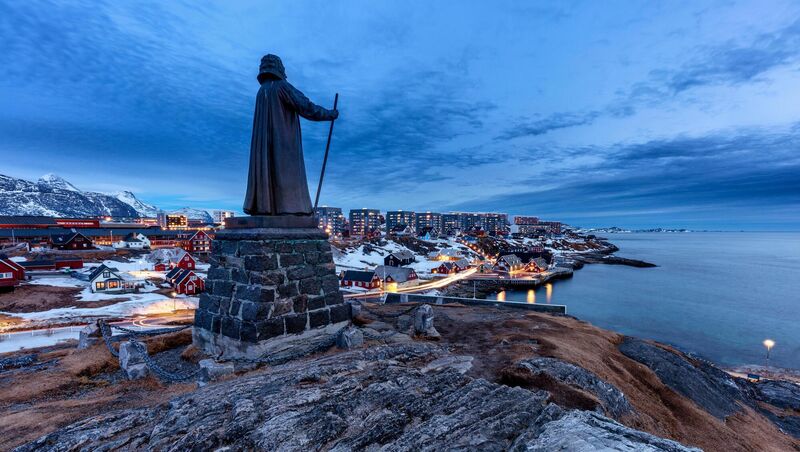 FXNM41 Nuuk, Greenland
In his text message to Støre, Trump said Denmark “cannot protect” Greenland from Russia or China.
The US president said he had “done more for Nato than anyone else since its founding, and now Nato should do something for the United States”. The world was “not secure unless we have Complete and Total control of Greenland”, he said.
Trump has ramped up his push to grab the island, a largely self-governing part of Denmark, in recent weeks, saying that the US would take control of the Arctic island “one way or the other”.
On Saturday he threatened to impose from 1 February a punitive 10% tariff, increasing later to 25%, on imports from Denmark, Norway, Sweden, France, Germany, the UK, the Netherlands and Finland unless they dropped their objections to his plan.
The dispute has plunged trade relations between the EU and the US into fresh chaos, forcing the bloc to consider retaliatory measures, and also risks unravelling the Nato transatlantic alliance that has guaranteed western security for decades.
 US President Donald Trump. File Picture: AP Photo/Alex Brandon
Trump has rocked the EU and Nato by refusing to rule out military force to seize the strategically important, mineral-rich island, which is covered by many of the protections offered by the two organisations since Denmark is a member of both.
He has repeatedly said the US needs to take control of the territory for “national security”, despite the US already having a military base on the island and a bilateral agreement with Denmark allowing it to massively expand its presence there.
EU leaders will meet for an emergency summit in Brussels on Thursday to discuss their response, which could include a package of tariffs on €93bn of US imports that has been suspended for six months since the two sides reached a trade deal last year.
Another possibility is the bloc’s anti-coercion instrument” (ACI), which has never been used but would limit US access to public tenders, investments or banking activities and restrict trade in services, including digital services. The EU said it was continuing to engage “at all levels” and the use of the ACI was not off the table.
 Simon Harris said the EU would be preparing for “all eventualities” as the rift with the US over Greenland deepens. Picture: Frank Vincini
Speaking on Monday afternoon, Tánaiste Simon Harris warned that the threats against Greenland and sweeping new tariffs could have an “enormous” destabilising effect.
Mr Harris has called for “cool heads” and that the EU is not seeking a confrontation with the United States, amid Mr Trump’s proposals to introduce a 10% tariff on goods from Denmark, Norway, Sweden, France, Germany, the UK, the Netherlands and Finland from 1 February.
These tariffs would then increase to 25% on 1 June, unless a deal is reached to allow the US purchase Greenland, Mr Trump said.
Mr Harris said the EU had worked hard to reach a trade deal with the US last year and moving away from that would potentially have “very, very significant consequences”.
“The destabilising effects of the recent geopolitical developments could potentially be enormous, that’s why it’s more important than ever now that we seek dialogue,” Mr Harris said.
“It’s really important that Europe stands united.
Europe will always stand with Greenland, will always stand with the Kingdom of Denmark. We will always stand together for our values and we want to have dialogue in a cool and calm way and use the window that is available.
“But we will, of course, prepare to respond accordingly should that be required.” The Finance Minister said much more can be achieved when the EU and US work together.
“It’s President Trump who, in recent days, has decided to threaten Europe with additional tariffs, ones that have a very significant destabilising effect. The destabilising effect could potentially be enormous, the cascading effect could be very, very significant,” Mr Harris said.
Mr Harris added the EU would be preparing for “all eventualities”.
The Tánaiste was speaking as he arrived for a meeting of EU Finance Minister’s in Brussels, where normal discussions have been overshadowed by threats from the US President.
Meanwhile, Taoiseach Micheál Martin, Mr Harris and ministers Thomas Byrne and Sean Canney met with senior officials at the Department of Finance to be briefed on the possible impact of US tariffs on the EU.
Discussions also focused on the current situation surrounding Greenland, ahead of an emergency meeting of the EU council this Thursday.
It’s understood ministers discussed the need for continued solidarity across the EU, alongside respect for the rights of people living in Greenland.