
Climate change does not lend itself to good news stories. But as the writer and activist Bill McKibben said in a recent interview, energy from the sun represents a fresh chance for civilisation to break from big oil. China is undoubtedly the world leader in solar generation, having installed a whopping 357GW (357,000MW) of solar PV in 2024. But while China leads in volume, Pakistan is one of the world’s fastest-growing markets for rooftop, distributed solar power.
This is no mean feat for a developing nation of 257 million people that is one of the top 10 most vulnerable nations to climate change. Since 2022, after suffering a large flooding event driven by the heaviest rainfall ever recorded in its history, Pakistan has seen an extraordinary citizen-led transformation of its energy system. A flood of very cheap Chinese solar panels enabled Pakistanis using TikTok videos to put together solar panels on rooftops across the country. In 2020, the share of electricity coming from solar power was 1.66 per cent, but by 2024, the country was generating 10 per cent of its electricity from solar PV sources. Remarkably, Pakistan’s solar revolution was largely “unplanned” and not as a result of government policy.
Most of the solar installations are rooftop panels above homes, shops and small businesses, easily visible on Google Earth. The grid is notoriously unreliable in parts of Pakistan. Small solar systems allow people to run air conditioners, pumps and freezers in a country that regularly experiences summer temperatures of up to 50 degrees. Net-metering allows energy producers to sell surplus power back to the grid and this meant that until recently, many households could earn money by installing solar panels on their roofs.
Rooftop solar democratises energy production by making renewable energy accessible and (reasonably) affordable to individuals and communities once the permitting process isn’t too cumbersome or expensive
By 2025, the combined capacity of off-grid and net-metered solar installations reached 18,000MW, of which a stunning 12,000MW is off-grid or “behind the meter”. (For reference, Ireland’s peak electricity demand is about 6,000MW.) These are adoption rates of small-scale off-grid rooftop solar that one Islamabad news outlet ironically described as “nuclear”. The sheer pace and scale of uptake is remarkable for a country that struggles to access international finance for its larger renewable energy projects.
In 2024, a team of researchers from China and Saudi Arabia employed open-source satellite data and deep learning (which is a combination of AI and machine learning) to quantify existing rooftop solar in Islamabad and to estimate the potential of scaling it even further. They identified 19,000 solar arrays generating 141.42 GWh of electricity, meeting 6.34 per cent of the city’s annual energy demand. The researchers estimated that utilising 50 per cent of the available rooftop area could generate 6,578 GWh annually, which would supply 294 per cent of the city’s electricity needs.
What happens when everyone is maxing out on solar generation is something that keeps grid operators – in our case ESB Networks and EirGrid – awake at night. Solar power tends to peak in the middle of the day, causing wholesale electricity prices to (briefly) plummet. This is why smart meters and smart tariffs are so important as ways to smooth out demand and encourage energy efficiency. Pakistan’s regulator moved in 2025 to shift from net metering to net billing to avert a “death spiral” of plummeting consumer demand while its utilities are straddled with debt and fixed network costs. Australia also experienced a solar boom, and has responded to lower and negative prices by pivoting to batteries, water heating and is now on the cusp of deploying virtual power plants and microgrids in yet another transformation of the energy system.
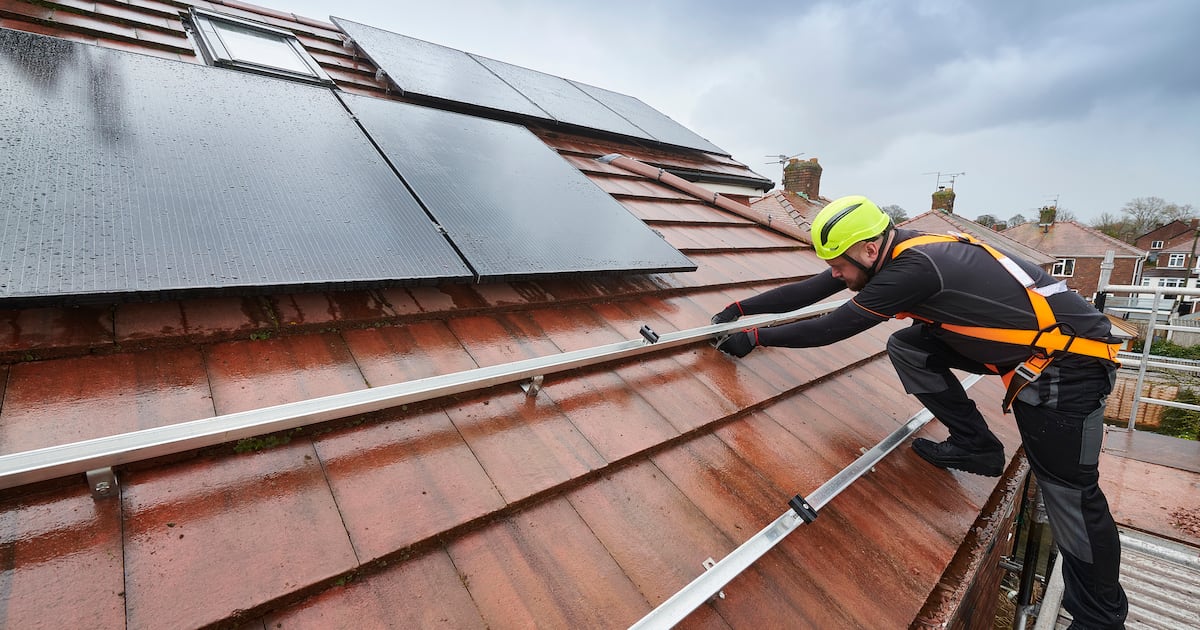
Ireland has much to learn from Pakistan. Targets aren’t everything: sometimes markets function better when the government gets out of the way. Rooftop solar democratises energy production by making renewable energy accessible and (reasonably) affordable to individuals and communities once the permitting process isn’t too cumbersome or expensive. While not suitable for every building, most residential properties could accommodate anywhere between six and 10 panels.
A 2022 UCC study found that putting 10 panels on a million rooftops throughout Ireland would generate 25 per cent of the country’s total residential electricity demand.
[ Marquis of Waterford claims solar farm will interfere with his sporting rightsOpens in new window ]
Given that just 155,000 Irish homes currently have rooftop solar, we still have a long way to go to realise the potential of this technology. Even six-10 panels on a standard house could generate more than a third of its annual electricity costs and save up to €1,000 in annual energy costs when combined with battery storage. The Government should ensure all existing and new housing gets rooftop solar as quickly as possible, and extend its benefits to renters, apartment dwellers and those on low incomes. After all, why should energy companies be the only entities to benefit from a resource that shines for free on all of us?
Sadhbh O’Neill is a climate and environmental researcher