
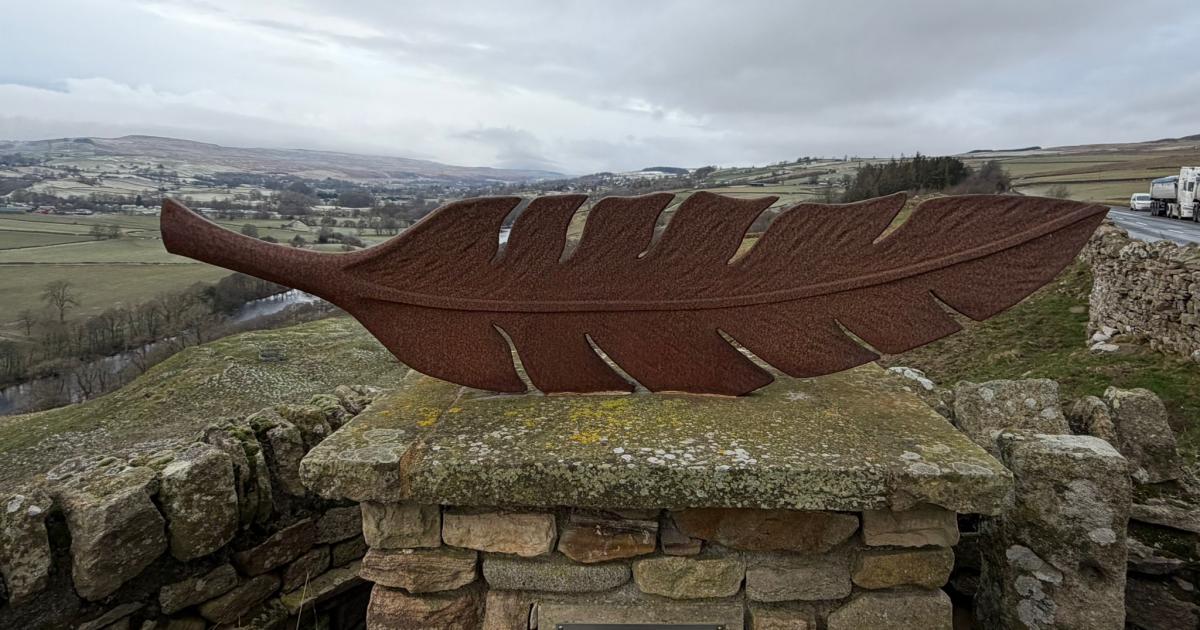
Standing at Whistle Crag on the B6282 east of Middleton‑in‑Teesdale, Air is one of the most recognisable pieces of public art in the Durham Dales.
The sculpture, created by artist Victoria Brailsford, forms part of a wider series of cast‑iron works installed throughout Teesdale as landscape ‘view‑markers’.
The sculpture is at a point which offers stunning views across Teesdale. and the North Pennines landscape (Image: SARAH CALDECOTT)
These pieces were designed to draw attention to the valley’s long, open vistas and to encourage visitors to pause at specific viewpoints.
According to regional tourism information, Air has “added interest” at a lay‑by known for its wide‑reaching views across the North Pennines.
The sculpture is commonly referred to as “the feather” due to its elongated, tapering form, though its official title is Air.
The piece is made of metal and stands upright on a stone plinth at the edge of the viewpoint.
A plaque on the stone plinth, which explains that Air is one of 11 sculptures that form part of a trail in Teessdale (Image: SARAH CALDECOTT)
Air belongs to a group of works sometimes referred to collectively as the Teesdale View Markers. These installations were placed at key vantage points across the valley, each offering a slightly different sculptural interpretation.
Many of the 11 cast‑iron artworks positioned across the valley were created by North Pennines-based sculptor Phil Townsend, but also include pieces by artists Keith Alexander and Brailsford.
The works represent a coordinated effort to integrate art into the natural environment of Teesdale, with the artists contributing to a sculpture trail that runs from Barnard Castle through the upper valley.
Victoria Brailsford, born in 1966, is a sculptor whose practice has included public art, environmental themes, and explorations of geological and topographical forms.
Air has become a familiar feature in the landscape and is commonly called ‘the feather’ for obvious reasons (Image: SARAH CALDECOTT)
Her official website notes that she works in wood, stone, steel, and glass, and that her early work centred on environmental issues before developing into a broader investigation of patterns and forms in natural materials.
Public art has been a major focus of her career, and her pieces often appear in outdoor settings where they interact directly with the surrounding landscape.
Recommended reading:
Today, Air functions both as a standalone artwork and as a marker for one of Teesdale’s most accessible viewpoints.
Its location at Whistle Crag makes it visible to passing visitors, and it has become a familiar feature of the landscape.
The sculpture is referenced in regional guides and public‑art listings as a notable example of contemporary outdoor work in County Durham.