

Disclaimer: Early release articles are not considered as final versions. Any changes will be reflected in the online version in the month the article is officially released.
Author affiliation: University at Buffalo, Buffalo, New York, USA (S. Elbaz, M. Ismail, S. Glassman, E.J. Dove); The Ohio State University, Columbus, Ohio, USA (A. Badr)
Nocardia are filamentous, gram-positive, aerobic bacteria that infect immunocompromised hosts, causing pulmonary, cutaneous, or central nervous system disease (1–4). Dissemination to abdominal organs is rare (5). Among published cases, splenic involvement accounts for <10% of abdominal nocardiosis (5). We report disseminated N. ignorata infection with concurrent splenic and brain involvement in a patient in the United States who had large B-cell lymphoma.
Figure 1
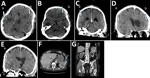
Figure 1. Computed tomography (CT) images of brain, abdomen, and spine of 79-year-old man with chronic obstructive pulmonary disease and large B-cell lymphoma who had disseminated Nocardia ignoratainfection, United States….
A 79-year-old man with chronic obstructive pulmonary disease and large B-cell lymphoma had a new-onset seizure, left facial droop, and slurred speech. Computed tomography of the brain revealed multiple enhancing lesions with surrounding edema and mild herniation (Figure 1, panels A–E). Computed tomography of the abdominal pelvis (Figure 1, panel F, G) and chest showed a pulmonary nodule, a right renal lesion, and a 6.1-cm splenic mass.
Figure 2
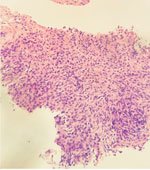
Figure 2. Ultrasound-guided biopsy image of spleen of 79-year-old man with chronic obstructive pulmonary disease and large B-cell lymphoma who had disseminated Nocardia ignoratainfection, United States. Tissue fragment shows extensive…
Figure 3
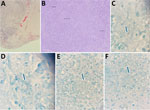
Figure 3. Brain tissue images from 79-year-old man with chronic obstructive pulmonary disease and large B-cell lymphoma who had disseminated Nocardia ignoratainfection, United States. A, B) Parenchyma with identifiable granulation…
Biopsy of the spleen demonstrated an extensively necrotic B-lymphocyte antigen cluster of differentiation 20–positive large B-cell lymphoma and limited viable tissue, explaining the negative primary stains we obtained (Figure 2). Cultures of splenic aspiration and brain biopsy grew filamentous branching N. ignorata (Figure 3). We used matrix-assisted laser desorption/ionization time-of-flight mass spectrometry for species-level identification. Blood culture results were negative. We used blood agar and chocolate agar for isolation. We extended the incubation period to accommodate slow growth.
We started the patient on antimicrobial therapy (intravenous imipenem and oral trimethoprim/sulfamethoxazole and linezolid) before susceptibility results were available. The patient’s hospital course was complicated by upper gastrointestinal bleeding. He was transitioned to comfort care and subsequently died.
Disseminated nocardiosis frequently affects the lungs, brain, or skin, but splenic involvement is rare (2,3,5). Immunosuppression from malignancy predisposes patients to opportunistic infections such as those caused by Nocardia (2,3,6). This case highlights the diagnostic challenge posed by nonspecific clinical findings and the need for microbiologic confirmation, given that Nocardia species exhibit variable antimicrobial drug susceptibility (1,3). The observed pattern of simultaneous brain and splenic involvement in the setting of lymphoma underscores the need to consider the emergence of this disease in immunocompromised patients. Our findings also support early inclusion of nocardiosis in the differential diagnosis for patients with concurrent central nervous system and visceral lesions (2,3,5,7).
Dr. Elbaz is a physician and geriatrics fellow in the Division of Geriatrics, Department of Medicine, Jacobs School of Medicine and Biomedical Sciences, University at Buffalo, Buffalo, New York, USA. He is currently a second-year nephrology fellow at HCA Houston Kingwood’s Tilman J. Fertitta Family College of Medicine, University of Houston, Houston, Texas, USA. His primary research interests include infectious diseases in older adults, immunocompromised host infections, geriatric nephrology, and onconephrology.