
A recent study proposes that gravity, the force shaping galaxies and anchoring planets, might not be fundamental after all. Instead, it could arise from entropy, a measure of disorder. The theory, developed by physicist and mathematician Ginestra Bianconi of Queen Mary University of London, aims to reconcile two long-conflicting pillars of physics: general relativity and quantum mechanics. By suggesting that quantum entropy might govern gravitational behavior, Bianconi‘s work introduces a new lens through which to view the universe’s architecture.
A Quantum Twist On Spacetime
At the core of Ginestra Bianconi’s idea is something called quantum relative entropy, which is used to tell one quantum state from another. In this framework, spacetime itself behaves like a quantum operator, something that actively acts on quantum states and reshapes them. That is a big shift from Einstein’s picture, where gravity emerges from the way mass bends spacetime.
When quantum entropy is woven into spacetime’s geometry, the model still allows for a gently curved, low-energy universe, just like the one we observe, but it changes the underlying explanation for gravity. In her recent paper published in published study in Physical Review D, Bianconi put it simply:
“Gravity is derived from an entropic action coupling matter fields with geometry [of spacetime].”
The theory also introduces a so-called G-field, a vector field with both direction and strength, which helps connect matter and spacetime.
Why Gravity Won’t Go Quantum
For decades, physicists have tried, and failed, to fully merge general relativity, which works beautifully on cosmic scales, with quantum mechanics, which rules the microscopic world. The two theories are built on very different assumptions, and that mismatch has made unification incredibly hard.
Bianconi’s approach tries to close that gap by treating gravity as something that emerges from the collective behavior of quantum states. According to a public research from Queen Mary University of Londonby, this setup allows quantum wave functions to interact with the G-field, potentially easing the tension between quantum physics and relativity.
In this picture, spacetime is no longer a passive backdrop. Instead, it becomes dynamic and responsive, shifting as quantum information changes.
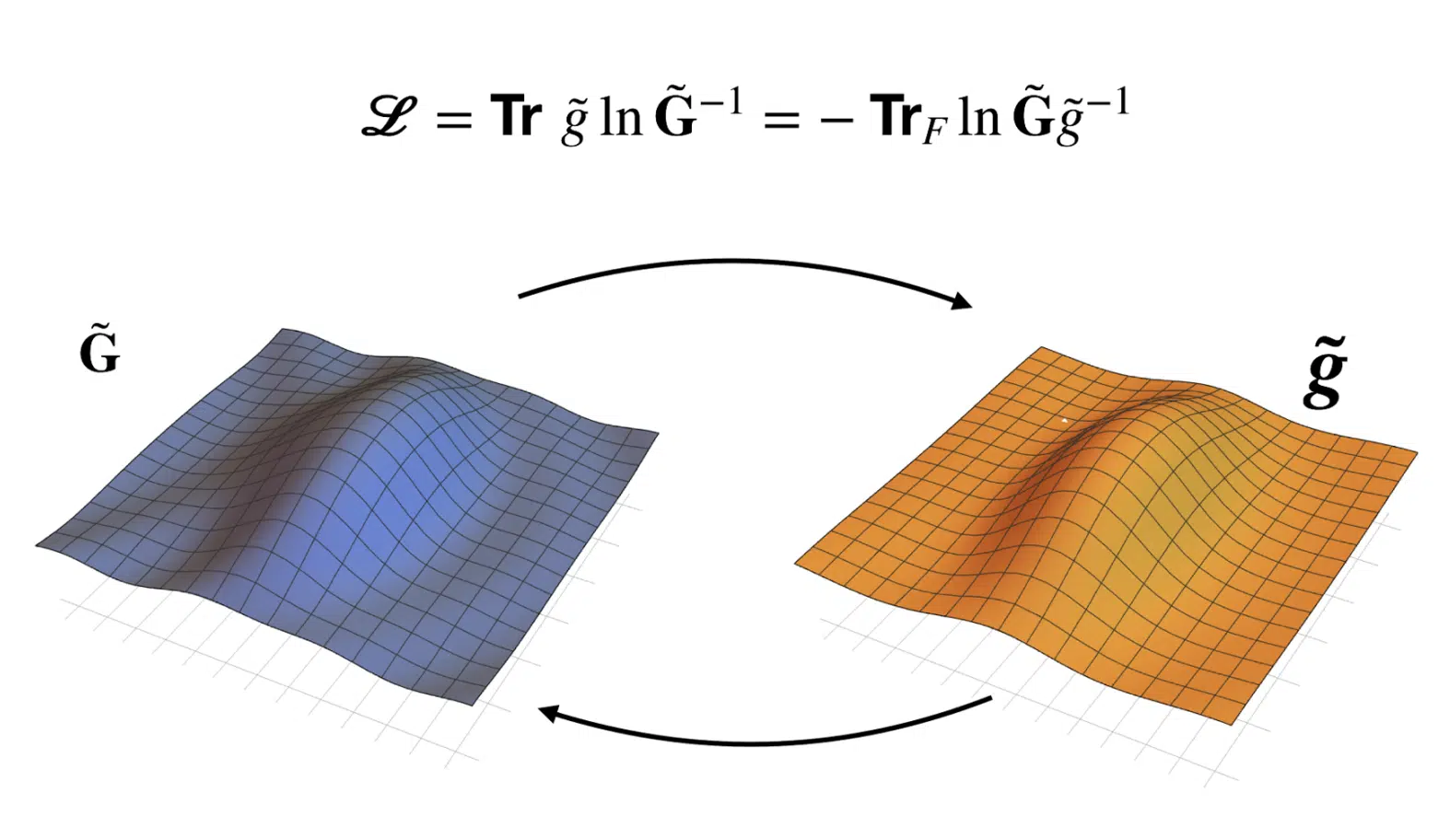 Visualization of the interaction between two quantum geometries. Credit: Queen Mary University of Londonby
Gravity As A Clue To Dark Matter
One of the most intriguing implications of the theory is its potential to explain the nature of dark matter. According to Bianconi, if gravity can be described in terms of particles, a possibility suggested by her entropic approach, then the G-field might account for dark matter’s unseen influence.
The Popular Mechanics report noted that this could offer a new perspective on why dark matter has remained so elusive: it might not be made of exotic, undiscovered particles, but instead be a manifestation of gravitational fields shaped by quantum information.
“This work proposes that quantum gravity has an entropic origin and suggests that the G-field might be a candidate for dark matter,” Bianconi explained. “Additionally, the emergent cosmological constant predicted by our model could help resolve the discrepancy between theoretical predictions and experimental observations of the universe’s expansion.”
The theory is far from confirmed, yet it dares to rethink one of astrophysics’ most elusive questions.