
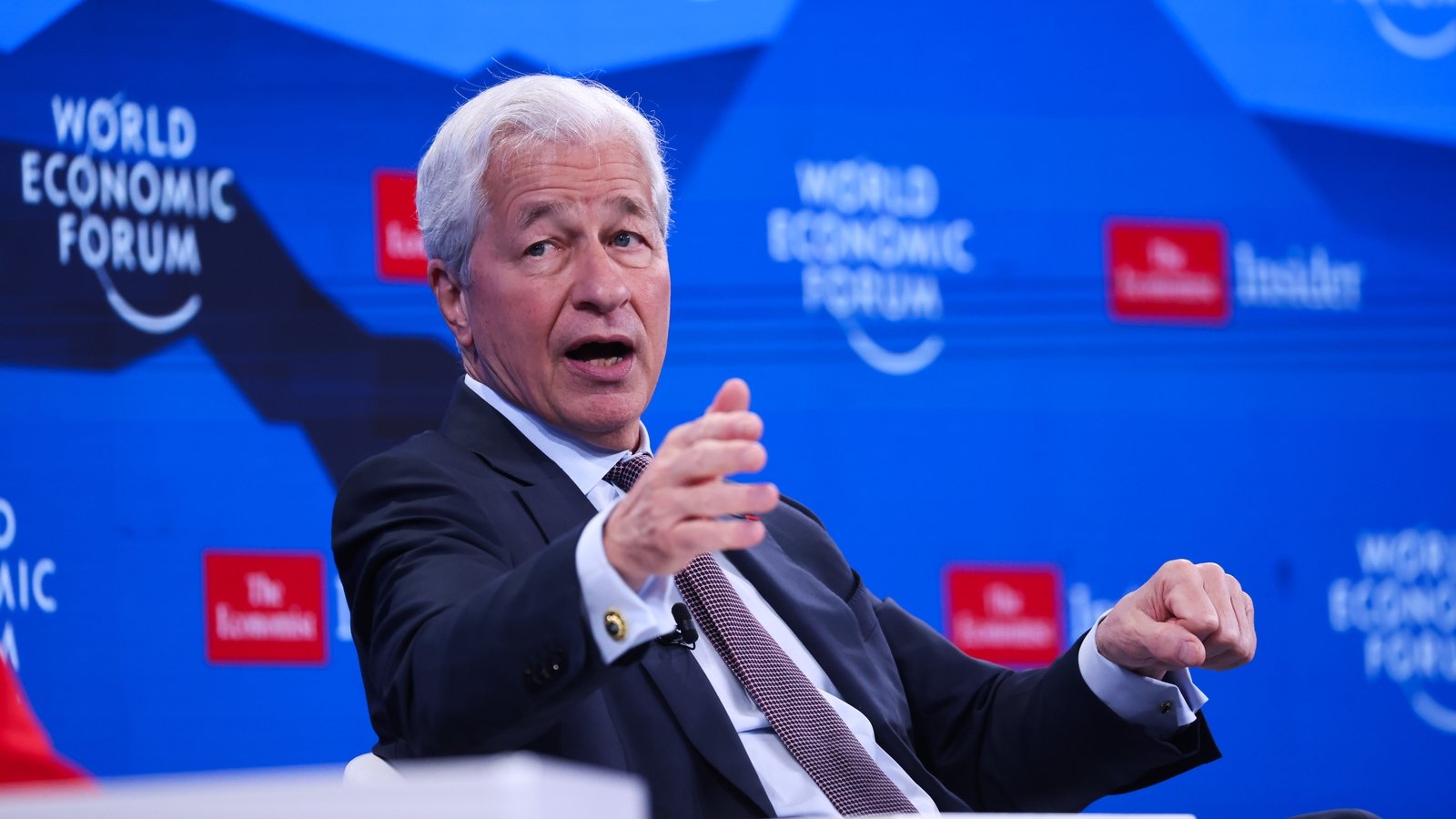
The CEO of US banking giant JPMorgan Chase Jamie Dimon warned today that the Trump administration’s proposed 10% cap on credit card interest rates would spell economic disaster, leaving everyday consumers without access to crucial credit.
President Donald Trump, under pressure to address voters’ cost-of-living concerns ahead of this year’s congressional elections, called for the cap earlier this month, without detailing how the plan would be implemented.
“It would remove credit from 80% of Americans, and that is their back-up credit,” Dimon, longtime chief of JPMorgan and Wall Street’s most influential banker, said at the World Economic Forum in Davos.
Banking industry bodies have pushed back strongly against the move, arguing it would limit credit access for everyday consumers.
Meanwhile, Wall Street analysts said such a measure would require legislation and has slim odds of passage, with Democrats and Republicans divided over it.
“I think we should test it,” Dimon said. “The government can do it, they should force all the banks to do it in two states – Vermont and Massachusetts – and see what happens.”
Though Dimon did not explain why he picked those two states, the idea drew laughs from the crowd at the WEF, an annual gathering of global political and business leaders.
Left-leaning Senators Elizabeth Warren and Bernie Sanders, who represent Massachusetts and Vermont respectively, have both advocated for legislation that would cap credit card interest rates.
“People crying the most will not be the credit card companies. It will be the restaurants, retailers, travel companies, the schools, the municipalities, because people will miss their water payments, this payment and that payment,” Dimon said.
Trump, who called on companies to comply by January 20 in a post on his Truth Social social media platform, blindsided the industry and sent bank stocks tumbling as investors baulked at the prospect of one of the sector’s most profitable businesses grinding to a halt.
Credit cards generate strong returns for banks, which charge high rates to compensate for the greater risk of default on card loans, which are unsecured.
Major Wall Street banks are pushing back on some of Trump’s ideas for lowering the US cost of living ahead of mid-term elections and suggesting alternatives in an effort to shape policy, Reuters reported, citing sources.
“We’re going to give them at one point real analysis on the effects of this. We’ve given some but not a lot,” Dimon said.
Last week, JPMorgan’s Chief Financial Officer Jeremy Barnum was asked in a post-earnings call if the company would pursue legal action against rate caps. “If you wind up with weakly supported directives to radically change our business that aren’t justified, you have to assume everything is on the table,” he said.
Analysts have said card providers could make conciliatory gestures with innovative offerings such as lower rates for certain customers, no-frills cards that could charge 10% but have no rewards, or lower credit limits.
Dimon’s remarks echoed the views of other top banking CEOs.
In an interview with CNBC from Davos, Citigroup CEO Jane Fraser said earlier this week she does not expect Congress to approve caps on credit card interest rates.
“The president is right in focusing on affordability,” Fraser said. “But capping rates would not be good for the US economy.”
In the wide-ranging interview at Davos, Dimon also reiterated his earlier remarks and said that the independence of the US Federal Reserve was critical.
Global central bank chiefs and top Wall Street bank CEOs lined up in support of Federal Reserve Chair Jerome Powell this month after the Trump administration threatened him with a criminal indictment.