
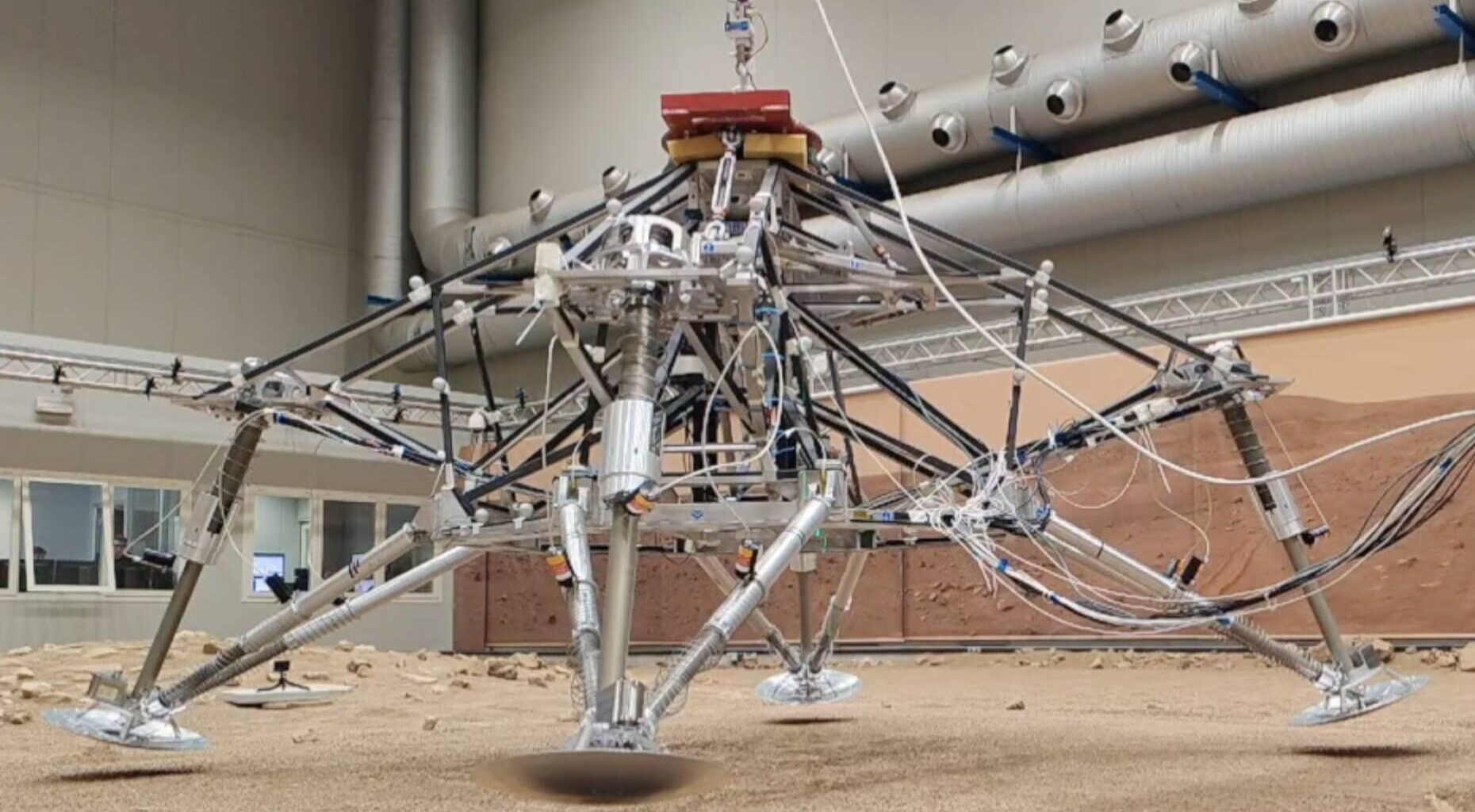
The European Space Agency (ESA) has unveiled a full-scale structural mock-up of the landing platform for its long-delayed ExoMars Rosalind Franklin rover.
The platform’s four legs must ensure the rover survives its final moments of descent, equipped with shock absorbers and sensors designed to trigger engine shutdown upon touchdown on Mars. Timing is critical: switch them off too soon, and the landing might be harder than planned. Too late, and Martian soil might be blasted into sensitive places.
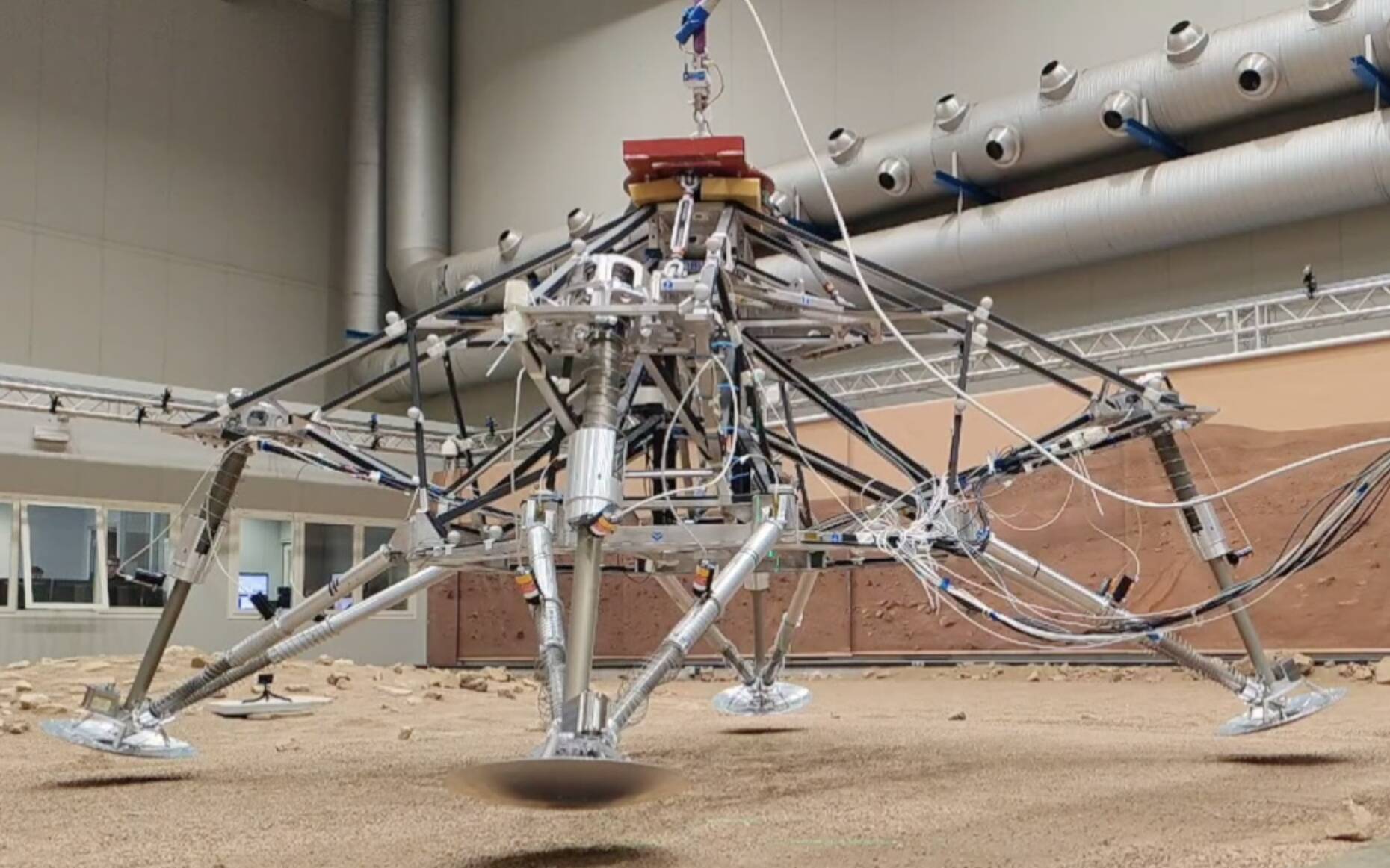
ExoMars lander testing (pic: Thales Alenia Space/ALTEC)
There is also a risk the whole thing will tip over if the engines are left running too long, or if the lander touches down at an angle or on top of a rock.
“The last thing you want is for the platform to tip over when it reaches the Martian surface. These tests will confirm its stability at landing,” said Benjamin Rasse, ESA’s team leader for the ExoMars descent module.
Teams from Thales Alenia Space and Airbus (which is providing the landing platform) spent more than a month dropping the model onto various surfaces to verify the system works as intended. Next, they’ll drop it onto a moving sledge at higher speeds to simulate angled landings.
The ExoMars team has faced repeated delays due to technical problems, and Russia’s invasion of Ukraine put paid to a 2022 launch. The Russian space agency, Roscosmos, was supposed to provide a launch vehicle and lander for the rover, but cooperation was suspended mere months before the spacecraft was scheduled to travel to the Red Planet. The mission now targets a 2028 launch.
In 2025, Airbus UK won a £150 million contract to complete the rover’s landing system. NASA will contribute the launch vehicle, heater units, and rockets to assist with the landing. The 2028 launch is scheduled from Kennedy Space Center in Florida and is expected to go ahead between October and December. The bot will finally arrive at Mars in 2030.
NASA’s involvement in the project has been turbulent. Originally a partner, the agency withdrew after budget cuts, prompting Roscosmos to join before Russia’s invasion of Ukraine caused a suspension of cooperation. NASA then signed on again in 2024, before the Trump administration proposed slashing the agency’s budget.
In late 2025, ESA boss Josef Aschbacher stated that NASA had confirmed its contribution would go ahead as planned.
The successful tests offer relief to ESA managers but underscore how much work remains before the 2028 launch window. ®