
At Davos, Ashwini Vaishnaw rejects the IMF’s “second-tier” AI tag, citing Stanford rankings that place India among global AI leaders.
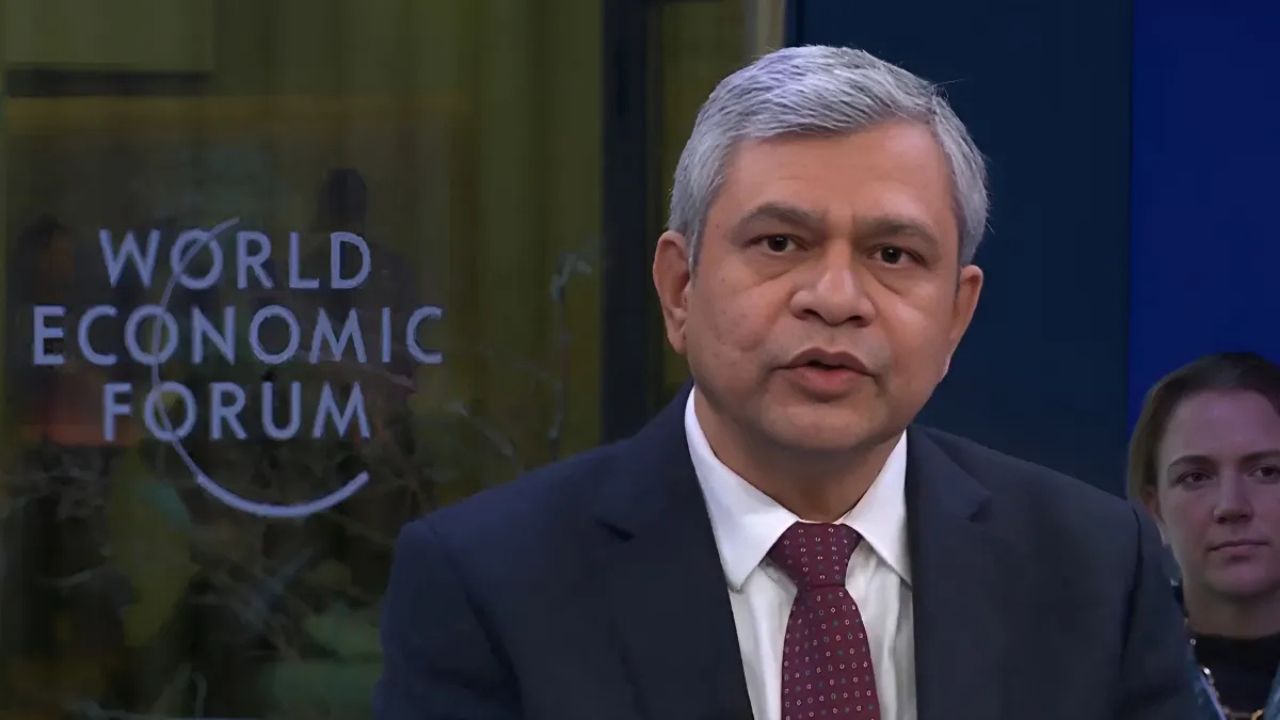
Ashwini Vaishnaw, Minister of I&B, at the World Economic Forum (WEF).
Where does India stand in the global race for artificial intelligence? The International Monetary Fund appears to place the country in a second tier—behind established frontrunners, the United States and China. But at the World Economic Forum in Davos, India’s IT Minister Ashwini Vaishnaw firmly rejected that assessment, calling it both inaccurate and out of step with widely accepted global benchmarks.
The disagreement played out during a panel discussion that also included IMF Managing Director Kristalina Georgieva. While the panel suggested that India was trailing the US and China in the AI ecosystem, Vaishnaw challenged the basis of the IMF’s classification, arguing that it overlooked credible international evaluations.
“I don’t know what the IMF criteria is,” Vaishnaw said during the discussion, “but Stanford places India at third in the world for AI preparedness. I don’t think your classification is correct.” He went on to assert that India should be seen as “clearly in the first group” of AI nations.
Read More | India Emerges as World’s Third Most Competitive AI Power: Stanford
To support his position, the minister pointed to rankings by Stanford University, which assess countries on parameters such as AI preparedness, penetration, and talent. According to these assessments, India ranks third globally in AI preparedness and penetration, and second when it comes to AI talent. “On AI talent, it is number two,” Vaishnaw noted, stressing that the label of a “second-tier” AI country does not reflect India’s current capabilities or momentum.
Vaishnaw also used the platform to outline the breadth of India’s AI strategy, emphasising that the country is not pursuing a narrow or fragmented approach. Instead, India is building capacity across what he described as five critical layers of the AI architecture: applications, models, chips, infrastructure, and energy.
Read More | India Eyes Upto $150 Bn in AI Infrastructure Investment by 2026: Ashwini Vaishnaw
“We are working on all five layers, making very good progress in all of them,” he said, underlining the government’s intent to develop a full-stack AI ecosystem rather than relying on strengths in just software or talent.
This integrated approach, the minister argued, distinguishes India’s AI ambitions from those of many other emerging economies. While some countries focus primarily on application development or data availability, India is simultaneously investing in foundational technologies such as semiconductors, large- scale compute and power infrastructure- areas that are increasingly seen as strategic bottlenecks in the global race.
Read More | India to Host AI Impact Summit in February 2026
The timing of Vaishnaw’s remarks is also significant. India is set to host an AI Summit next month, where it is expected to showcase progress in AI adoption, skills development, and frameworks for responsible innovation. The event is likely to be positioned as a statement of intent, reinforcing India’s claim to be among the world’s leading AI ecosystems rather than a follower playing catch-up.
Speaking separately at Davos, Vaishnaw highlighted the scale of investment already flowing into AI-enabling infrastructure. According to him, India has secured substantial commitments across data centres, compute capacity, semiconductor manufacturing, and power generation. Combined investments in these areas are on track to cross $150 billion by the end of 2026.