

What if outer space isn’t empty, but behaves like a thick, slow-moving fluid? A new study suggests just that, and it could help solve a puzzling mismatch between current models of the universe and recent astronomical observations.
The paper, written by physicist Muhammad Ghulam Khuwajah Khan of the Indian Institute of Technology in Jodhpur, proposes a radical shift in how we think about the fabric of the cosmos. His idea? Space itself may flow and stretch like honey, subtly resisting the forces that make the universe expand.
Is The ΛCDM Model Starting To Break Down?
The study enters the scene amid mounting tensions in cosmology. While the prevailing ΛCDM model (Lambda Cold Dark Matter) has long been the standard for explaining dark matter, dark energy, and cosmic expansion, new data from powerful surveys is exposing cracks in this framework. Telescopic observations don’t seem to match what the model predicts, and that’s where Muhammad Ghulam Khuwajah Khan’s fluid-space idea steps in.
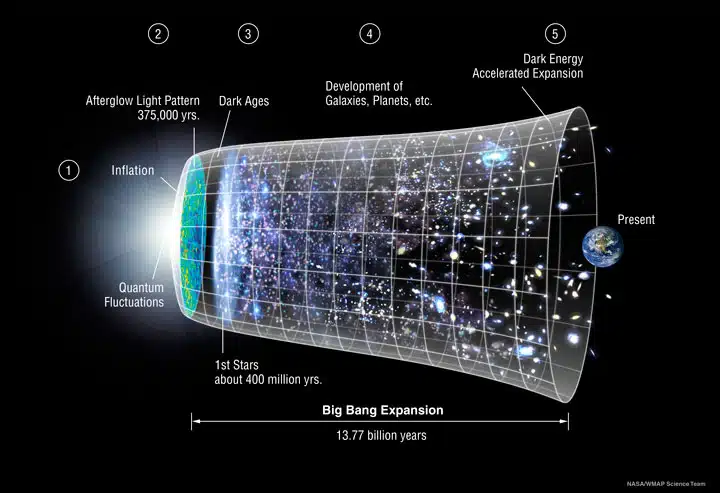 Summarize the main stages of the universe’s evolution to contextualize the ΛCDM parameters. Credit: NASA/ LAMBDA Archive / WMAP Science Team
Published as a preprint on arXiv, the paper does not discard the ΛCDM model altogether but attempts to reconcile it with discrepancies observed by the Dark Energy Spectroscopic Instrument (DESI) in Arizona and the Dark Energy Survey in Chile. Both projects have picked up unexpected variations in the rate at which the universe is expanding, suggesting that dark energy might not be the immutable force it was once believed to be.
Revisiting The Cosmological Constant
At the core of today’s cosmological models is the concept of the cosmological constant, represented by the Greek letter Lambda (Λ). It refers to the energy density of space, believed to be uniform and unchanging across the universe. This principle helps explain why galaxies continue to move away from each other, an effect attributed to dark energy.
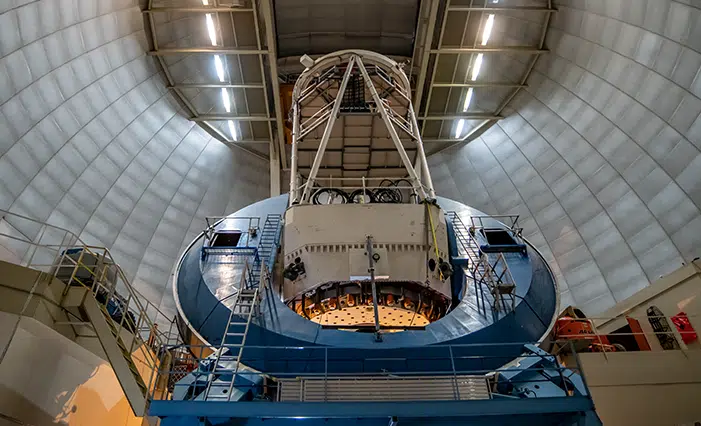 Dark Energy Spectroscopic Instrument. Credit: DESI
However, data captured by the DESI and Dark Energy Survey projects has challenged this idea. According to Futurism, researchers have observed that the universe’s expansion isn’t as steady as predicted by the ΛCDM model. Instead, the push of dark energy appears to be waning over time. That kind of shift doesn’t align with a truly constant energy density.
Spatial Phonons And Stretchy Space
Khan’s theory introduces the concept of “spatial phonons,” a term he uses to describe vibrations in the structure of space generated by atomic activity. These phonons, in his view, create waves of tension, subtly pushing back against the universe’s expansion.
Rather than a perfect vacuum, space would behave more like a viscous fluid, able to deform and resist, much like honey flowing slowly on a surface. As reported by the Futurism article, this friction-like behavior could be enough to account for the deviations noticed in the results.
The model maintains dark energy as the main driver of cosmic expansion but adds an internal mechanism: spatial phonons act like local brakes, helping explain the irregularities observed in the universe’s expansion.
While the idea is intellectually stimulating, it remains highly speculative. The paper has not yet undergone peer review, and no experimental data currently confirms the existence of spatial phonons or fluid-like space.