
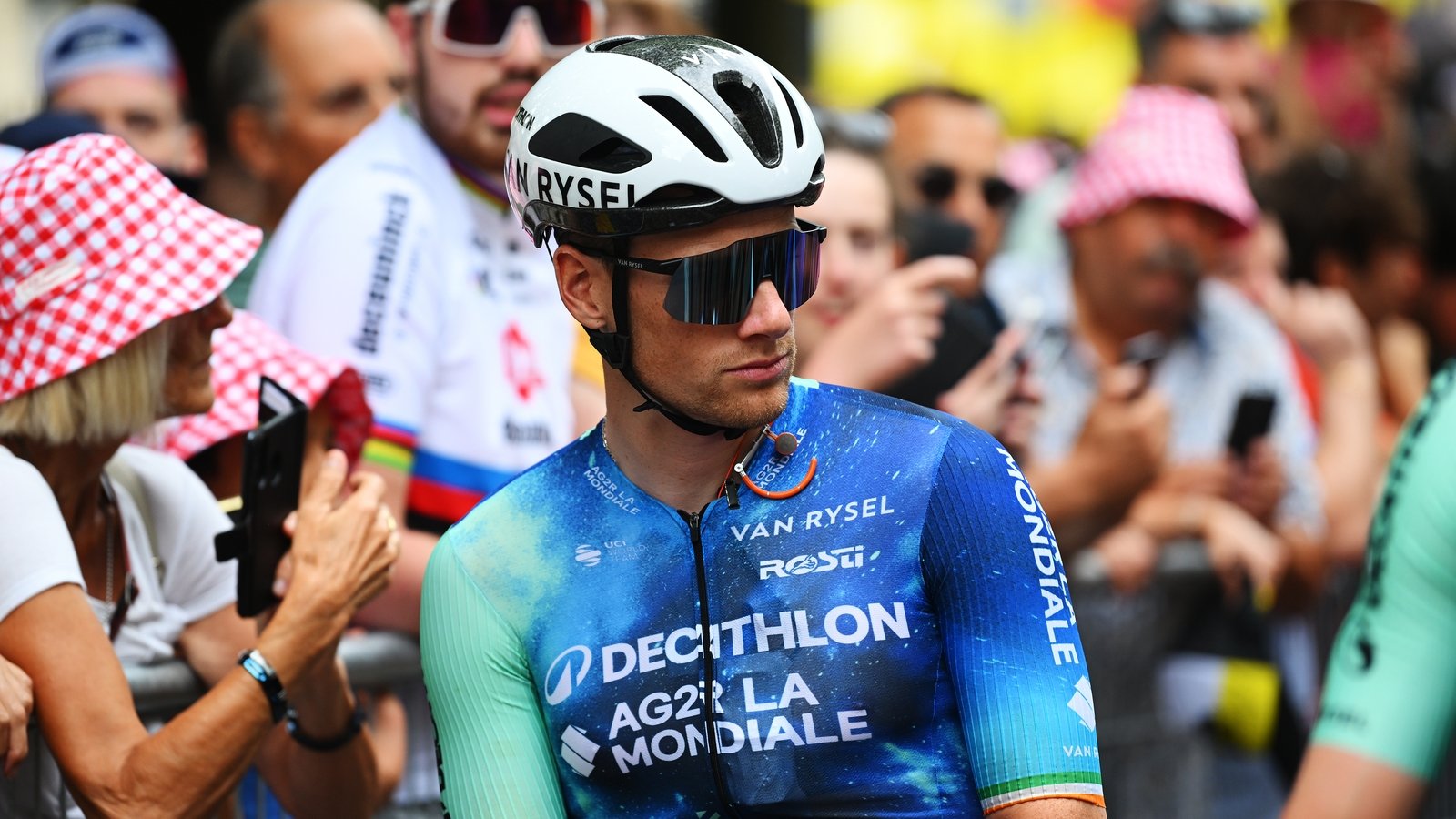
Irish cyclist Sam Bennett has opened up on his road to recovery after the discovery of a heart condition led him to re-evaluate past performances and his very future in the sport.
In October, the highly successful sprinter signed a one-year deal with Q36.5 to complete the squad’s roster for 2026, moving on from Decathlon AG2R La Mondiale after two seasons.
He had big ambitions and high hopes for the new year, but they were rocked when his health took a turn.
In a lengthy interview for RTÉ Radio 1’s Inside Sport, the Tipperary rider – who won two stages and the points classification green jersey at the Tour de France back in 2020 – revealed he had persistent heart flutters and palpitations, which required surgery in November.
“It was kind of strange because at the end of the season, I wasn’t feeling well,” said the 35-year-old.
“I couldn’t get out the performances and couldn’t understand it. I had the off season, came back and then I was having these flutters, palpitations in training.
“I was away with my previous team in London, and in the nights I had flutters and palpitations, I didn’t know what was going on.
“I remember that I was wearing a Whoop (smart watch) and I was able to check my ECG (electrocardiogram) and it showed me that I had AFib, atrial fibrillation.
“I have to say around the team, they were absolutely amazing, got me straight into specialists in London the next morning. I spoke to three different specialists, we decided to go with one in Frankfurt, Germany.
“Four days or five days later, I had the ablation (a surgery to treat irregular heartbeats), which was a success. The thing was, we wanted to go slow. They said I could start building after one or two weeks, two weeks back to normal, but we wanted to be sure that everything was right.
“They say you fully heal after three months. So we wanted to build it slowly. I was starting at the end of November, like trying to build. And then unfortunately I got the flu after New Year’s. When you have the flu, it’s not great for the heart. I was really cautious then, so I really backed off. I went to the training camp and I was like at zero, like really zero.
“In the moment, you kind of have these sensations and you’re not quite sure of what’s happening.”
“Actually we had a great week and the progression was really quick. I was super happy with that.”
Bennett is keen to portray his story in a positive light, stressing that the condition is not rare, and the chances of recovering strongly are high.
Still, he admits there were moments of anxiety.
“I think you have the fear of the unknown,” he added. “In the moment, you kind of have these sensations and you’re not quite sure of what’s happening. But I think this is kind of the main reason why I want to share the stories because I hear that this is quite common, you know.
“A lot of people are having AFib and ablations and for younger cyclists or people in general public… there’s a fear of the unknown when it happens, but I wanted to share it just so that they can understand it.
“They might understand what’s happening with their body and they don’t have to be afraid. Once you go after it and treat it, you can recover fully and get back to like, as an athlete, to a top level again. And for a normal person, you can have a long, normal life.
“If people can afford it, if they can have a smartwatch, like a Garmin or some other device that has ECG, they can catch it in the moment because a lot of the time they might feel something, they’re not sure and then they go to a specialist and they kind of describe it and they don’t know what’s happening.
“ECGs mightn’t be the most accurate thing, but they’re enough for a specialist to see it and to see what’s happening and to really go from there.
“It’s quite a common thing but it can really be treated.”
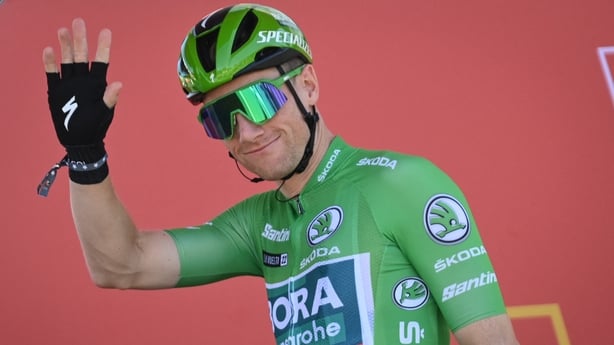
Sam Bennett pictured in 2022
Bennett felt the symptoms in mid-November but believes the condition “was underlying for quite a long time”.
“It’s not a given, but it’s possible that I was having many episodes going into sprints because I always felt something in the sprints and I couldn’t push,” he said.
“I would go into a sprint and then I’d be fine and I’d go to get off the saddle and I wouldn’t be full of lactate, but I’d have to sit back down and it was just super strange.
“I don’t know if it’s the same for everybody or if it’s different (heart) chambers, but my top two chambers were beating twice as fast as the lower two chambers. They said it is possible that in the sprints, the top two start going into AFib, then you lose 30% of the pump, the pumping power. So then you do lose that performance.
“But I don’t want to put everything on this idea. It is a possibility, but it might not be the case.”
Bennett is based in Cork now, bringing his family back to Ireland after years of living in an apartment.
A garden, the “heavy” Irish roads and a sense of calm all nourish his belief that 2026 can still be a great year.
“I have an amazing team with amazing support and everything in place. If I can’t do it here, I can’t do it anywhere,” he said.
“We don’t have anything set in stone yet. The team want to see how I progress. If I progress quicker, brilliant. If slower, then it’s whatever time I need. I want to make the target of middle to end of March, just so that I’m not too relaxed and I have something to chase. If you have too much time, you’ll never get on it.
“I moved back home to Ireland, now based in Cork. My idea was, well, first of all, I think my family outgrew apartment living and I wanted to give my son a garden and start school in our own culture. I think that was important, but on the sporting side, I just thought I can’t continue doing the same thing, expecting a different result. So I said, ‘let’s move home’.
“I get my best legs in Ireland anyway, so the next weeks now I’ll be at home in Ireland kind of discovering the same style of roads, but in a different area. They’re slow, heavy roads.
“I don’t know what it is, I’ve just got my best legs in Ireland. I’m hoping now with everything, put all the pieces of the puzzle together, that it clicks.”