
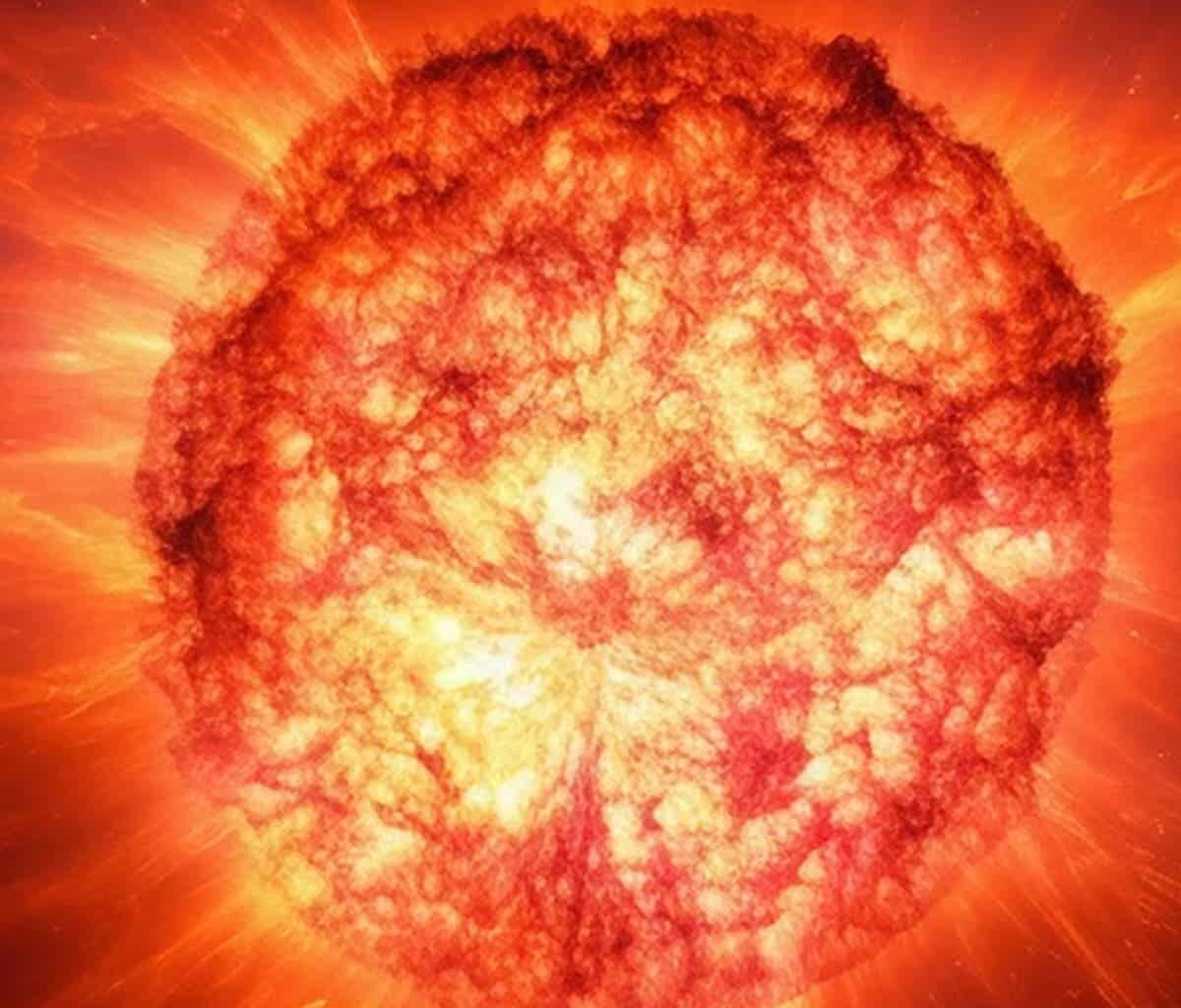
Between late 2019 and early 2020, the red supergiant Betelgeuse showed signs of weakening that led many to wonder whether its long-expected explosion into a supernova just a few hundred light-years from the Solar System might be imminent. Other ideas were put forward, and more recently, fresh data have shed new light on the question.
It’s well established that stars with masses greater than eight to ten times that of the Sun won’t end up as white dwarfs like our Sun will. Instead, they explode as type II supernovae, leaving behind a neutron star and sometimes, if the mass is high enough, a stellar black hole.
Located roughly 650 light-years from Earth in the constellation Orion, Betelgeuse is one of these stars, and it’s clearly nearing the end of its life. It sits in the red supergiant phase, outside the main sequence on the Hertzsprung–Russell diagram.
Because it’s so close to the Solar System, its size is not hard to gauge — large enough to hold more than 400 million Suns. More broadly, Betelgeuse gives astronomers a rare chance to study the surface and atmosphere of a star other than the Sun, offering clues about how giant stars evolve, shed mass, and finally explode as supernovae, as noted in a NASA release.
That release highlights a new paper in The Astrophysical Journal about this star, which has drawn attention for years thanks to its puzzling recent behavior — enough to make some wonder if we were seeing early warning signs of a supernova. Drawing on observations of other galaxies and historical archives, scientists find good reason to think — based on the average rate of supernovae per century in the Milky Way — that we should witness one before the second half of the 21st century.
Betelgeuse, the Mysterious Star by Pierre Cruzalèbes. The star Betelgeuse, clearly visible on long winter evenings in the constellation Orion, made headlines at the end of 2019 by exhibiting a sudden drop in brightness, falling for a few months from 8th to 21st place in the list of the brightest stars in the sky. In April 2023, its brightness increased sharply, moving it up a place on this list. To try to understand the causes of these sudden and unpredictable variations, astronomers have made it a prime target for their observational instruments. The Matisse instrument, installed at the heart of the VLT interferometer at the European Southern Observatory in Chile, is no exception. I will present the results of the study conducted using observations obtained before, during, and after the dimming phase at the end of 2019. With the recent increase in brightness, the mystery remains unsolved. A lecture given at the “Rencontres du ciel et de l’espace” (Sky and Space Encounters) in November 2024, organized by the French Astronomy Association. © French Astronomy Association (AFA)
Betelgeuse, a Double Star!
According to NASA, analyses of nearly eight years of data from the Hubble Space Telescope and other instruments, including those at the Fred Lawrence Whipple and Roque de los Muchachos observatories, led a team from the Center for Astrophysics | Harvard & Smithsonian to address one of Betelgeuse’s biggest mysteries: the star’s unusual brightness and atmospheric variations.
The explanation has two parts. First came the discovery of a small companion star named Siwarha, racing along an orbit through the atmosphere and plasma around Betelgeuse. Then came the detection and characterization of a dense, swirling gas cloud in Betelgeuse’s atmosphere, generated by Siwarha’s motion.
‘It’s a bit like a boat moving through water. The companion creates a ripple effect in Betelgeuse’s atmosphere that we can observe directly in the data. For the first time, we see direct signs of this gas trail, confirming that Betelgeuse truly has a hidden companion shaping its appearance and behavior… The idea of an undetected companion had been gaining traction for years, but without direct proof, it remained unconfirmed. With this new evidence, Betelgeuse gives us a front-row seat to watch a giant star evolve over time. Detecting the companion’s wake now lets us understand how such stars change, lose material, and ultimately explode as supernovae,’ explains Andrea Dupree, an astronomer at the CfA and lead author of the study, in NASA’s statement.
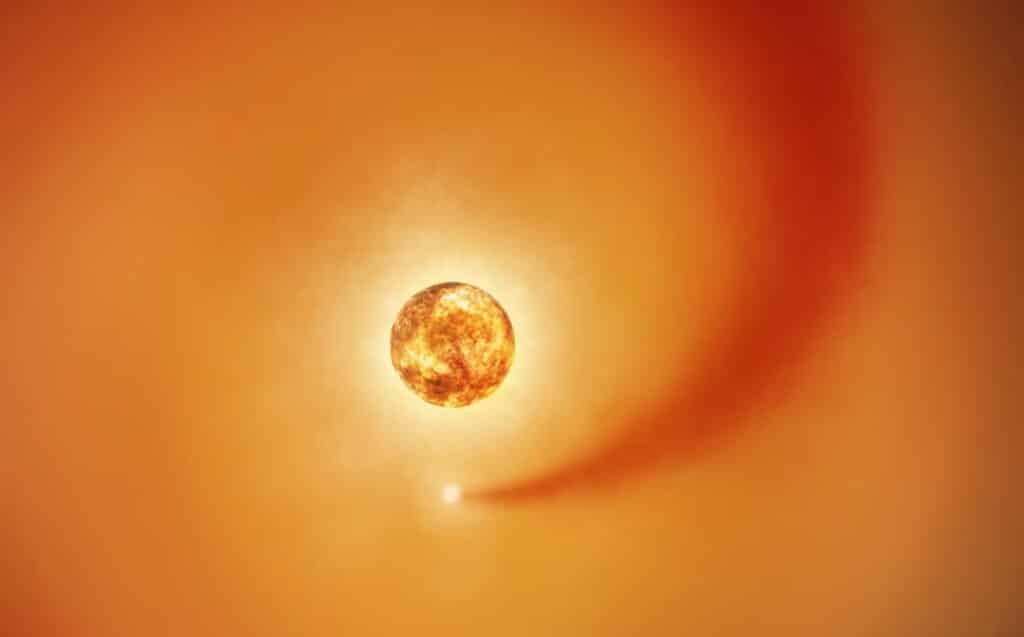
This illustration depicts Betelgeuse, a red supergiant, and an orbiting companion star. The companion star, which rotates clockwise from this viewpoint, generates a dense wake of gas extending outward. It is so close to Betelgeuse that it passes through its extended outer atmosphere. The companion star is not to scale; it would be minuscule compared to Betelgeuse, which is hundreds of times larger. The distance between the companion star and Betelgeuse, however, is to scale relative to Betelgeuse’s diameter. © NASA, ESA, Elizabeth Wheatley (STScI); Science: Andrea Dupree (CfA)
The same statement notes that after the unusual brightness changes seen in the late 2010s and early 2020s, scientists considered not only a nearby explosion but also shifts in giant convection cells or the release of dust clouds. Two activity cycles were identified as well: a short 400-day cycle, recently linked to internal pulsations, and a longer secondary cycle of 2,100 days, which could be driven by a low-mass companion star orbiting deep within Betelgeuse’s atmosphere.
Solid evidence for this latter idea was lacking — until now.
There no longer seems to be any sign that Betelgeuse’s final explosion as a supernova is imminent!
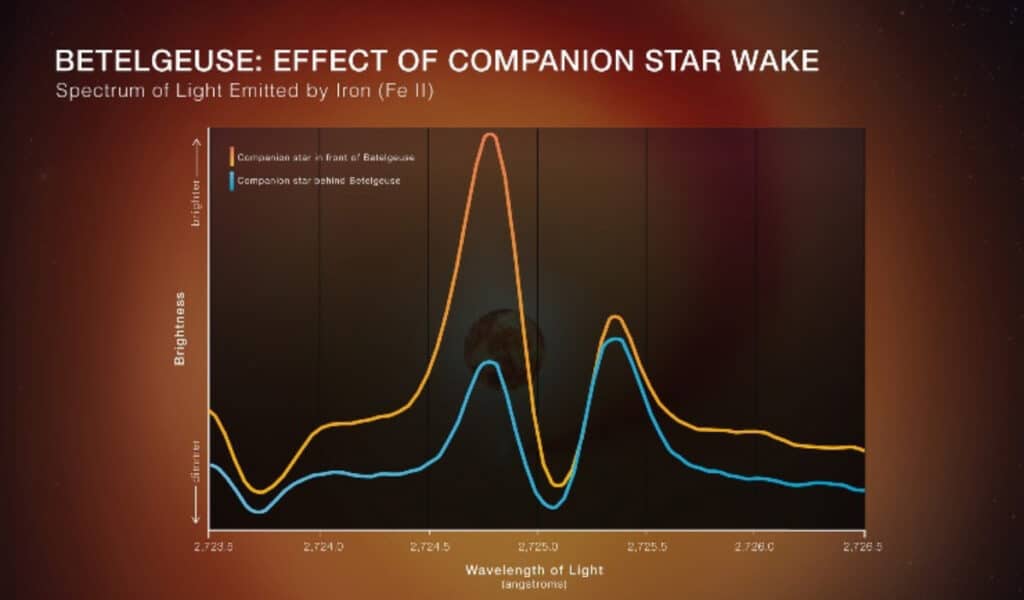
See explanations below. © NASA, ESA, Elizabeth Wheatley (STScI); Science: Andrea Dupree (CfA)
Did You Know
Scientists used NASA’s Hubble Space Telescope to look for signs of a wake produced by a companion star orbiting the red supergiant Betelgeuse. They focused on ultraviolet light emitted by ionized iron, Fe II — an iron atom missing one electron.
Light from material moving toward us shifts to shorter wavelengths, producing a blue shift. The team observed a clear difference in this shift — visible in the left-hand peak of the spectrum — depending on the companion’s position in its orbit. The blue shift was much stronger when the companion was in front of Betelgeuse than when it was behind.
This pattern shows that the supergiant’s atmosphere is flowing outward and absorbs the wake after the companion passes, just as expected. In other words, when the companion is in front, there is no wake to absorb the iron emission, so astronomers detect a strong peak; after the companion moves past the front of Betelgeuse, the trailing wake absorbs the iron emission, yielding a smaller peak.

Laurent Sacco
Journalist
Born in Vichy in 1969, I grew up during the Apollo era, inspired by space exploration, nuclear energy, and major scientific discoveries. Early on, I developed a passion for quantum physics, relativity, and epistemology, influenced by thinkers like Russell, Popper, and Teilhard de Chardin, as well as scientists such as Paul Davies and Haroun Tazieff.
I studied particle physics at Blaise-Pascal University in Clermont-Ferrand, with a parallel interest in geosciences and paleontology, where I later worked on fossil reconstructions. Curious and multidisciplinary, I joined Futura to write about quantum theory, black holes, cosmology, and astrophysics, while continuing to explore topics like exobiology, volcanology, mathematics, and energy issues.
I’ve interviewed renowned scientists such as Françoise Combes, Abhay Ashtekar, and Aurélien Barrau, and completed advanced courses in astrophysics at the Paris and Côte d’Azur Observatories. Since 2024, I’ve served on the scientific committee of the Cosmos prize. I also remain deeply connected to the Russian and Ukrainian scientific traditions, which shaped my early academic learning.