
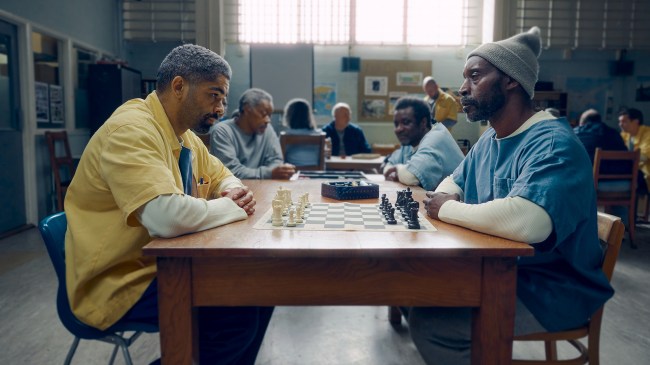
A schematic but sensitive prison drama about a maximum-security lifer who begins to care for an older inmate suffering from early-onset dementia, Petra Volpe’s “Frank & Louis” soberly interrogates what it really means to “serve time.” Time may be the currency with which people are required to pay for their crimes, but as this gloomy two-hander confronts at every turn, the purgatorial nature of prison doesn’t excuse convicts from being subjected to its effects.
Change is constant, even within the walls of an institution where people are rigidly defined by what they did before they got there. Bodies age. Minds harden or expand. New memories are made, coloring the old ones in a different light. Some felons become entirely different people, while others might lose sight of who they used to be altogether. Our punitive carceral system might prefer to pretend that criminals remain as static as the sentences that define them as such, but Volpe’s film — dour and dull gray as it tends to be — palpably recognizes how even the smallest display of personal growth might seem like a genuine spectacle in a place where nothing ever changes, just as the slightest display of compassion might resonate with explosive force in a place that’s unforgiving by design.


A story about the weight of memory as it’s shared between a pair of forgotten men, “Frank & Louis” never steps foot outside of the upstate New York penitentiary where the younger of its title characters is transferred at the start of the film. The first thing we sense about Frank (a crushed and compellingly recessive Kingsley Ben-Adir) is that he’s used to life in a loose-fitting jumpsuit. Long and fit but dead behind the eyes in a way that makes him look much older than he is, Frank has been in prison for at least half of his time on this earth, though the only specific information we get is that it’s been 17 years since he suffered through a stint in solitary confinement. He’s cooled down since then. Maybe he’s found a lasting measure of peace in the toy motorcycles he carves out of soap in his cell. Or maybe he’s just given up.
It’s hard to glean much of anything from his non-reaction to the news that he’s up for parole, but Frank agrees to join the Yellow Coats — the prison’s in-house memory care program — in a bid to make him seem worthier of release. After just a few minutes with Louis (a fully committed Rob Nelson, never betraying his character’s mental condition for the sake of a more emotionally digestible film) it feels like the gig might blow up in Frank’s face, as he seems more liable to kill the old-timer than to help him tie his shoes. Louis is such a tough customer that Frank would sooner be assigned to the unit’s biggest skinhead — at least that guy is too far gone to hate people anymore. Maybe it’s just the fact that he looks like an oversized baby, but the towering bigot radiates a pitiable innocence that’s only belied by his unavoidable swastika tattoo; the ink that identified him as a Nazi has outlasted the ideology that made him one in the first place.
Louis is a different story. Although a pale shadow of the vicious gang leader that he used to be, 60-year-old Louis still brims with the rage and ferocity that once made him king of the prison yard; all of the same emotions are still kicking around inside him, but they’ve been completely unmoored from their context, and sharpened by the shiv-like volatility of dementia. A roaring lion one minute and a helpless lamb the next, Louis is so clearly at the mercy of his disease that Frank struggles to imagine that his new friend could be the same man who made enemies or underlings out of all the other inmates. When another convict pressures Frank to let him beat the shit out of Louis in his cell (revenge for a previous slight of some kind), Frank agrees with an indifferent shrug — not only is it not any of his business, it doesn’t seem to be Louis’ business, either. At least not the Louis that he knows.
Ben-Adir and Morgan bring a raw and layered energy to the dynamic between their characters, and while the relationship between them thaws and complicates along a very predictable trajectory, progressive brain afflictions don’t exactly lend themselves to novelty or surprises. That Volpe and Esther Bernstorff’s script is overly diagrammed on a scene-by-scene basis is more difficult to ignore (when Frank and Louis sit down to play chess, you know it’s only a matter of time before the latter swipes all of the pieces off the board in a fit of rage), but the actors are too locked into the circumstances at hand for the movie to ever meaningfully diminish the urgency of the questions it’s trying to ask. It also helps that “Frank & Louis” tends to unfold in a minor key, and that even its most nakedly sentimental plot points — such as Louis’ persistent belief that he’s got a lunch date scheduled with his daughter — are undergirded by the kind of hard truths that leave you with a fuller appreciation for the lives these characters have led.
Still, “Frank & Louis” is at its best during the subtler moments when its minute human gestures contrast against the art house stiffness of Volpe’s compositions (the Swiss “Late Shift” director brings a small but welcome dose of European formalism to her English-language debut), and the glassy abstractions of Oliver Coates’ score. Watching Frank learn to touch Louis without either of them flinching is a movie unto itself (Rene Perez Joglar is excellent as a Yellow Coats veteran with hypersensitivities of his own), and it’s heart-rending to watch these two men forge new sense memories between them in the short time they have together.
The more that Louis forgets about his past, the more that Frank comes to reconsider about his own, and while Frank’s backstory isn’t quite as textured as Volpe needed for her movie to deliver a lastingly powerful gut-punch, it crucially resists the temptation to answer its most pressing questions. What’s the point of punishment if someone doesn’t understand what they’re being punished for? Are these the same men they were back when they committed their crimes? It’s the Ship of Theseus paradox in human form, its discrete parts held together by a quietly stirring drama that finds dignity in decay, and grace in the memory of men who the rest of society would sooner forget.
Grade: B
“Frank & Louis” premiered at the 2026 Sundance Film Festival. It is currently seeking U.S. distribution.
Want to stay up to date on IndieWire’s film reviews and critical thoughts? Subscribe here to our newly launched newsletter, In Review by David Ehrlich, in which our Chief Film Critic and Head Reviews Editor rounds up the best new reviews and streaming picks along with some exclusive musings — all only available to subscribers.