
This article is part of the FT Financial Literacy & Inclusion Campaign’s seasonal appeal. The appeal is supported by lead partner Experian, which is generously match-funding other donations.
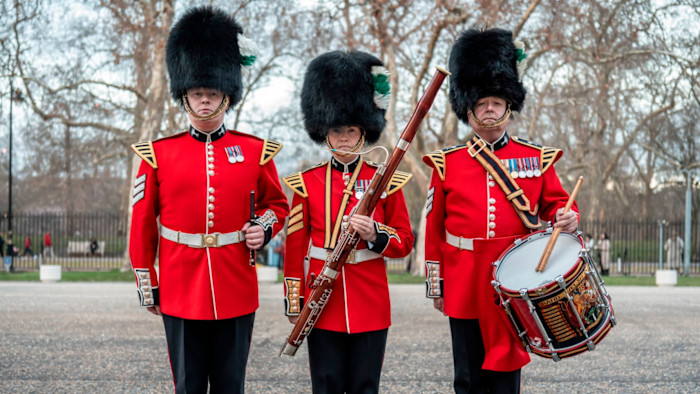
Up the road from Buckingham Palace, two dozen of the Welsh Guards’ finest are rehearsing with gusto. From piccolo player to percussionist, the band — once restricted to traditional parade-ground dirges — is blasting out one of its pop favourites: “Gold” by Spandau Ballet.
It feels apposite. How to invest, whether in gold, stocks or property, is one of a suite of financial education modules that the British army is about to roll out across the country, following a successful pilot project with the Royal Marines last year.
The programme, provided by FT-backed charity FLIC and funded by the Association of British Insurers, is part of an adult scheme of financial education that also stretches to the NHS.
“Obviously, when you look at probably the most crucial skill that people need, it’s finances,” says Lieutenant Colonel Jodie Kennedy-Smith, who is also convinced that the training will contribute to staff recruitment and retention.
 Lt Col Jodie Kennedy-Smith: ‘The most crucial skill that people need is finances.’ © Charlie Bibby/FT
As the senior officer gets to her feet in the barracks’ lecture theatre to introduce a training session on pensions, she is greeted with whooping applause.
The audience at the workshop has just had its regimental Christmas lunch — which may explain some of the exuberant mood. But the enthusiasm endures for the next hour as Chantelle Clarke, FLIC’s head of content, presents a mix of beginner’s guide and bespoke training on financial literacy. She covers everything from the army’s beloved 1975-era final-salary pension scheme through to today’s less fulsome (though still generous) retirement offering.
There have been plenty of questions throughout, so it is clearly a topic that resonates with the 20 to 50-somethings in the room. But I’m keen to get some more detailed feedback, so at the end of the session I hold back a few of the 30-odd attendees.
 Back in the classroom: Welsh Guards attend FLIC’s financial literacy workshop to prepare for later life © Charlie Bibby/FT
Sergeant Kirstin Milne, who joined the army aged 18 and judges the pension training the “most useful” she’s ever had, is not your archetypal pensions obsessive. A bassoonist in the band and a competitive bodybuilder, the 40-year-old is now on her second army stint, having taken a five-year break to live in America and work as an air steward.
She first joined up after being inspired by a military band concert and says the army’s magnetic appeal is underpinned by the ongoing training and support services. “[A colleague] went to work in the City [of London] not so long ago and came back within a couple of years,” says Milne. “He was earning big money and he still came back.”
 Sgt Kirstin Milne, who joined the army at 18, judges the pension training the ‘most useful’ she’s ever had © Charlie Bibby/FT
“Quite a few people do come back,” agrees Lance Sergeant Max Mason, one of the band’s flautists. “The grass is greener sometimes, but not always.”
FT financial literacy charity
Support the FT’s Financial Literacy and Inclusion Campaign (FT FLIC)
He and his partner take advantage of cheap army accommodation — they pay about £400 a month for a two-bedroom house near the Welsh Guards’ Windsor garrison. And they’ve meanwhile bought an investment property an hour away, which they rent out, making a profit on the mortgage outlay.
“We don’t have any dependants, we don’t have any children, so we save up as much as we can,” says Mason, adding that he already has his eye on a potential second investment property. “We like to enjoy life as well, so we go on some nice cruises. But we do try to save as much as possible. We try to save £1,500 a month.”
 Lance Sgt Max Mason: ‘We don’t have any dependants so we save up as much as we can’ © Charlie Bibby/FT
Impressive as this kind of saving and investment record is, it also illustrates a broader truth about the narrow view of investment of many Britons.
Outside of pensions, Britons hold 50 per cent of their wealth in property, compared with only 8 per cent in equities or mutual funds, and 15 per cent in cash, according to research published early last year by investment group Aberdeen.
A more recent report from asset management giant BlackRock found that worries about losing money, or about lacking the knowledge to invest, are the main obstacles for the 62 per cent of Britons who have no investments.
This training programme will introduce various types of investments . . . the potential upside is huge
Financier Mark Fitzgerald
Investment experts with connections to the military say those issues — particularly the bias towards property — are even more acute within the armed forces.
“Investing requires confidence,” says Mark Fitzgerald, a longtime City financier who has supported the armed forces’ engagement with FLIC. “Without it, people often stick to what they know — property and cash. This training programme will introduce various types of investments, the benefits of diversification and the power of compounding returns over the long term [ . . .] The potential upside is huge.”
As Clarke explains, diversifying investments mitigates the danger of all an individual’s assets being exposed to either low-yielding cash savings accounts or the vagaries of the property market.
Kennedy-Smith, who has limited experience of diversified investments but describes herself as “financially savvy”, has three generations of experience of the phenomenon. “My grandmother was an army wife. And every time they moved, she bought a house, did it up and sold it. She created her income totally independently from my grandfather.”
Early in her own army career, she did what Mason is doing now: “I was [living] in the mess, which was costing very little and I thought, ‘Goodness, I could buy a house and rent it out’. And so that’s what I did.”
If they’ve come straight from school into the army, they can struggle a little bit [when they leave]
Lt Col Jodie Kennedy-Smith
Shrewdly she rented the Devon house to students during term time, and to holidaymakers in the summer months. She followed up with two additional property purchases near subsequent barracks — first a flat in Colchester, then more recently a house near Aldershot — though changed family circumstances have meant having to sell the Devon and Colchester properties.
Kennedy-Smith has worked since 2013 with what the army used to call its “transition support” service, designed to help army leavers going through a redundancy programme to acclimatise to civilian life. But at a time of large-scale lay-offs, she realised the approach was too late and limited in scope. The service has since been renamed “life skills” with the aim of preparing personnel for life beyond the army.
“If they’ve come straight from school into the army, they can struggle a little bit [when they leave],” says Kennedy-Smith. “Society is suddenly very, very different.”
Resettlement programmes in the last year or two of service are now supplemented with career-long life-skills training. She gestures at the lecture theatre, where the FLIC pensions training took place, and beams: “You know, this will help so much.”
Patrick Jenkins is the deputy editor of the Financial Times and chair of FT FLIC