
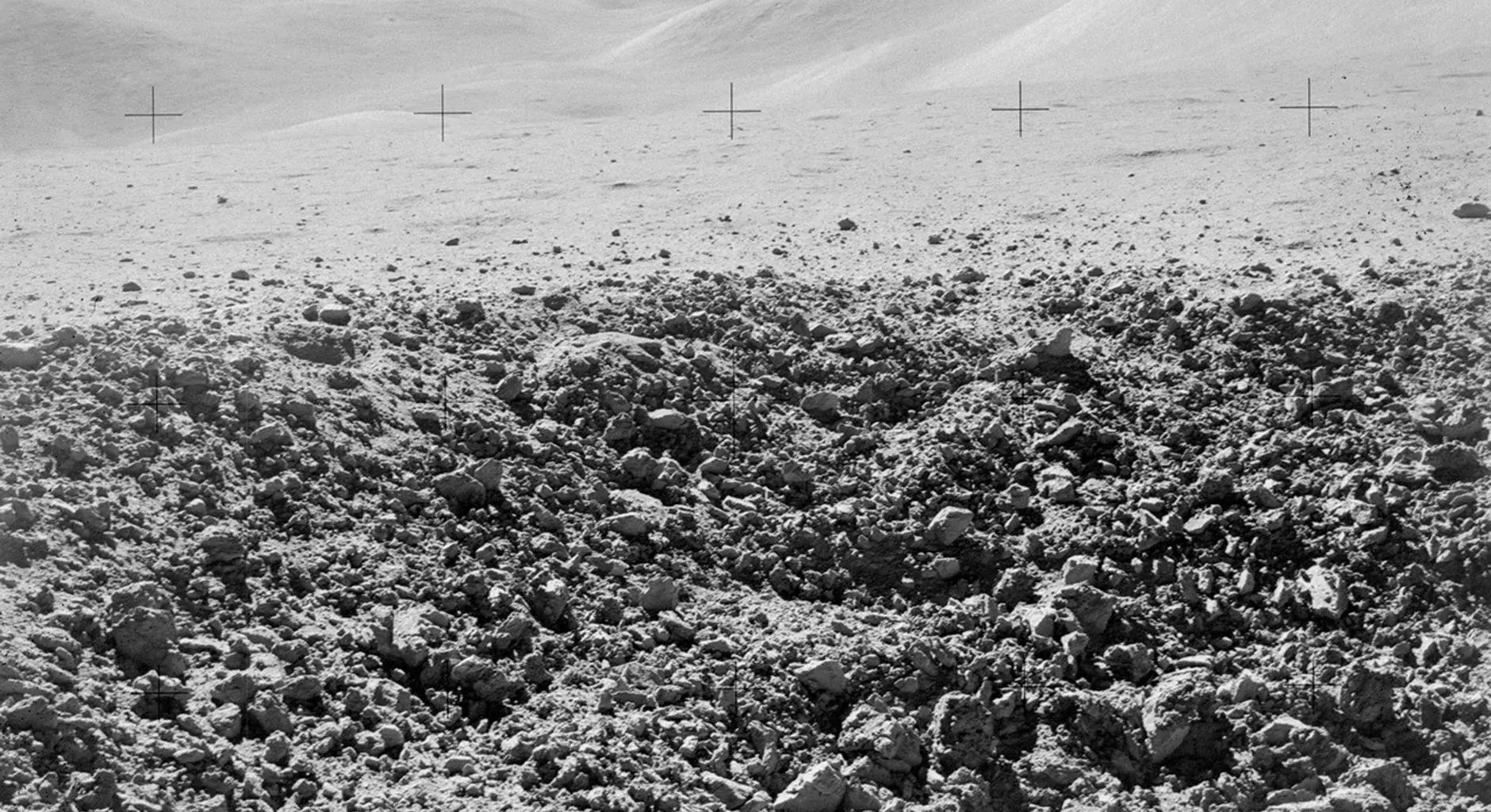
For 50 years, Apollo’s Moon samples have rested in labs, looking like plain dust and rocks. But hidden inside them is a record of cosmic impacts that shaped our Earth-Moon neighborhood over billions of years.
A new NASA-led study has cracked open that diary, revealing not only the rhythm of meteorite impacts but also the limits of how much water those celestial visitors could have delivered to Earth.
The question of Earth’s water has always carried a mythic weight. Did our oceans arrive as gifts from icy comets? Were they brewed from within Earth’s mantle? Or did meteorites, rich in carbon and volatile compounds, rain down to seed the seas?
Earlier research leaned toward meteorites as significant contributors, especially during the solar system’s turbulent youth. But the new study, published in PNAS, suggests that the later chapters of this story are far less generous.
Mars’ gravitational pull may influence Earth’s long-term climate
Tony Gargano, a postdoctoral fellow at NASA’s Johnson Space Center and the Lunar and Planetary Institute, led the team that turned to the Moon’s regolith, the dusty blanket covering its surface, for answers.
“The lunar regolith is one of the rare places we can still interpret a time-integrated record of what was hitting Earth’s neighborhood for billions of years,” Gargano explained. “The oxygen-isotope fingerprint lets us pull an impactor signal out of a mixture that’s been melted, vaporized, and reworked countless times.”
Traditional approaches to decoding lunar soil relied on metal-loving elements, but repeated impacts blurred those signals. Gargano’s team, instead, used triple oxygen-isotope ratios, subtle variations in oxygen atoms that act like high-precision fingerprints.
Because oxygen dominates the mass of rocks and resists alteration by impacts, these isotopes offered a cleaner window into the past.
The measurements revealed that about one percent of the regolith’s mass came from carbon-rich meteorites, partially vaporized upon impact. By calculating the water content such meteorites would have carried, the researchers could estimate the scale of delivery over time.
Scaled up to Earth’s much higher impact rate, roughly twenty times greater than the Moon’s, the numbers told a sobering tale. Even under generous assumptions, the cumulative water delivered since four billion years ago amounted to only a small fraction of Earth’s oceans.
“Our results don’t say meteorites delivered no water,” noted Justin Simon, a planetary scientist at NASA Johnson’s Astromaterials Research and Exploration Science Division. “They say the Moon’s long-term record makes it very hard for late meteorite delivery to be the dominant source of Earth’s oceans.”
This finding challenges the idea that Earth’s seas were topped up significantly by late-arriving meteorites. Instead, it suggests that most of our water must have come earlier, or from other reservoirs entirely.
For the Moon itself, the story is different. The Moon has far less water than Earth, but for such a dry world it’s important. Most of it lies frozen in dark polar craters, and these icy spots could one day help astronauts during NASA’s Artemis missions.
Moon formation brought water to the Earth
The samples used in this study came from Apollo landing sites near the lunar equator, all on the Earth-facing side. The Apollo samples, gathered over 50 years ago, still teach us new things, though they come from only a small part of the Moon. Future Artemis missions will add to this collection, bringing back material from new areas, including the poles.
“I’m part of the next generation of Apollo scientists, people who didn’t fly the missions, but who were trained on the samples and the questions Apollo made possible,” Gargano reflected.
“The value of the Moon is that it gives us ground truth: real, physical material we can measure in the lab and use to anchor what we infer from orbital data and telescopes. I can’t wait to see what the Artemis samples have to teach us and the next generation about our place in the solar system.”
Journal Reference:
Anthony M. Gargano et al, Constraints on the impactor flux to the Earth–Moon system from oxygen isotopes of the lunar regolith, Proceedings of the National Academy of Sciences (2026). DOI: 10.1073/pnas.2531796123