
Stay informed with free updates
Simply sign up to the Airlines myFT Digest — delivered directly to your inbox.
The heads of two of the world’s largest aircraft leasing companies have cast doubt on the aviation industry’s ability to meet its goal of eliminating carbon emissions by 2050, describing it as little more than a “soundbite” and “pie in the sky”.
John Plueger, chief executive of America’s Air Lease, said the targets were “really important, but within our industry are practically unachievable as I see it now”.
He pointed to the industry’s persistent production and delivery challenges as among the factors undermining progress, with the goal now “more of a soundbite”.
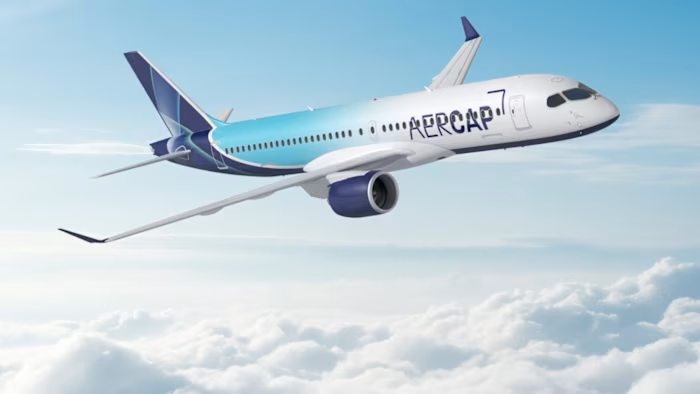
Aengus Kelly, the head of AerCap, the world’s largest lessor, dismissed the 2050 target as “pie in the sky”. He said no one would pay the extra costs for sustainable aviation fuel, which is regarded as critical to achieving the target.
The outspoken assessments, in separate interviews at the Airline Economics conference being held in Dublin this week, add to a rising assessment in the industry that it will be difficult for it to keep expanding while reducing carbon emissions significantly.
Flying accounts for about 2 per cent of global energy-related emissions every year. Scientists say that its global warming effect is higher, because of the heat-trapping effects of contrails — the clouds produced from plane engine exhaust, made up of water vapour and soot, that condense at high altitudes.
Iata, the airline trade body, has increasingly been warning that carriers will struggle to meet their sustainability goals. Five years ago the sector agreed to target net zero emissions by 2050 based mainly on a gradual switch to sustainable fuel. It is made from used cooking oil or organic waste but costs between two and eight times as much as conventional jet fuel.
Critics warn there is not enough feedstock to support such high sustainable fuel demand, while next-generation fuel that uses other processes remains small-scale and prohibitively expensive.
AerCap’s Kelly also criticised mandated EU targets for the use of sustainable air fuel. The ReFuelEU regulation requires all airlines to use more of it in their fuel mix, rising to 20 per cent from 2035 and 70 per cent by 2050.
Imposing targets that would “bankrupt the industry is not in anyone’s interest and definitely not in the taxpayers’ interest”, Kelly added.
Peter Barrett, chief executive of lessor SMBC Aviation Capital, was more optimistic. Although hitting the 2050 target would be “very difficult”, the industry had to “continue to try” to do so by taking measures such as investing in sustainable fuel. The company is working with Trinity College, Dublin on research for such fuels.
Compounding the challenge for the industry are delivery delays from Boeing and Airbus following supply chain hurdles since the pandemic, which are forcing airlines to fly older, less fuel-efficient planes for longer.
The slow pace of production is estimated to have cost the industry more than $11bn last year, mainly due to excess fuel costs and additional maintenance and increased engine-leasing costs.
Steven Udvar-Hazy, chair of Air Lease, separately told the conference on Monday that Boeing and Airbus production last year was still below pre-pandemic levels, meaning some aircraft would have to remain in service beyond their typical 25-year lifespan.
Recommended

Neither manufacturer achieved their production rates in 2025, while long development cycles were also constraining aircraft supply, he said.
Derivatives of popular models were taking “much longer to get online”, added Udvar-Hazy, citing Southwest Airlines’ ordering 30 new Boeing 737-7 Max aircraft in May 2013 as an example. The model is still awaiting certification by regulators.
AerCap’s Kelly said he had “zero interest” in either Boeing or Airbus developing a new single-aisle aircraft anytime soon.
“The technology we have in service today is going to make up the majority of the technology that will be in service when you get to 2050. That ain’t changing,” he said. “I couldn’t care less about a new aircraft. I have zero interest in it. I want them to produce on time and on spec the assets they have.”
Additional reporting: Peter Campbell
Climate Capital
Where climate change meets business, markets and politics. Explore the FT’s coverage here.
Are you curious about the FT’s environmental sustainability commitments? Find out more about our science-based targets here