
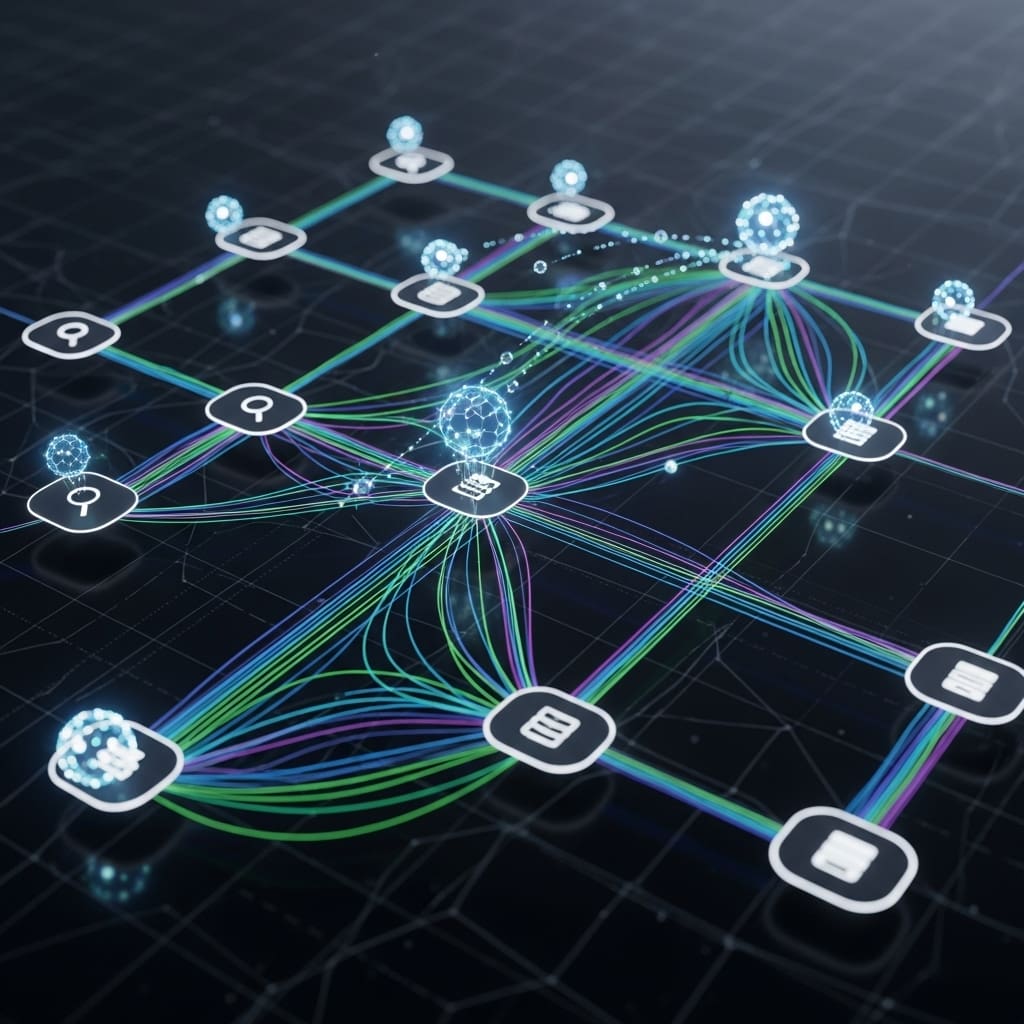
Researchers are exploring whether database systems can achieve a similar leap in capability to the ‘Move 37’ breakthrough seen in the game of Go, where AI surpassed human expertise. Yeasir Rayhan and Walid G. Aref, both from Purdue University, alongside their colleagues, investigate the potential of generative AI to revolutionise database learning, envisioning a ‘Generative Database Agent’ (Gen-DBA) as the key to unlocking this next stage of development. This work details a blueprint for building such an agent, incorporating novel tokenisation, training and inference processes, and represents a significant step towards imbuing database systems with generative reasoning and creativity , potentially transforming how we interact with and learn from data.
Gen-DBA a novel AI for database systems
Scientists are striving to replicate the groundbreaking “Move 37” moment, a feat achieved by Google DeepMind’s AlphaGo in the game of Go, within the field of database systems. This research introduces the concept of a Generative Database Agent (Gen-DBA), envisioned as a pathway to unlock a new era of AI-driven database innovation and creative problem-solving. The team proposes a foundational model capable of unifying diverse database learning tasks, hardware configurations, and optimisation objectives under a single framework, mirroring the transformative impact of Large Language Models (LLMs) in Natural Language Processing. Gen-DBA aims to move beyond incremental improvements and towards discovering genuinely novel strategies for database design and optimisation, surpassing conventional human-designed approaches.
The study centres around building an AI agent that can not only optimise database performance but also impart actionable insights that reshape how database systems are conceived and managed. Researchers are developing Gen-DBA using a Transformer backbone, leveraging its inherent parallelism and scalability to handle millions of parameters. This agent undergoes a two-stage training process, inspired by LLMs, beginning with pre-training on a comprehensive “experience dataset” encompassing diverse database tasks, hardware, workloads, and databases. This holistic approach contrasts with training separate models for each task, fostering generalisation and reducing the initial data requirements for new learning scenarios.
A key innovation lies in the use of “DB-Tokens”, which unify disparate representations, including hardware performance metrics, into a shared embedded space, enabling Gen-DBA to reason across heterogeneous environments. Following pre-training, a post-training stage fine-tunes the agent on task-specific datasets, adapting it to particular deployment needs, such as optimising PostgreSQL on Intel hardware for specific workloads. This generalist-to-specialist training paradigm aims to unlock the potential for AI4DB systems to discover unconventional data-routing policies, novel query transformation rules, and unorthodox data layouts that challenge existing database design principles. Experiments demonstrate that Gen-DBA employs Goal-conditioned Next Token Prediction, generating structured policies token by token, allowing for creative strategies to emerge from a vast action space. Unlike current AI4DB systems that typically predict numerical values or select from predefined options, Gen-DBA’s generative nature opens the door to truly innovative solutions. The researchers believe that achieving a “Move 37” moment in database systems requires an AI capable of both discovering creative solutions beyond human intuition and distilling that knowledge into a tangible form from which humans can learn and adapt, a goal Gen-DBA is designed to address.
Gen-DBA Development and Two-Stage Transformer Training accelerate large
Scientists are investigating the current state of Artificial Intelligence for Database Systems (AI4DB) research, seeking to determine how close these systems are to achieving a breakthrough comparable to Move 37 in the game of Go. The research team envisions a Generative Database Agent (Gen-DBA) as the key to unlocking this potential, aiming to integrate generative reasoning and creativity into database learning tasks. This work details the development of Gen-DBA, built upon a Transformer architecture to harness its parallel processing capabilities and scalability to millions of parameters. Researchers engineered a two-stage training paradigm for Gen-DBA, inspired by Large Language Models (LLMs), beginning with a pre-training phase utilising a comprehensive ‘experience dataset’ encompassing diverse database learning tasks, hardware configurations, and workloads.
To facilitate learning across this heterogeneous space, the study pioneered DB-Tokens, a hardware-grounded tokenization mechanism that unifies diverse representations into a shared embedded space, enabling Gen-DBA to reason over alternative strategies. This generalist-over-specialist training approach not only promotes generalization but also reduces the initial data requirements for new database learning tasks by providing a single entry point for training. Following pre-training, Gen-DBA undergoes a post-training stage employing a specialist training paradigm, where the model is fine-tuned on high-quality, task-specific datasets to adapt to particular deployment needs, such as optimising PostgreSQL on Intel hardware with a JOB workload. During both training stages, the system employs Goal-conditioned Next Token Prediction, where Gen-DBA predicts actions one token at a time to achieve a predefined goal, like a desired throughput.
Crucially, this method achieves generative behaviour , Gen-DBA doesn’t simply select from options but generates structured policies token by token, allowing for the emergence of creative strategies within a vast action space. Experiments employ this innovative approach to move beyond current AI4DB systems, which often fall short of true creative problem-solving, and the team anticipates that Gen-DBA will ultimately impart actionable insights that reshape how database systems are designed and optimised, potentially discovering unconventional data-routing policies or novel query transformation rules. The system delivers a unified framework for database learning, capable of tackling diverse tasks across varied hardware and execution environments, and represents a significant step towards achieving a ‘Move 37 moment’ for database systems.
Gen-DBA backbone built using Transformer architecture enables robust
Scientists are striving to replicate the “Move 37” breakthrough in artificial intelligence, a feat where AI surpassed human expertise in the game of Go, within the realm of database systems. Researchers envision a Generative Database Agent (Gen-DBA) as the key to achieving this milestone, bringing generative reasoning and creativity to database learning tasks. The team developed a recipe for building Gen-DBA, encompassing a foundational backbone, a hardware-grounded tokenization mechanism, a two-stage Goal-Directed Next Token Prediction training paradigm, and a generative inference process. Experiments revealed that an initial, uninitialized Transformer model, comprising 3 million learnable parameters, served as the backbone of this 0th-generation Gen-DBA.
Pre-training this model on an NVIDIA A30 tensor core GPU required approximately 4 hours, followed by a post-training phase of 7 to 8 minutes. Tests proved that inferring a scheduling policy with the post-trained Gen-DBA took up to 1.5 minutes. Data shows the post-trained Gen-DBA, trained on processor-specific datasets, outperformed the OS baselines by 2.51×, 2.49×, 2.51×, and 5.30×, respectively. Training Gen-DBA on a diverse experience dataset, encompassing multiple modalities, consistently improved performance. Specifically, on the Intel Skylake-X processor, the Gen-DBA pre-trained across multiple servers achieved a 2.17% performance increase compared to its instance-specific counterpart.
Further fine-tuning the pre-trained Gen-DBA on the Intel Skylake X server yielded an additional 0.56% performance improvement. Measurements confirm that while these gains are modest, they demonstrate the potential of scaling, and larger, more diverse training datasets can translate into substantially greater benefits. The work explores a departure from existing AI4DB systems that frame database learning as a question-answering problem using Large Language Models (LLMs). Unlike these approaches, Gen-DBA aims for a unified framework, addressing limitations in representational impedance between database knowledge and LLM token-based representations. The team believes this generative approach, capable of synthesizing new strategies, is crucial for achieving a true “Move 37” moment for database systems.
Gen-DBA a blueprint for intelligent databases
Scientists are drawing parallels between recent advances in artificial intelligence, particularly in areas like Go, natural language processing, and robotics, and the potential for similar breakthroughs in database systems. Researchers propose a vision for a Generative Database Agent (Gen-DBA), a foundational model intended to unify learning, reasoning, and optimisation within database learning tasks. This agent aims to move beyond traditional performance-driven learning towards a more knowledge-augmented approach, potentially achieving a ‘Move 37’ moment for database systems, referencing the AI milestone in Go. The core of this work lies in a proposed ‘recipe’ for building Gen-DBA, encompassing a comprehensive dataset of diverse learning tasks, hardware telemetry, database configurations, query workloads, and databases themselves.
A hardware-grounded tokenisation mechanism, termed DB-Tokens, is central to this design, alongside a two-stage Goal-Directed Next Token Prediction training paradigm and a generative inference process. Unlike existing methods that often focus on isolated components or lack a unified framework, Gen-DBA adopts a single, end-to-end model trained to directly improve database performance metrics. Acknowledging limitations, the authors note that current AI4DB systems often overlook the crucial aspect of leveraging semantic knowledge from pre-trained large language models and transferring that knowledge to human users. Future research directions include exploring methods for effectively distilling knowledge from Gen-DBA to enhance human understanding and database administration. This work establishes a foundational framework for a new generation of AI4DB systems, shifting the focus from purely performance-driven learning to a more holistic, knowledge-augmented approach, and potentially unlocking significant advancements in database management and optimisation.