
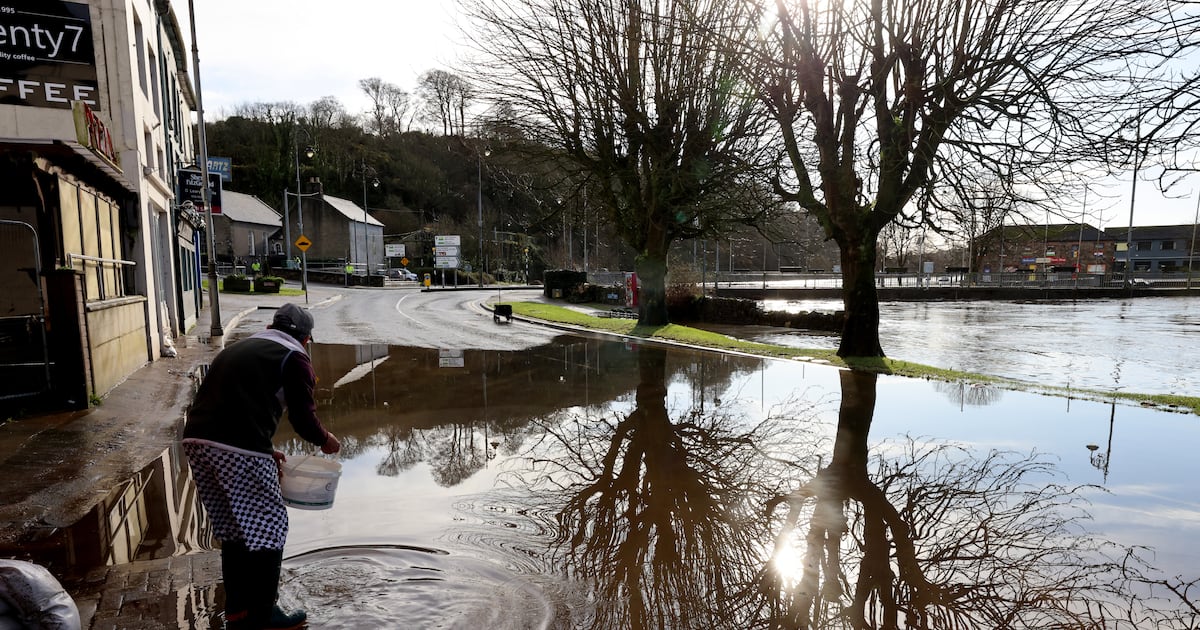
Climate change made this week’s floods almost three times more likely to occur, analysis by Maynooth University and Met Éireann has found.
The researchers said the high volume of rain that fell in the seven days up to and including Storm Chandra turned the heavy but “not particularly remarkable” rainfall during the storm into a “devastating” flood event.
They found the magnitude of the rainfall over the full week was 9 per cent greater than it would have been in the cooler Earth that existed before climate change.
“We would have expected similar seven-day rainfall to happen once in every 150 years,” they said.
“Today, though, the event is expected to happen once in every 60 years, representing an almost three-fold increase in likelihood.”
The analysis is the latest in a series of “attribution” studies carried out by Wasitus, a joint project of Met Éireann and the Icarus climate research centre at Maynooth University.
Attribution studies seek to determine the role climate change plays in extreme weather events.
“One point of considerable concern highlighted by our study is that we no longer necessarily need to experience a remarkable single day rainfall extreme for it to cause devastating effects,” said Wasitus researcher, Lionel Swan.
“As we continue to warm the planet, we are seeing evidence that longer duration rainfall events, such as the seven-day accumulation shown in our study, is becoming far more intense and frequent, leading to a greater flood risk.”
The study focused on counties Louth, Dublin, Wicklow and Wexford, which were worst hit by Storm Chandra and the subsequent flooding.
“Storm Chandra hit the eastern Irish coast when soils were saturated and rivers high after several days of high rainfall,” they said.
“This made an otherwise relatively uninteresting rainfall event far more devastating from a flooding perspective.”
As the planet warms, the atmosphere holds more moisture, about 7 per cent more for every one degree of warming.
This leads not only to more rain, which saturates soils, but also more intense downpours that make it even more difficult for land and rivers to contain.
A similar sequence of events occurred last November when Storm Claudia struck the east and southeast of the country.
[ ‘No one was pumping the water’: Rathfarnham deals with Storm Chandra aftermathOpens in new window ]
The attribution study then found climate change made the rainfall and flooding that followed twice as likely.
“Soils have been consistently saturated since early autumn,” the latest report says.
“The environment was therefore primed for potential flooding.”
Dr Claire Bergin, who led both studies, said human-caused climate change from the burning of fossil fuels was making its impact clearly felt.
“So far, twice this storm season, we have seen flooding and potential flooding as a result of rain storms falling on previously saturated soils,” she said.
“Our studies show that rainfall events in Ireland are becoming heavier, with more rain falling.
“The increase in rainfall magnitude can be directly linked with excess pollution caused by humans.
“Not only do we need to shore up flood defences but we also need to reduce global warming.”