
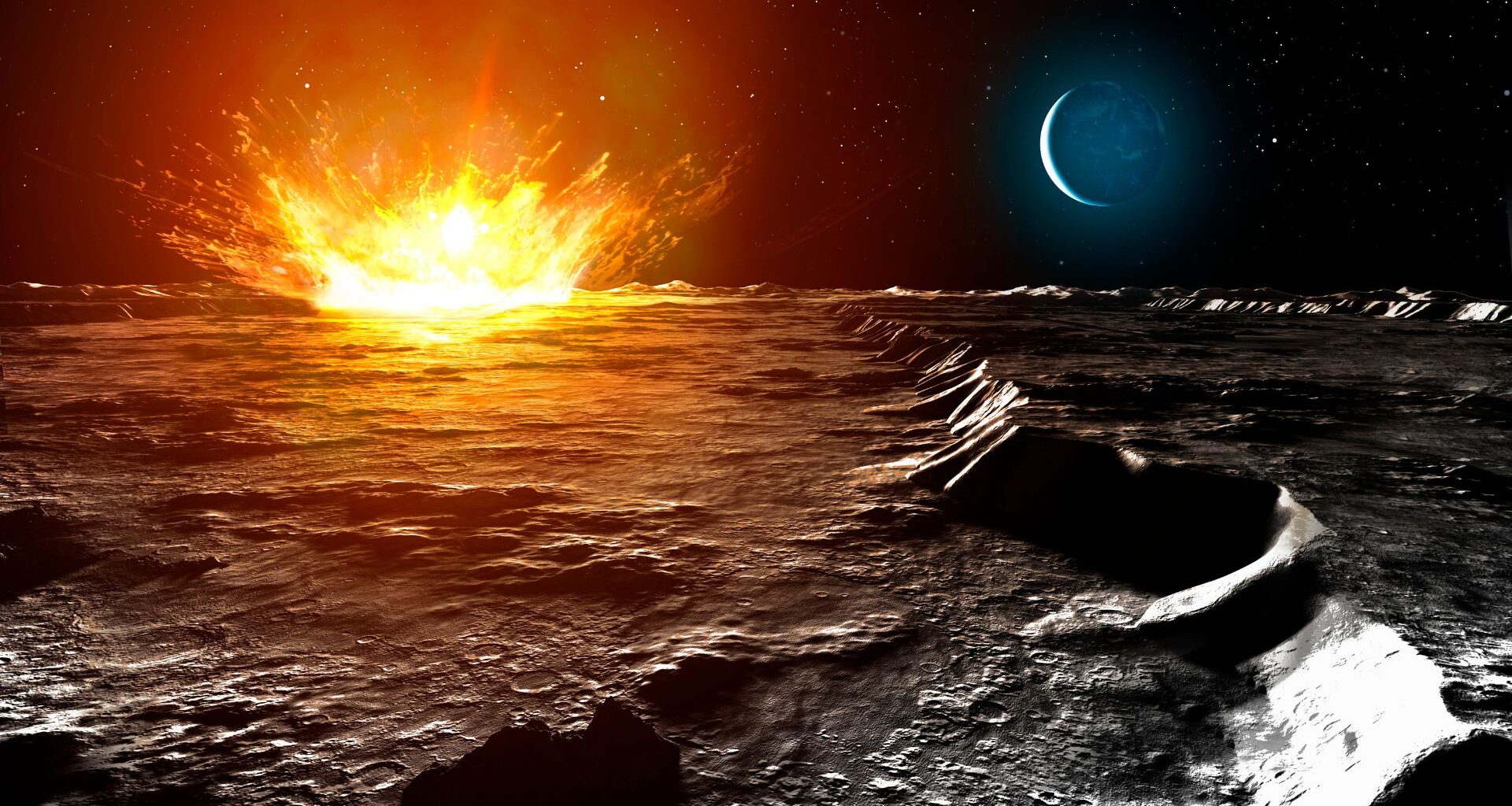
The asteroid 2024 YR4 was, for a brief time, thought to be on a potential collision course with Earth. Now, that has been ruled out, but scientists still believe it has a small chance (only about 4 percent) of smashing into the moon.
In that unlikely scenario, there would be a risk of debris breaking off the asteroid and hitting Earth. But it’s not all bad news. The 60-meter-wide asteroid would also create a particularly bright spot on the moon that could help scientists analyze the lunar surface like never before.
The 2024 YR4 collision scenario
Though there’s only a small—though non-negligible—chance the asteroid 2024 YR4 will hit the moon, scientists are assessing how they could make the most of such a scenario.
In a new paper published in the pre-print server arXiv, Yifan He of Tsinghua University and co-authors highlighted several ways in which a 2024 YR4-moon collision would be useful. According to their study, this potential event could provide a once-in-a-lifetime chance to study the geology, seismology, and chemical makeup of the moon.
The collision, which has a 4 percent chance of occurring on December 22, 2032, would release energy comparable to a nuclear explosion. Specifically, the scientists stated that it would be equivalent to a medium-sized thermonuclear weapon. This would make it six orders of magnitude more powerful than the last major impact observed on the moon in 2013.
If 2024 YR4 does hit the moon, it will provide incredibly valuable real-world data. While scientists can simulate such an impact using computer models, this does not compare to observing the real event. As the scientists noted in their paper, the collision would take place during the day and would be clearly visible from the Pacific region.
A massive molten rock pool
In the potential collision scenario, 2024 YR4 would create a crater roughly 1 km wide and up to 260m deep. This crater would have a 100m pool of molten rock at its center.
In observations, astronomers would be able to collect data detailing the transformation of rock into plasma due to the extreme power. The melt pool of the impacted material would still be visible for days after the impact, the scientists wrote.
Training some of the world’s most powerful observatories on the moon, would yield never-before-seen scientific data, according to a Universe Today report. The James Webb Space Telescope, for example, could use its infrared imagers to capture a wealth of data, shedding light on the formation process of moon craters.
The impact would also cause a magnitude 5.0 “moonquake”. Using existing seismometers on the moon, scientists could shed new light on the moon’s interior and better understand its composition.
Most impressively of all, the impact would likely cause a massive debris blast. Up to 400 kg of that debris could survive reentry to Earth. This would essentially create a massive opportunity for collecting lunar samples without actually traveling to the moon. If this scenario did play out, it would also cause an impressive fireball display for observers on the ground. Somewhere between 100-400 fireballs would hurtle through the sky per hour, and these would be visible to the naked eye.
Would there be a risk to human life?
The obvious downside to that debris blast scenario, is that it could cause damage here on Earth. According to simulations, that debris would most likely land on South America, North Africa, and the Arabian Peninsula.
This would cause chaos if the space rocks were to fall over populated regions. In low Earth orbit, meanwhile, collisions with satellites could lead to a disastrous effect known as Kessler syndrome.
As such, scientists are considering whether it would be in our best interests to launch a deflection mission, taking cues from NASA’s DART spacecraft. For now, the chances of 2024 YR4 colliding with the moon are small. According to Yifan He and colleagues, though, it is best to carefully fully examine every potential scenario.