
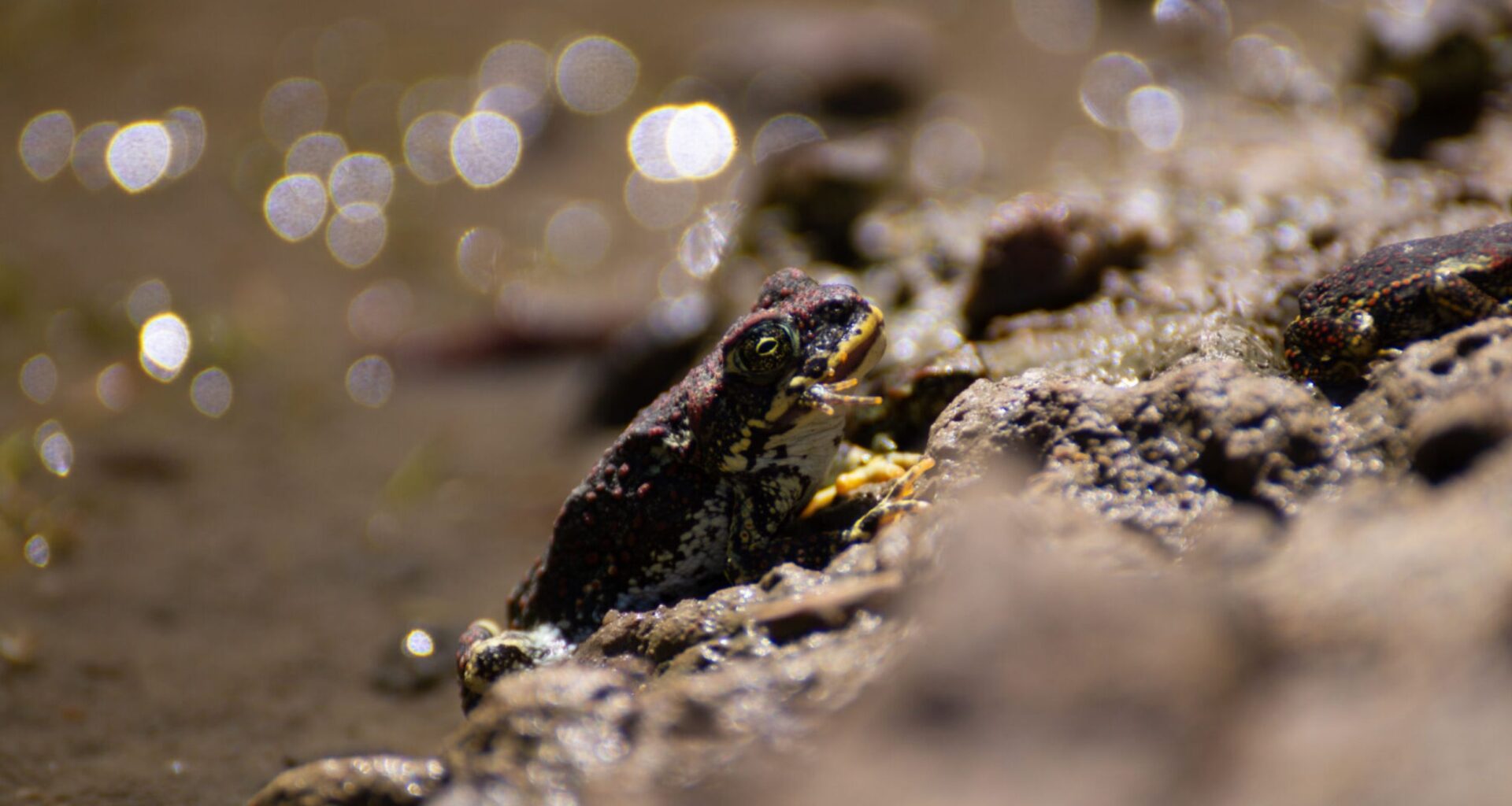
Researchers have documented a juvenile Atacama toad swallowing a smaller one whole in a Chilean desert pond.
The first-known record shows that life after metamorphosis can include cannibalism when food and water restrict a population.
A desert pond surprise

Near the hamlet of Quebradita, outside Freirina in Chile’s Atacama Region, one shallow pond brought two Rhinella atacamensis juveniles into deadly contact.
Ignacio Garrido-Muñoz, a veterinary medicine student, tracked the juveniles there while studying at Universidad Andres Bello (UNAB).
His fieldwork with the Amphibian Project connected back to UNAB coursework, and it kept him returning to isolated desert waters.
Their study turned a brief field sighting into a permanent record, giving biologists a new clue about desert survival.
Capturing a rare behavior
Photographs captured the larger juvenile pinning a smaller toad at the water’s edge while conspecifics, other individuals of the same species, stayed nearby.
That kind of swallowing demands flexible jaws and steady pressure, so the prey cannot twist free and escape.
“The cannibal remained motionless until it had completely swallowed its prey and subsequently stayed close to the other conspecifics without showing any further attempts at predation,” wrote Garrido-Muñoz.
Because the cannibal did not chase another target, the images stayed focused on one event, not a feeding spree.
Why the life stage matters
Once a juvenile becomes post-metamorphic, after a tadpole becomes an air-breathing juvenile, it can roam and hunt on land.
Most reports of amphibian cannibalism involve eggs or larvae in anurans, frogs and toads as a group, when cramped water forces frequent contact.
With more space and different prey, older juveniles can avoid each other, so scientists have logged fewer cannibal attacks.
This record adds to what is known about the species’ natural history and expands documented cases of cannibalism in post-metamorphic anuran amphibians.
Living with little water
From Paposo to Las Chilcas, small oases and short streams hold this endemic Atacama toad in pockets, so each pond can matter.
When water holds only a few breeding sites, many tadpoles and juveniles cluster together, raising contact and competition.
An article traced the species across about 470 miles and linked smaller adult size to drier northern climates.
Those climatic pressures can leave less food around the waterline, which makes extreme feeding choices more likely during growth.
Bigger bodies meet smaller prey
Size differences showed up fast in the Quebradita pond, and the largest juveniles could overpower neighbors with ease.
Cannibalism can deliver a large meal in one grab, which boosts growth and removes a competitor at once.
A broad review of frog diets found that larger frogs ate other frogs more often, and habitat and local diversity played a role.
That pattern does not prove why this toad attacked, but it fits a simple rule of mouths and size.
Cannibalism can spread disease
Eating a member of your own species also means swallowing whatever microbes and parasites the prey carried.
A study showed that cannibalistic cane toads picked up lungworms from infected prey, lowering their hopping performance.
For Atacama toads, that risk matters because juveniles often share the same tiny pool, trading germs as well as bites.
Researchers have not measured disease spread in this population yet, so the costs of cannibalism remain uncertain.
One sighting sets limits
Field notes are important because the team watched the pond for 90 minutes and saw the attack only once.
The cannibal appeared larger and more developed, yet it still lacked full sexual maturity.
A single event cannot reveal whether hunger drove the behavior or whether some juveniles specialize in eating others.
Repeated visits across wet and dry seasons will be needed before biologists can estimate how often this happens.
Regional evidence grows
Reports from Chile have described cannibalism in several frogs and toads, but mostly in larvae or in captivity.
The new paper cited cases in Alsodes barrioi, Calyptocephalella gayi, Telmatobufo ignotus, and Rhinella spinulosa, all species of native Chilean frogs and toads where cannibalism has been documented at earlier life stages.
Within Chile, the genus Rhinella includes four species, so one confirmed case can guide work on its close relatives.
Even so, each species faces different habitats, so scientists must avoid treating cannibalism as a fixed trait.
Implications for conservation
Conservation plans rely on knowing how many young survive, and cannibalism can change that number in quiet ways.
If a few large juveniles eat many smaller ones, they may grow faster while shrinking the next generation of breeders.
Managers could protect shallow ponds by limiting pollution and water withdrawal, which keeps prey insects and refuge spots available.
Without steady monitoring, a rare behavior might look like a crisis or a benefit when it is neither.
Future research paths
A single predation event in a desert pond now links life-stage biology, harsh habitat limits, and the risks of crowding.
Follow-up surveys that track food, disease, and pond conditions could show whether cannibalism signals resilience or rising danger.
The study is published in Revista Latinoamericana de Herpetología.
—–
Like what you read? Subscribe to our newsletter for engaging articles, exclusive content, and the latest updates.
Check us out on EarthSnap, a free app brought to you by Eric Ralls and Earth.com.
—–